Autonomous Demos for Health: Fixing the 12-Month Sales Cycle

Executive Summary
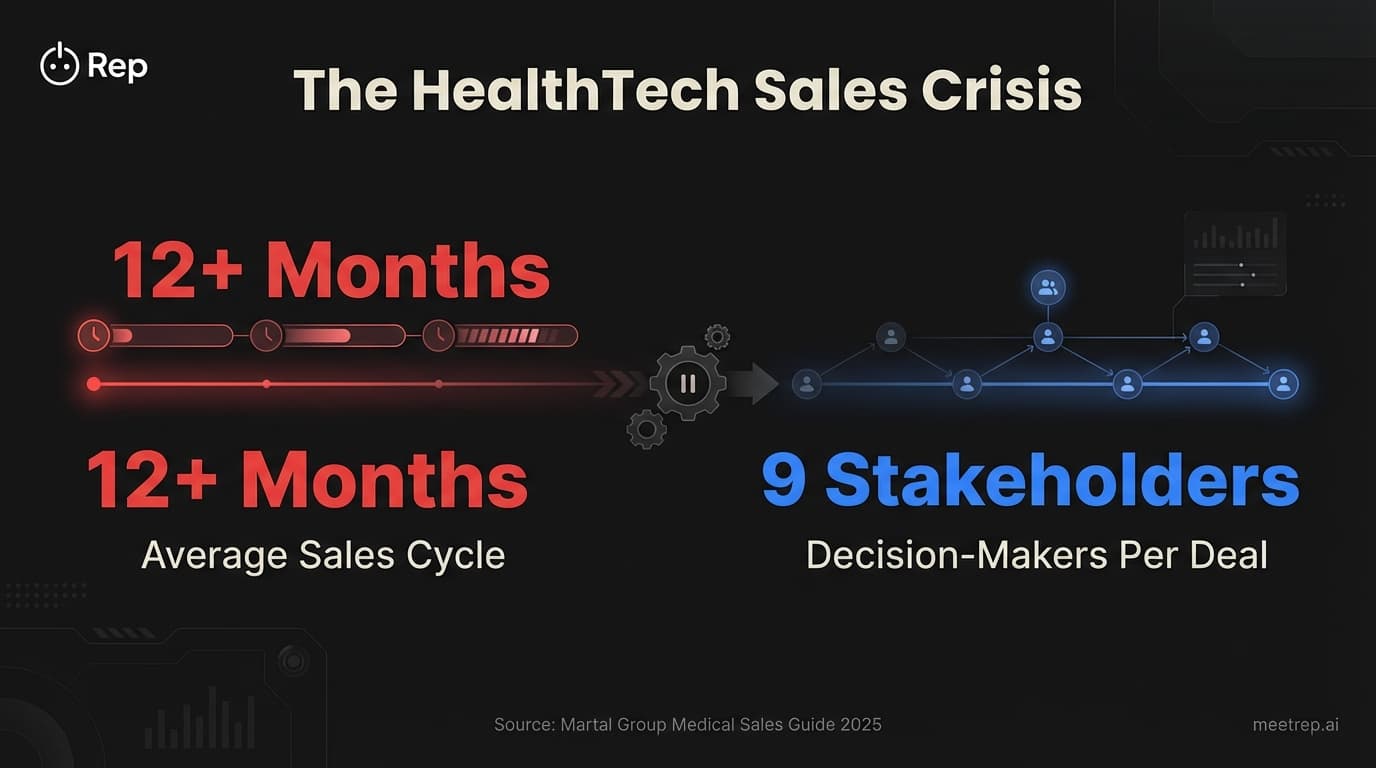
- The Crisis: Sales cycles are 12+ months with 9 decision-makers involved.
- The Gap: 77% of health systems won't buy because they doubt AI maturity ("vaporware" fears).
- The Fix: Autonomous demos prove product stability instantly by navigating live software, not playing videos.
- The Result: You stop losing 15% of your pipeline to no-shows and scheduling friction.
The 12-Month Problem: Why HealthTech Sales Needs an Autonomous Engine
The average HealthTech sales cycle has hit a grueling 12 months.
Twelve months.
That isn't just a slowdown; it's a cash flow crisis. With medical software deals now requiring consensus from nine decision-makers on average and Customer Acquisition Cost (CAC) soaring to $921, the old playbook of "just hire more SDRs" is broken.
You can't solve a complexity problem with more headcount.
I’ve built sales automation tools for years—first at GoCustomer and now at Rep—and I’ve seen the shift. The bottleneck isn't your product quality. It's access. Buyers want to see if the tool works now, but your team is stuck navigating weeks of scheduling tag. To survive 2026, HealthTech leaders must bridge the gap between the 61% of buyers who demand rep-free experiences and the rigorous demands of clinical procurement.
The Efficiency Crisis: Why Deals Are Stalling
HealthTech deals stall because access to product information is gated behind human availability. While software companies operate on quarterly targets, hospital procurement operates on annual (or multi-year) committee cycles, often involving nine distinct decision-makers who rarely meet simultaneously.
The Data: According to the Martal Group's 2025 Medical Software Sales Guide, enterprise medical software deals now average 12+ months to close, involving 9 decision-makers.
When you combine that timeline with a $921 average CAC (source: Amra & Elma), the math gets ugly.
Here is the friction point most VPs miss. It’s not that the hospital CIO doesn't want to buy. It's that they are doing their research at 9 p.m. on a Tuesday, or between rounds at 6 a.m. When they visit your site and see "Book a Demo," they know what that means: a qualification call in three days, a "real" demo two weeks later, and a pricing discussion a month after that.
So they bounce.
At Rep, we call this the "Access Gap." You have the solution they need. They have the budget. But the mechanism connecting the two—the scheduled Zoom call—is too slow for modern buying behavior.
The "Maturity Gap": What Hospitals Are Actually Buying
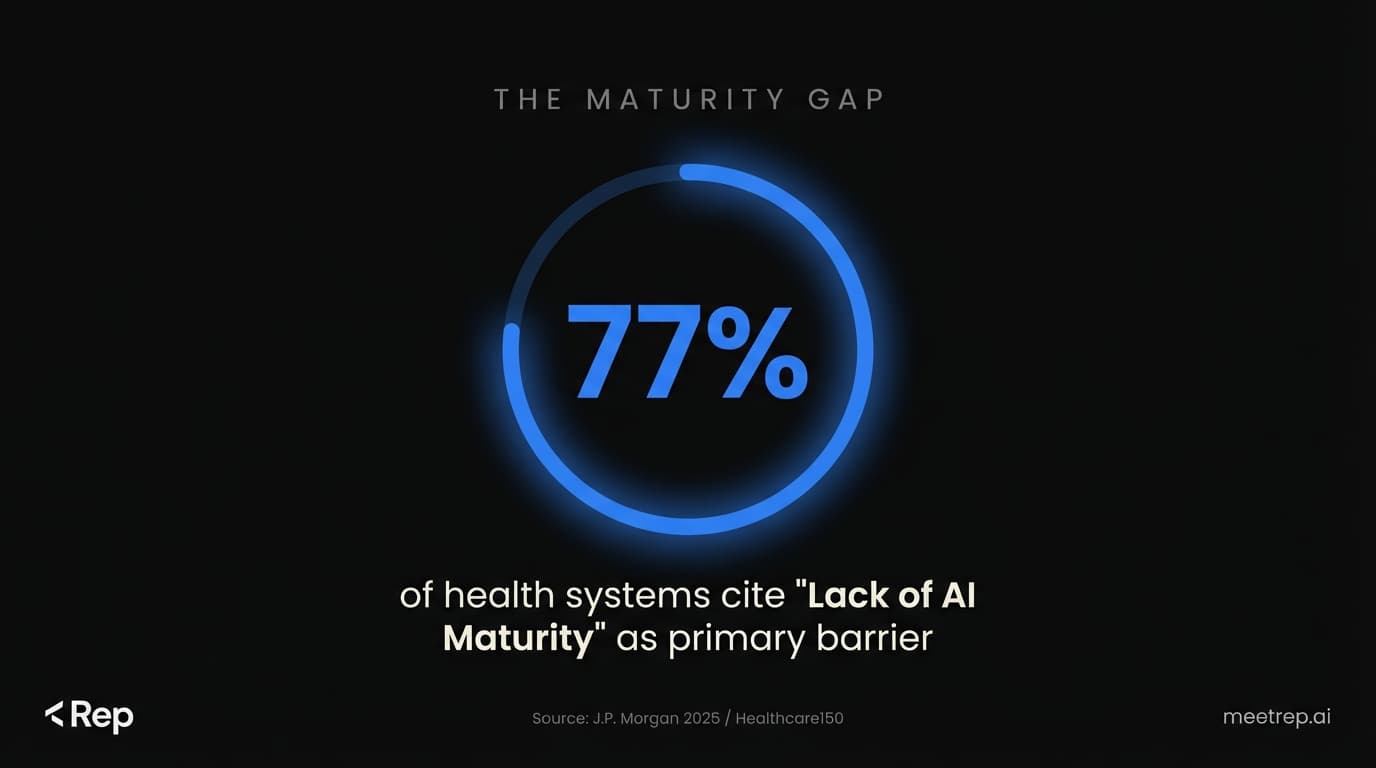
The Maturity Gap is the difference between what AI companies promise and what health systems trust. 77% of health systems cite "lack of AI tool maturity" as their primary barrier to adoption—ranking it higher than cost. Buyers are terrified of "vaporware."
Key Insight: According to a 2025 J.P. Morgan survey, 77% of healthcare system respondents cite "lack of AI tool maturity" as the biggest barrier to adoption.
This is where standard demo automation fails.
If you send a prospect a prerecorded video tour (like a generic click-through demo), you aren't proving maturity. You're proving you have a good video editor. Hospitals have been burned by slide decks promising features that don't exist. They need to see the live product handling complex clinical workflows.
This is why we built Rep to use live browser automation rather than video overlays. When an autonomous agent logs into your actual sandbox environment and clicks through a patient intake flow in real-time, it sends a powerful subconscious signal: This software is stable. It is real. It works right now.
Video says "marketing." Live execution says "infrastructure." In HealthTech, infrastructure wins.
Autonomous Demos vs. Video: The "Vaporware" Test
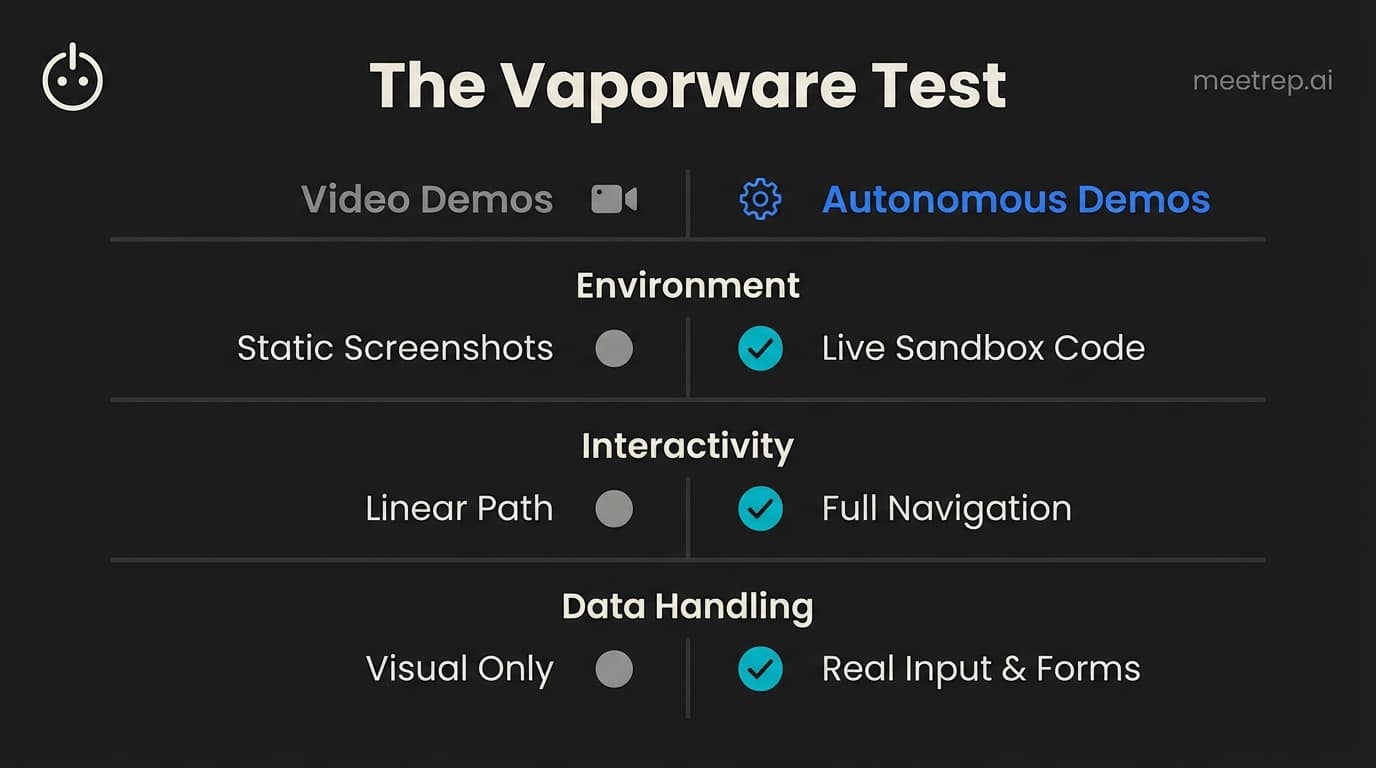
An autonomous demo is an AI-driven sales engagement where a voice-enabled agent navigates your live software environment, answering questions in real-time. Unlike video-based tools that guide users through static screenshots, autonomous agents interact with the actual DOM (Document Object Model) of your application.
Here is why that distinction matters for a technical buyer (like a CMIO):
| Feature | Video/Click-Through Demos | Autonomous Demos (Rep) |
|---|---|---|
| Environment | Static screenshots or video files | Live production/sandbox code |
| Interactivity | Linear path (click A to see B) | Non-linear (can jump to any feature) |
| Proof of Utility | Low (could be faked/edited) | High (software actually runs) |
| Q&A | None (pre-scripted text only) | Real-time voice answers from Knowledge Base |
| Data Handling | Visuals only | Can fill forms, save data, generate reports |
My take: If your product is simple enough to be explained by a video, use a video. It's cheaper. But HealthTech products—EHR integrations, RCM platforms, diagnostic tools—are rarely simple.
If a prospect asks, "What happens if I enter an ICD-10 code that doesn't match the diagnosis?", a video tool is stuck. It can't show the error validation. An autonomous agent can actually type the code, trigger the validation error, and explain why it happened.
That isn't just a demo. That is proof of capability.
Bridging the Divide: Self-Service vs. Human Touch
Buyers are conflicted. 61% of B2B buyers prefer a rep-free experience, yet complex medical deals almost always require human negotiation at the end. The solution is a hybrid model: use autonomy for discovery and education, and humans for strategy and closing.
The Data:Gartner's 2025 findings show that 61% of B2B buyers prefer an overall rep-free buying experience.
This isn't about replacing your Account Executives. Trust me, an AI agent isn't going to take the Chief Medical Officer out to dinner or navigate the politics of a hospital board (at least, not in this decade).
But your AEs shouldn't be answering "Does this integrate with Epic?" for the 500th time.
We learned this the hard way at GoCustomer. Your most expensive resources—your senior sellers—burn out when they do repetitive, low-level qualification work. By placing an autonomous demo at the front of the funnel, you satisfy the 61% who want self-service while filtering the pipeline.
When the prospect finally talks to a human, they are educated. They know the features. They've seen the workflow. Now the conversation is about value, not functionality.
Security & Compliance: The Non-Negotiable Layer
In 2026, cybersecurity is no longer just an IT concern; it is a patient safety issue. 48% of health executives now rank cybersecurity as a patient safety risk. If your demo solution touches PHI (Protected Health Information) or creates a vulnerability, you are dead in the water.
Key Insight: According to Healthcare150, 48% of non-US health executives classify cybersecurity as a patient safety issue.
The "Zero-PHI" Architecture
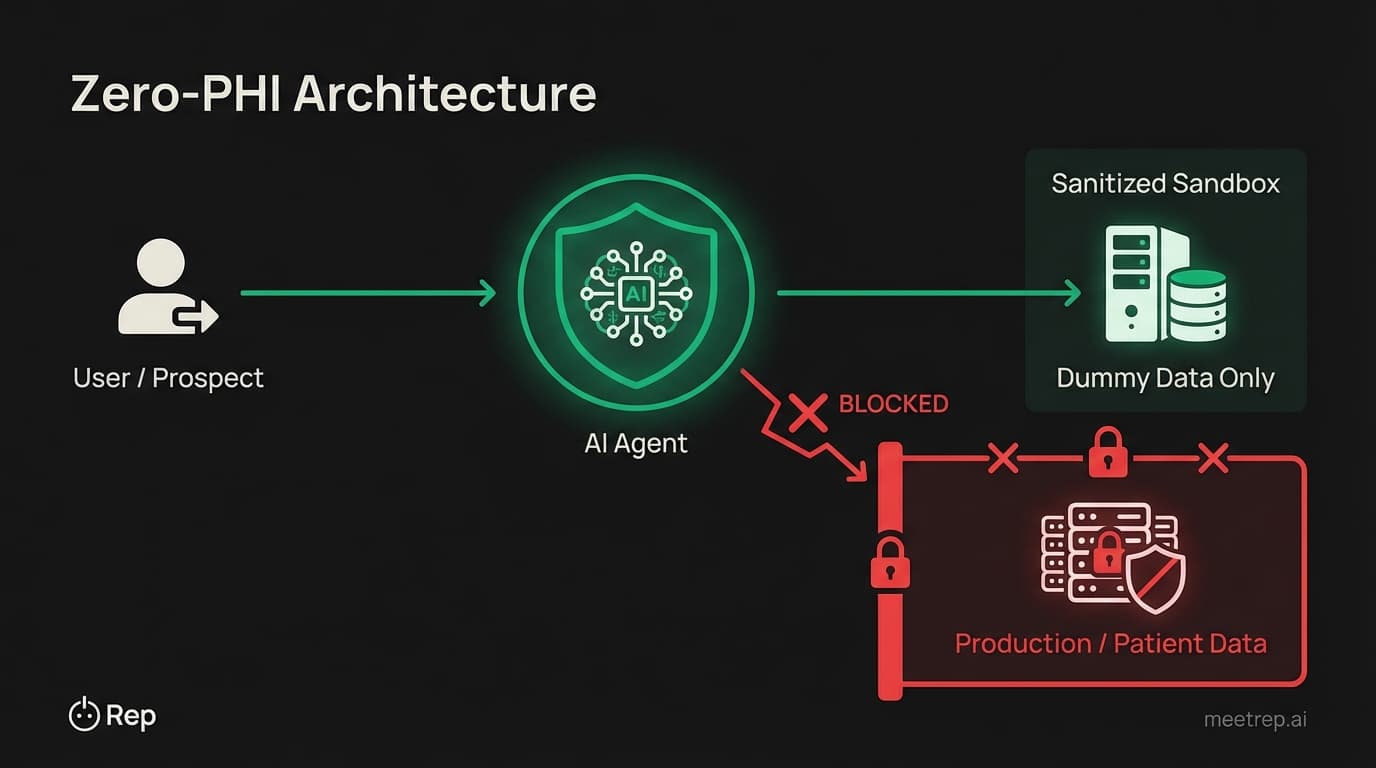
This is the part that keeps Engineering VPs awake at night. How do you let an AI run a demo without risking a HIPAA violation?
Why we built Rep this way: We designed Rep to operate entirely within a sanitized demo environment. The agent holds credentials for a specific dummy account. It does not access your production database. It does not touch real patient records.
When a prospect asks a question, Rep queries your uploaded Knowledge Base (documentation, white papers, security specs). It does not hallucinate answers based on open internet data.
This distinction is critical for your security review. You can truthfully tell the hospital CISO:
- The AI only operates in a sandbox.
- No real patient data is ever displayed.
- The agent follows strict guardrails on what it can and cannot discuss.
How to Deploy Autonomous Demos in a Regulated Funnel
Deploying autonomous demos requires a strategic shift from "gatekeeping" to "accelerating." You cannot simply slap a "Talk to AI" button on your homepage and hope for the best. You need a workflow that respects the complexity of the sale.
Here is the deployment strategy I recommend for HealthTech teams:
1. The 2 a.m. Triage Your inbound leads don't sleep. Global health markets and overworked clinicians are researching your tool at odd hours.
- Action: Replace the "Contact Sales" form success message. Instead of "We'll get back to you," say: "Want to see how it works right now? Join our AI agent for a live look."
- Result: You capture intent at the moment of highest interest.
2. The Stakeholder Multi-Thread This is the killer app for the 9-person buying committee. Your champion (maybe a department head) likes the tool. But they need to convince the CMIO, the CFO, and the IT Director.
- Action: Give your champion a custom Rep link. Tell them, "Send this to your team. They can ask it technical questions about security and integration without needing to schedule a call with me."
- Result: The champion looks like a hero, and the skeptics get their answers immediately.
3. The "Vaporware" Test Use Rep to prove new features. Launching a new AI-radiology module?
- Action: Train Rep on that specific workflow.
- Result: When investors or buyers ask, "Is this real?", you send the link. The AI drives the product. Proof established.
Common Mistake: Don't try to hide that it's an AI. Be transparent. We found that users are surprisingly forgiving of AI latency if they know they are talking to a bot, but they feel deceived if they think it's a human. Rep introduces itself clearly as an AI agent. Honesty builds trust.
Conclusion
You can't shorten a 12-month sales cycle by asking your team to work harder. The math doesn't work. You shorten it by working simultaneously with every prospect, 24/7.
The "Maturity Gap" is real. Your buyers are skeptical, tired, and risk-averse. But they are also desperate for efficiency. By handing the keys to an autonomous agent, you aren't just saving money on SDR headcount. You are giving your buyers the one thing they value more than anything else: proof.
Don't let another qualified lead slip away because they couldn't find a time on your calendar.
Stop losing 15% of your pipeline to no-shows. Let Rep handle the first touch.

Nadeem Azam
Founder
Software engineer & architect with 10+ years experience. Previously founded GoCustomer.ai.
Nadeem Azam is the Founder of Rep (meetrep.ai), building AI agents that give live product demos 24/7 for B2B sales teams. He writes about AI, sales automation, and the future of product demos.
Frequently Asked Questions
Table of Contents
- The 12-Month Problem: Why HealthTech Sales Needs an Autonomous Engine
- The Efficiency Crisis: Why Deals Are Stalling
- The "Maturity Gap": What Hospitals Are Actually Buying
- Autonomous Demos vs. Video: The "Vaporware" Test
- Bridging the Divide: Self-Service vs. Human Touch
- Security & Compliance: The Non-Negotiable Layer
- How to Deploy Autonomous Demos in a Regulated Funnel
- Conclusion
Ready to automate your demos?
Join the Rep Council and be among the first to experience AI-powered demos.
Get Early AccessRelated Articles
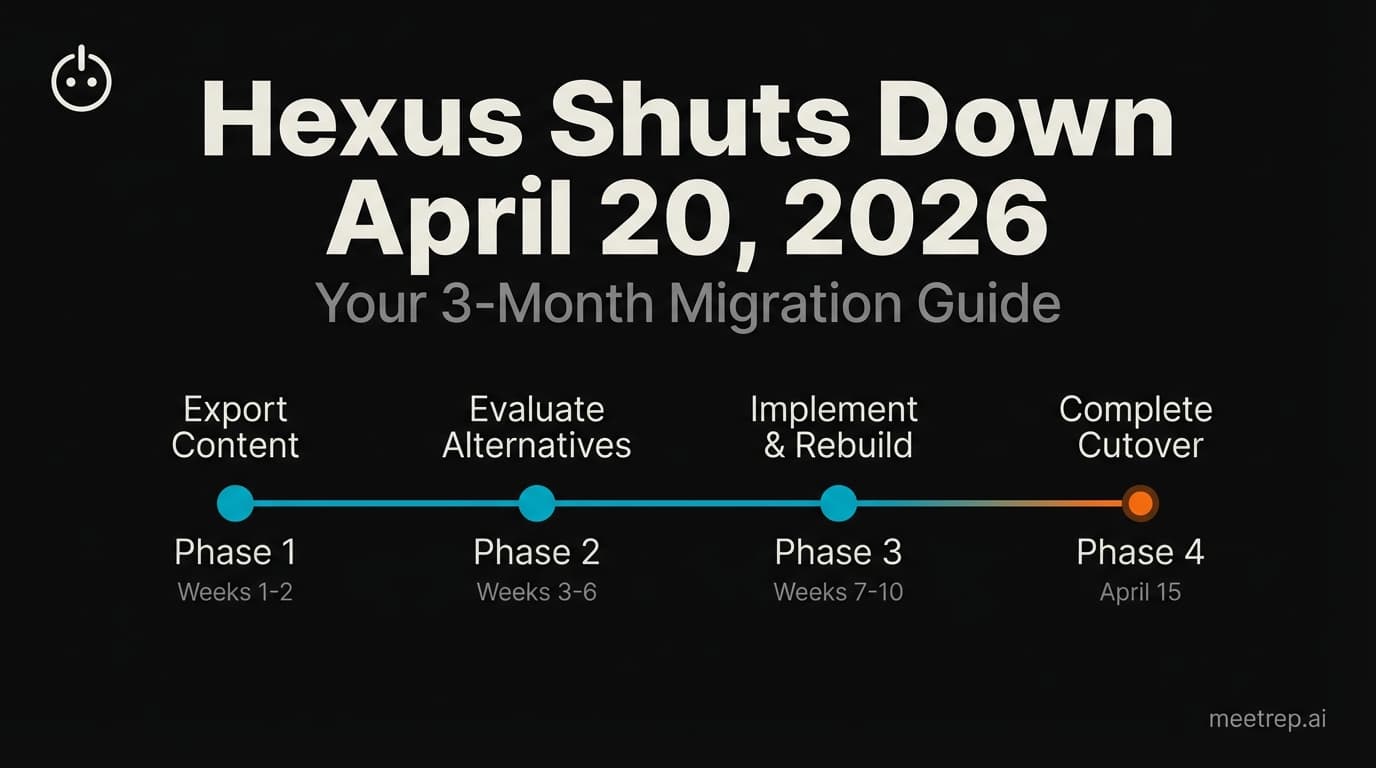
Hexus Acquired by Harvey AI: Congrats & What It Means for Demo Automation Teams
Hexus is shutting down following its acquisition by Harvey AI. Learn how to manage your migration and discover the best demo automation alternatives before April 2026.
Why the "Software Demo" is Broken—and Why AI Agents Are the Future
The traditional software demo is dead. Discover why 94% of B2B buyers rank vendors before calling sales and how AI agents are replacing manual demos to scale revenue.
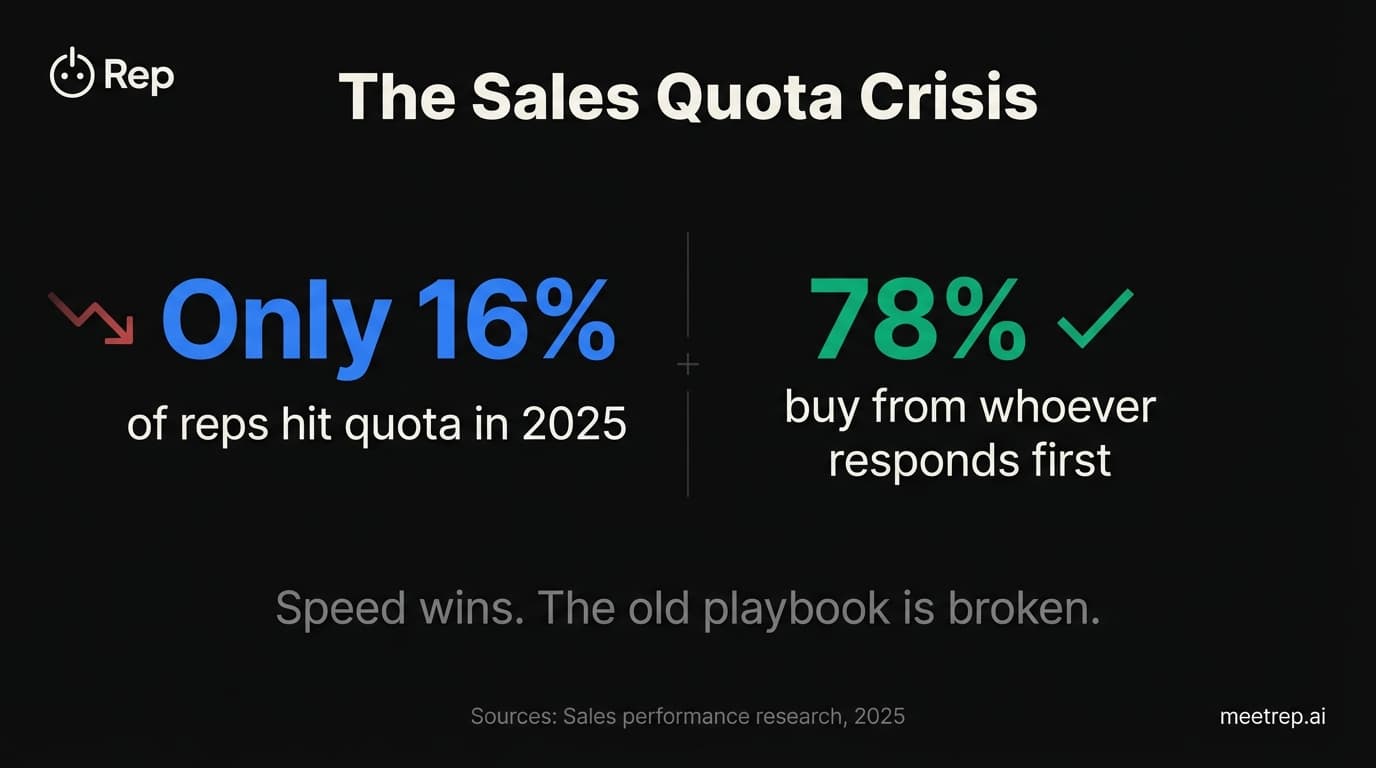
Why Autonomous Sales Software is the Future of B2B Sales (And Why the Old Playbook is Dead)
B2B sales is at a breaking point with quota attainment at 46%. Discover why autonomous 'Agentic AI' is the new standard for driving revenue and meeting the demand for rep-free buying.