Autonomous Demos for MarTech: How to Prove Value Fast When Buyers Won't Wait

Executive Summary
- 61% of B2B buyers prefer rep-free experiences—your scheduling friction is costing you deals
- 90% of leads drop off at "Schedule a Demo" (Layerpath)—the button itself is the problem
- Autonomous demos use AI agents to conduct live, conversational product walkthroughs 24/7
- Companies like Hunters Security cut sales cycles by 50% using demo automation
Your "Book a Demo" button is bleeding pipeline.
I know that sounds dramatic. But here's what Gartner found in June 2025: 61% of B2B buyers now prefer a rep-free buying experience. They don't want to schedule. They don't want to wait. They want to see your martech demo on their terms—and if you can't deliver that, they'll find someone who can.
I've spent years building sales automation tools, first at GoCustomer.ai and now at Rep. And the pattern I keep seeing is this: MarTech companies with amazing products are losing deals not because their product is weak, but because their demo process is.
This piece breaks down why traditional martech demos are failing, what autonomous demos actually are, and how to deploy them without the AI-hallucination nightmares that keep sales leaders up at night.
Why Traditional MarTech Demos Are Failing
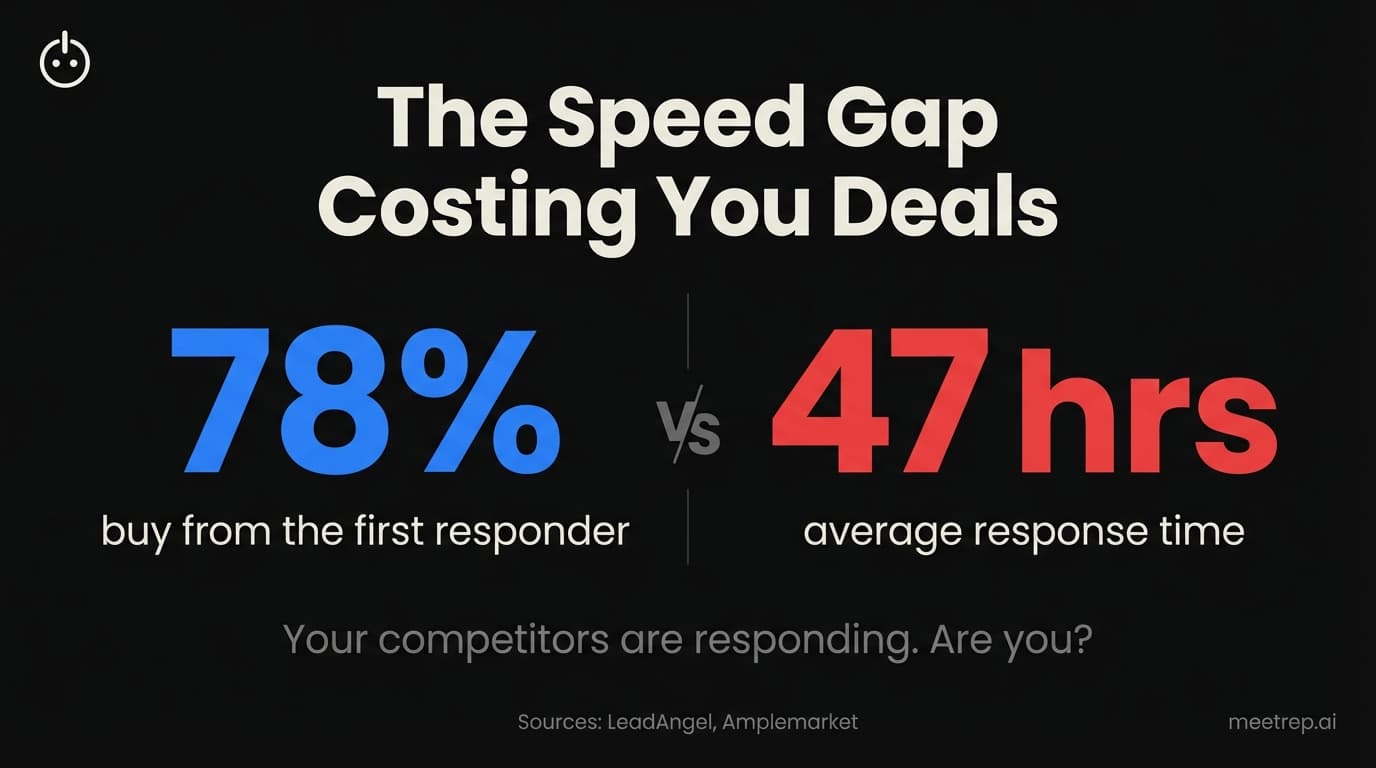
Traditional martech demos fail because they force buyers to wait when they're ready to buy now. The math is brutal: 78% of customers buy from the first company that responds, and your average B2B company takes 42-47 hours to respond to a lead.
Think about that. Nearly half your leads have already chosen a competitor before you even reply.
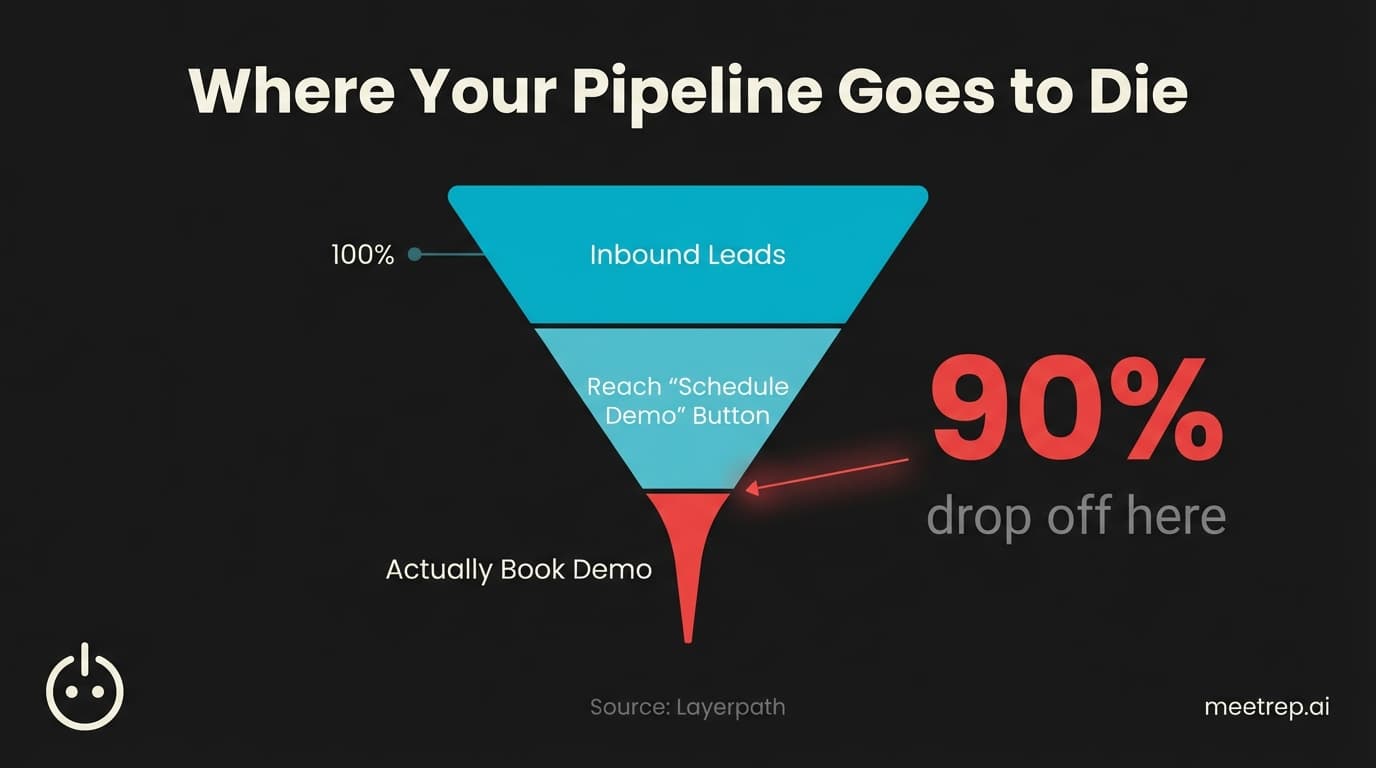
It gets worse. According to Layerpath's research, 90% of leads drop off at the "Schedule a Demo" stage. Nine out of ten. That's not a conversion problem—it's a systemic failure of the entire demo model.
The Data: No-show rates double from 12.4% to 23% when demos are delayed by 8+ days. Every day you make prospects wait, you're watching deals evaporate. (Reply.io)
And here's what frustrates me most about this: MarTech products are often complex. They need explanation. But buyers are researching at 11pm, comparing three vendors in one sitting, and your rep is asleep. So they move on to whoever has a self-serve option.
The "book a demo" model was built for a world where buyers had patience. That world is gone.
What Is an Autonomous Demo? (And Why It's Not Just Another Chatbot)
An autonomous demo is a live, interactive product demonstration conducted by an AI voice agent that joins video meetings, shares its screen, and walks prospects through your actual product in real-time—answering questions as they come up.
This is fundamentally different from what you've probably seen before.
| Type | How It Works | Limitation |
|---|---|---|
| Pre-recorded videos | Prospect watches passively | Can't ask questions, can't personalize |
| Click-through demos (Navattic, Walnut) | Screenshots with hotspots | Not real product, can't handle Q&A |
| Chatbots | Text-based, scripted | No visual demonstration, rigid |
| Autonomous demos | AI agent joins call, shares screen, navigates live product, has real conversation | New category—requires training |
The difference matters. Click-through tools show a simulation. Autonomous demos show your actual product while having a real conversation with the prospect.
Key Insight: 88% of software buyers won't book a sales call without seeing the product in action first (HowdyGo). They want to see it—but they also want their questions answered. Autonomous demos do both.
I'm biased here—we built Rep to solve exactly this problem. But the category itself matters more than any single tool. Whether you use Rep or build something internally, the shift from static demos to live AI-guided demonstrations is happening.
The "Rep-Free" Reality: What the Data Actually Shows
Let me be direct about the market shift happening right now.
Gartner's June 2025 survey of 632 B2B buyers found that 61% prefer an overall rep-free buying experience. Not "tolerate." Prefer.
And McKinsey's 2024 B2B Pulse Survey found that 71% of B2B buyers are willing to spend over $50,000 in a single transaction using self-service or remote models. We're not talking about small purchases. Enterprise deals are moving digital.
| Buyer Behavior | Stat | Source |
|---|---|---|
| Prefer rep-free experience | 61% | Gartner 2025 |
| Will spend $50K+ via self-service | 71% | McKinsey 2024 |
| Avoid suppliers with irrelevant outreach | 73% | Gartner 2025 |
| Buying time spent with suppliers | 17% | Gartner 2025 |
That last one hits hard. Buyers spend only 17% of their buying time meeting with potential suppliers. The other 83%? They're researching on their own. Reading reviews. Watching competitors' demos.
What we learned at GoCustomer: When we first launched, we made prospects schedule calls with our team for every demo. Our conversion rate was mediocre. When we added a way for prospects to see the product immediately, qualified pipeline jumped within 30 days. Speed beats perfect sales execution almost every time.
If your martech sales motion requires prospects to wait days for a live demo, you're swimming against a very strong current.
The Trust Problem: Why Only 6% of Leaders Trust AI Agents
Here's where I have to be honest about the elephant in the room.
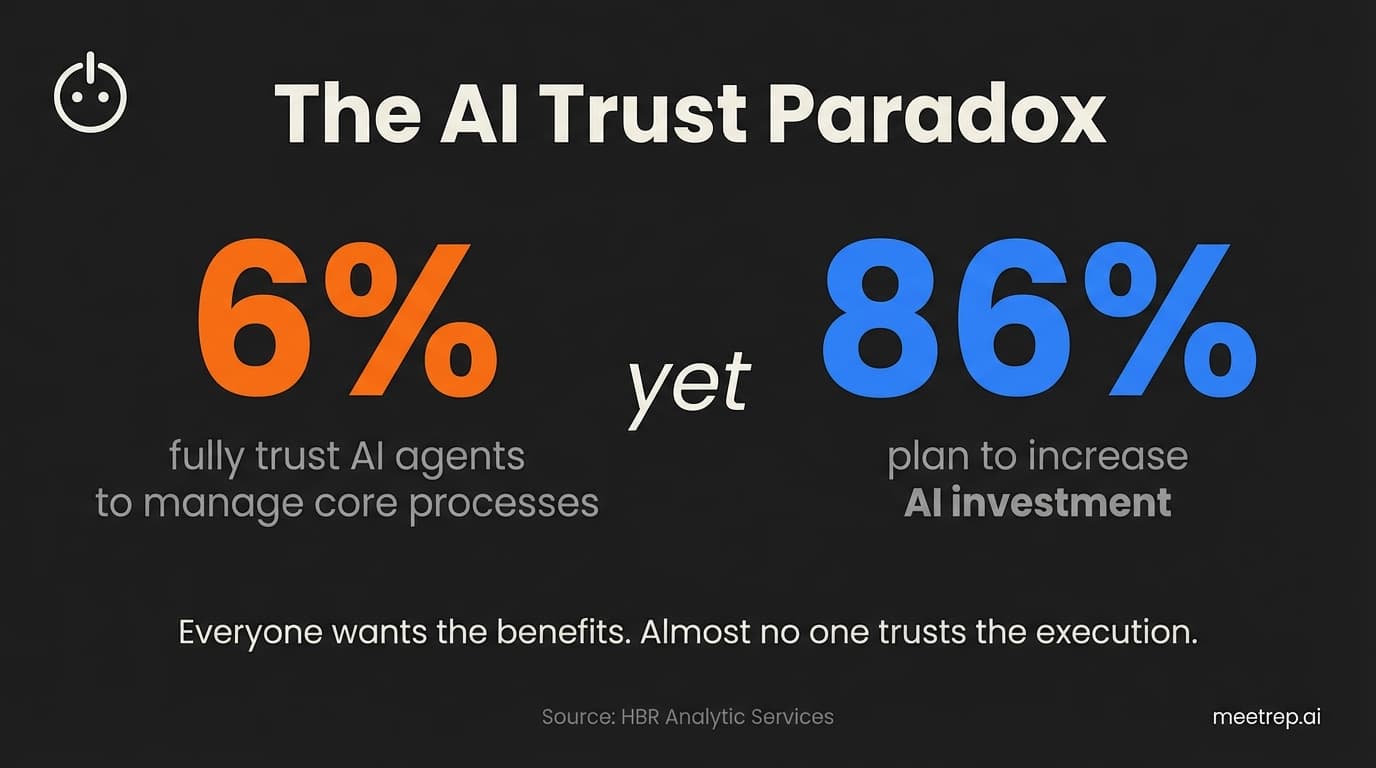
Harvard Business Review Analytic Services found that only 6% of companies fully trust AI agents to autonomously manage core business processes—even though 86% plan to increase their investment in AI.
Everyone wants the benefits. Almost no one trusts the execution.
Honestly? That skepticism is earned. We've all seen AI chatbots hallucinate, give wrong answers, and damage customer relationships. If your AI demo agent invents a feature that doesn't exist, you've just created a legal liability and a very angry prospect.
Why we built Rep this way: This is exactly why we designed Rep around structured playbooks and organization-scoped knowledge bases instead of letting an open LLM run wild. The AI can only discuss content that's been explicitly validated. No improvisation on pricing. No making up integrations. The playbook is the constraint.
The solution isn't avoiding AI. It's constraining it properly.
What does that look like in practice?
Structured Playbooks: The AI follows a validated demo flow. It knows which features to show, in what order, and what to say about each.
Organization-Scoped Knowledge Bases: The AI pulls answers only from your approved documentation. No external hallucinations.
Inline Validation: Before going live, you review AI-generated content and answer clarifying questions to fill gaps.
The companies successfully deploying autonomous demos aren't trusting AI blindly. They're treating AI agents like new hires who need onboarding, scripts, and guardrails.
Real Results: What Autonomous Demos Actually Deliver
Let me share verified results from companies that have deployed demo automation. These aren't projections—they're documented outcomes.
Hunters Security (Demostack case study): Cut their sales cycle from 9 months to 4 months—a 50% reduction. They also closed 3 deals without requiring a proof-of-concept.
Sovos (Consensus case study): Achieved 67% reduction in live SE calls and 60% faster SMB sales cycle. Eliminated 2 weeks of demo lag time.
Gainsight (Demostack case study): 25% growth in win rate with customized demos. Demo response time dropped from 48 hours to less than 1 hour.
| Company | Result | Source |
|---|---|---|
| Hunters Security | 50% sales cycle reduction (9→4 months) | Demostack |
| Sovos | 67% reduction in live SE calls | Consensus |
| Gainsight | 25% win rate improvement | Demostack |
| Synack | Demo build time: 100+ hours → under 10 hours | Demostack |
The Data: According to Optifai's 2025 Sales Ops Benchmark, interactive demos convert at 38%—that's 52% higher than traditional screen share demos at 25%. The format itself drives conversion.
But here's what I want you to notice: these aren't startups experimenting with toys. Sovos has 27,000 employees. These are enterprise companies making serious bets on demo automation.
How to Deploy Autonomous Demos for Your MarTech Product
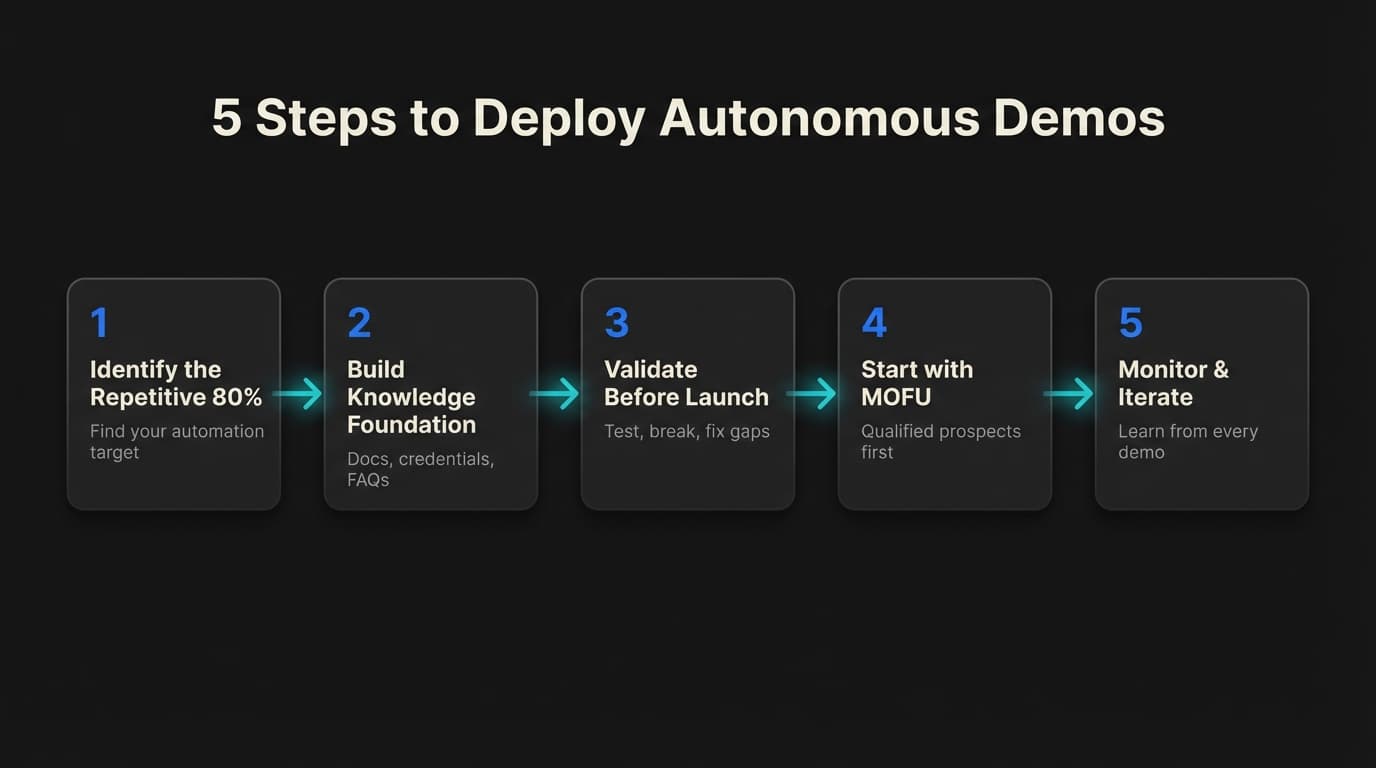
If you're convinced the model makes sense, here's how to actually deploy it. I'll be practical.
Step 1: Identify the "Repetitive 80%"
Not every demo needs AI. Your complex enterprise deals with 12 stakeholders and custom integration requirements? Keep those human.
But the intro demos, the "what does your product actually do" conversations, the first-touch with inbound leads—those are repetitive. And they're eating your reps' time.
Start by auditing: What percentage of your demos follow essentially the same script? For most MarTech companies, it's 70-80%. That's your automation target.
Step 2: Build the Knowledge Foundation
Autonomous demos are only as good as the knowledge behind them. You need:
- Product documentation: What the features do, how they work
- Demo credentials: A demo account the AI can log into and navigate
- FAQ content: The 20 questions prospects ask in every demo
- Objection responses: How to handle common pushback
The training can come from recordings of your best demos, written documentation, or live training sessions where the AI observes.
Step 3: Validate Before Going Live
Look, this is where most teams cut corners. Don't.
Run the AI through test demos. Ask tricky questions. Try to break it. Every gap you find before launch is a gap that won't embarrass you in front of a prospect.
At Rep, we built inline validation directly into the playbook editor. The AI identifies gaps and asks clarifying questions. You answer them, and the playbook gets smarter. It's not foolproof, but it's a lot safer than hoping for the best.
Step 4: Start with MOFU, Not TOFU
My recommendation: don't put autonomous demos on your homepage immediately.
Start with middle-of-funnel prospects who already know what you do. They've read content. They've engaged with your brand. They're ready to see the product.
This gives you a better signal-to-noise ratio. You'll learn faster what works because the prospects are more qualified.
Step 5: Monitor, Learn, Iterate
Every autonomous demo generates data. What questions are prospects asking? Where do they spend the most time? When do they drop off?
This intelligence is gold for your human reps too. You'll learn what actually matters to buyers—not what you think matters.
What About Complex MarTech Products?
I hear this objection constantly: "My product is too complex for AI to demo."
Maybe. But probably not.
Here's my take: complexity isn't about the product. It's about the conversation. A marketing automation platform with 47 features isn't inherently too complex. The question is whether you can teach an AI to navigate the conversation well.
The 6% trust stat from HBR matters here. But it's not about whether AI can handle complexity—it's whether you've built the guardrails to do it safely.
Consider this: McKinsey's research shows that 39% of B2B buyers are willing to spend over $500,000 through self-service digital commerce. If buyers are comfortable spending half a million dollars without talking to a human, "complexity" isn't the barrier we think it is.
Key Insight: The real complexity isn't your product. It's building trust that the AI won't say something wrong. Structured playbooks and constrained knowledge bases solve this—not avoiding AI entirely.
The alternative is worse: making every prospect wait for a human who's booked out for two weeks, while competitors respond in two minutes.
The Speed Advantage: Why First Response Wins
Let me close with the stat that should haunt every VP Sales.
78% of customers buy from the first company that responds.
Not the best company. Not the cheapest. The first.
And the average B2B lead response time? 42-47 hours according to Amplemarket's research.
Meanwhile, your competitor has an AI agent available at 3am when your prospect is researching solutions.
The Data: Responding within 5 minutes makes you 21x more likely to convert than waiting 30 minutes. Speed isn't just an advantage. It's the whole game. (Rep.ai citing Velocify/InsideSales)
This is why autonomous demos matter. Not because AI is trendy. Not because headcount is expensive. Because speed determines who wins—and humans can't be everywhere at once.
The MarTech market hit $557.94 billion in 2025 according to Precedence Research. It's projected to reach $2.8 trillion by 2034. The winners won't be the companies with the best product. They'll be the companies who can prove value fastest.
The martech demo isn't dying. It's evolving.
The companies that figure out how to deliver value instantly—without scheduling friction, without timezone constraints, without making prospects wait—will capture disproportionate market share.
We built Rep because we saw this shift coming and wanted to be part of the solution. But regardless of what tool you use, the strategic point stands: your prospects are researching at 2am, your competitors are responding at 2am, and if you're not there, you're losing deals you'll never know about.
The 61% of buyers who prefer rep-free experiences aren't going backward. The question is whether you'll meet them where they are.

Nadeem Azam
Founder
Software engineer & architect with 10+ years experience. Previously founded GoCustomer.ai.
Nadeem Azam is the Founder of Rep (meetrep.ai), building AI agents that give live product demos 24/7 for B2B sales teams. He writes about AI, sales automation, and the future of product demos.
Frequently Asked Questions
Table of Contents
- Why Traditional MarTech Demos Are Failing
- What Is an Autonomous Demo? (And Why It's Not Just Another Chatbot)
- The "Rep-Free" Reality: What the Data Actually Shows
- The Trust Problem: Why Only 6% of Leaders Trust AI Agents
- Real Results: What Autonomous Demos Actually Deliver
- How to Deploy Autonomous Demos for Your MarTech Product
- What About Complex MarTech Products?
- The Speed Advantage: Why First Response Wins
Ready to automate your demos?
Join the Rep Council and be among the first to experience AI-powered demos.
Get Early AccessRelated Articles
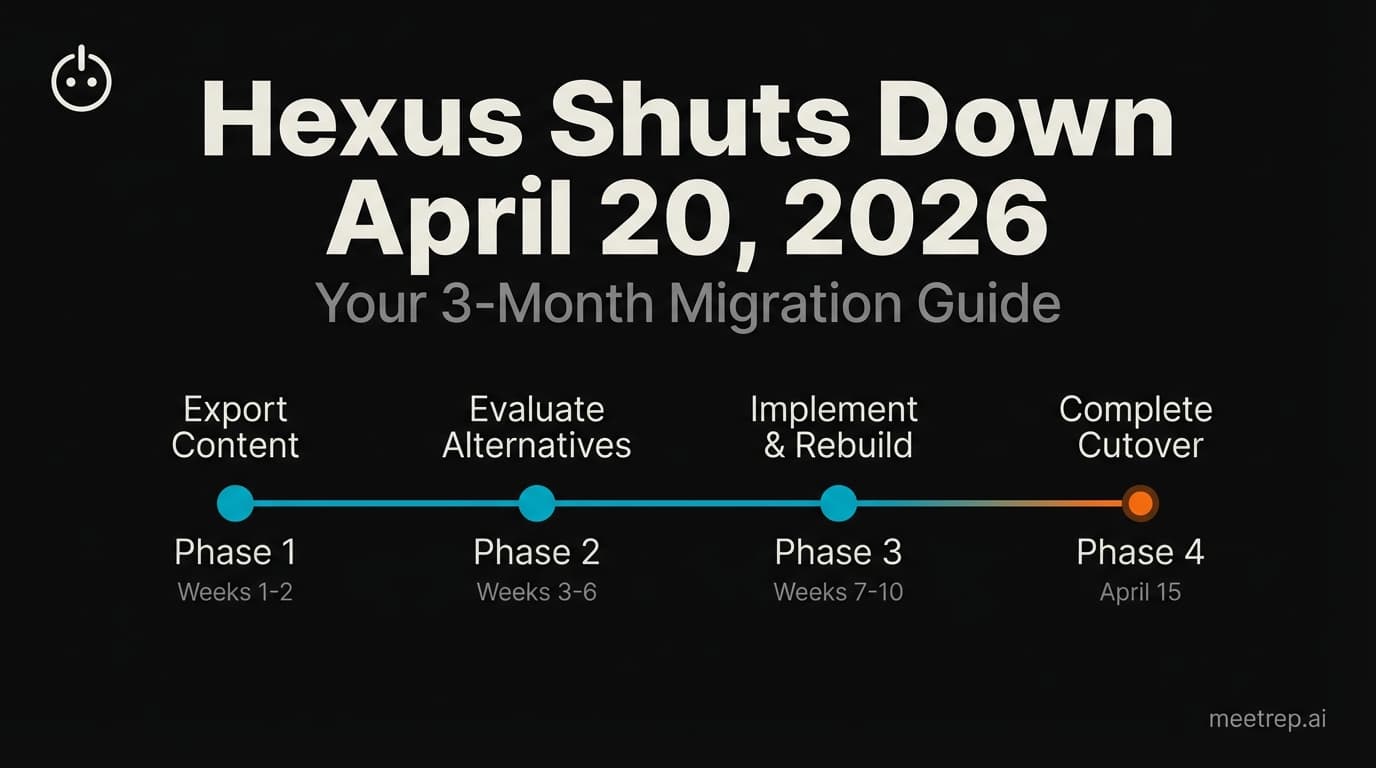
Hexus Acquired by Harvey AI: Congrats & What It Means for Demo Automation Teams
Hexus is shutting down following its acquisition by Harvey AI. Learn how to manage your migration and discover the best demo automation alternatives before April 2026.
Why the "Software Demo" is Broken—and Why AI Agents Are the Future
The traditional software demo is dead. Discover why 94% of B2B buyers rank vendors before calling sales and how AI agents are replacing manual demos to scale revenue.
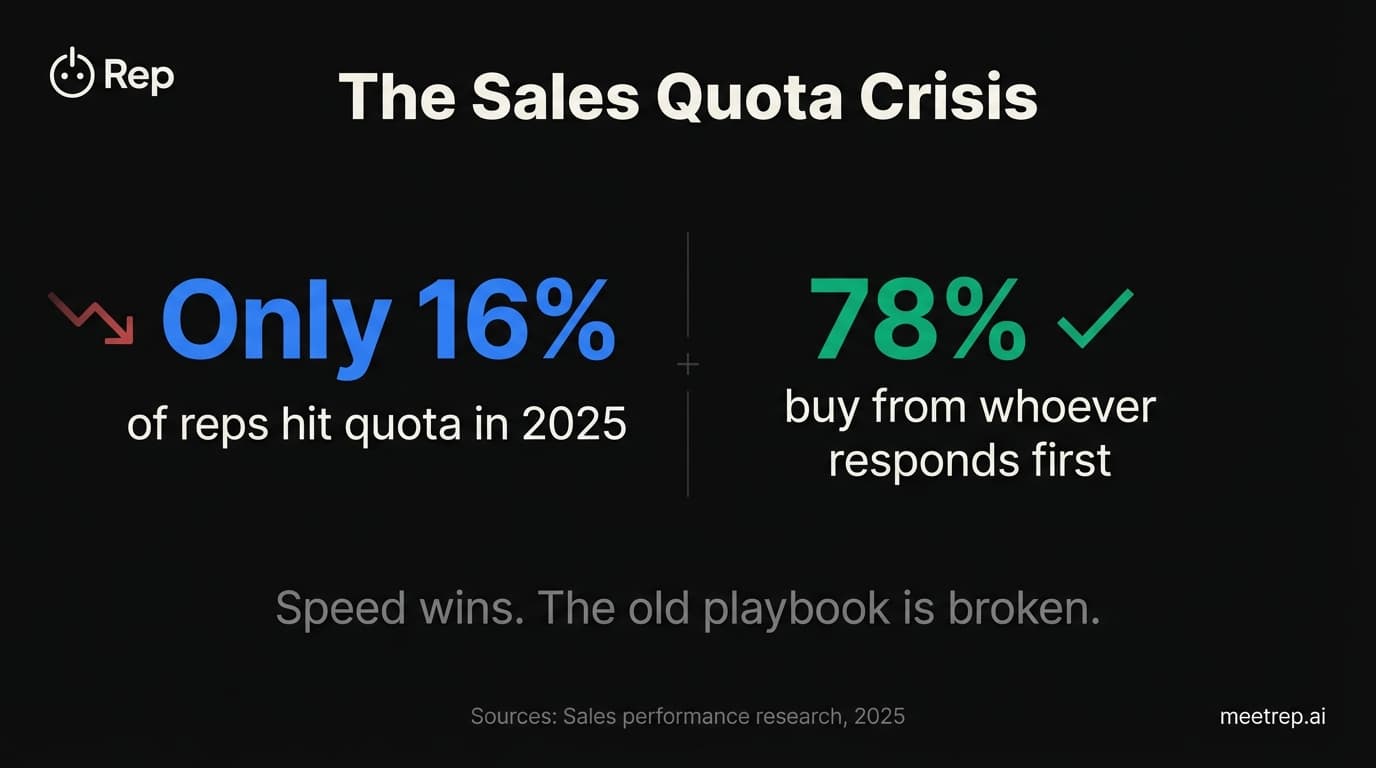
Why Autonomous Sales Software is the Future of B2B Sales (And Why the Old Playbook is Dead)
B2B sales is at a breaking point with quota attainment at 46%. Discover why autonomous 'Agentic AI' is the new standard for driving revenue and meeting the demand for rep-free buying.