Autonomous Demos for Fintech: Solving the Efficiency Paradox

Executive Summary
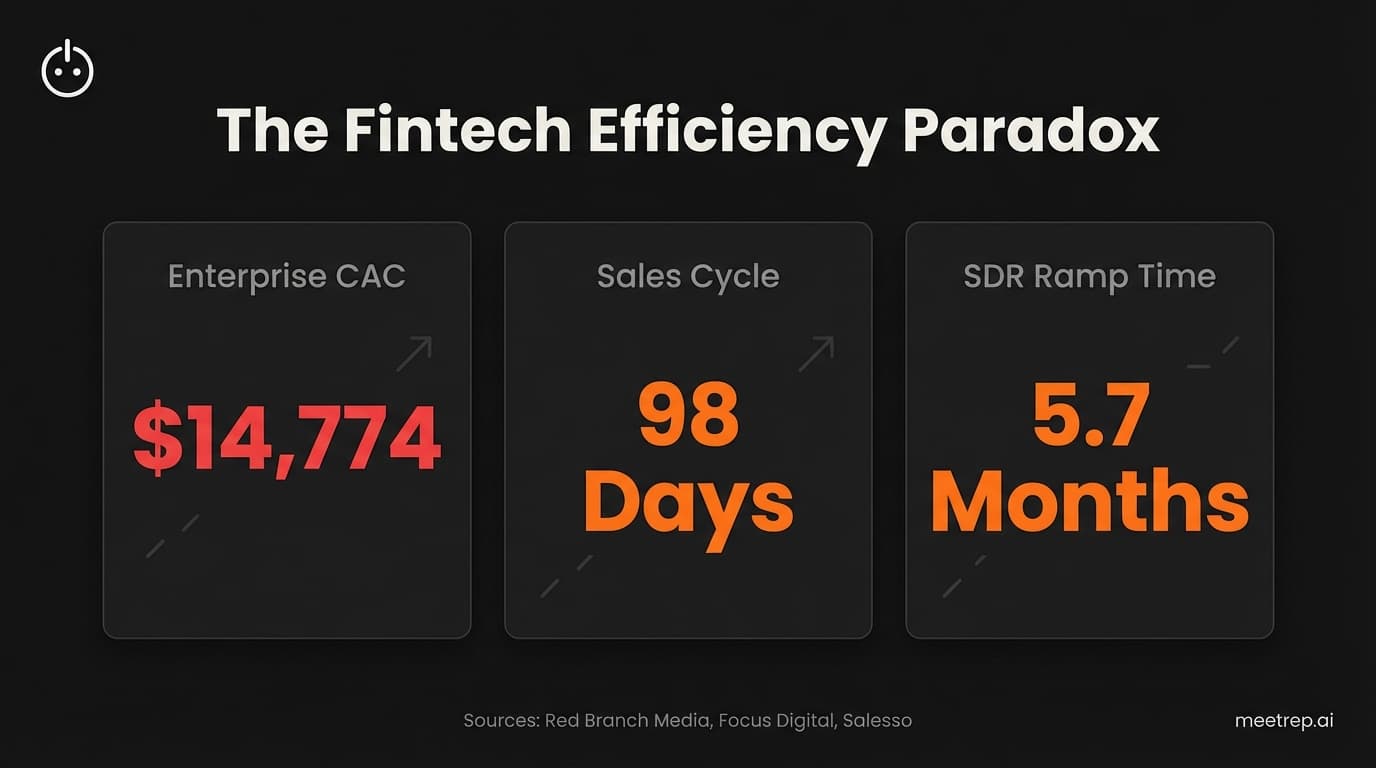
- Fintech CAC has hit $1,450, and sales cycles are dragging to 98 days.
- Hiring more SDRs fails because ramp time is now 5.7 months.
- "Click-through" screenshots fail in fintech because they don't prove backend data integrity.
- Synthetic Data and Session Isolation are the only safe ways to automate demos without PII risks.
In 2025, the average fintech company spends $1,450 to acquire a single customer.
That number keeps me up at night.
If you’re running a sales org in this industry, you’re likely stuck in a brutal bind. On one side, your board demands "efficient growth." They want lower CAC. On the other side, your buyers are terrified of risk, dragging sales cycles out to three months or more.
To fix the math, 36% of B2B companies decreased their SDR headcount last year, according to SaaStr. The logic seems sound: cut the expensive humans at the top of the funnel, save money.
But here’s the problem.
When you cut SDRs but don’t change how you demo, you just dump more work on your Account Executives. Your expensive closers end up doing "Intro to Dashboard" calls instead of closing deals. And because your buyers are technical, they demand to see the product now, not next Tuesday.
We built Rep to solve this specific problem. But in fintech, you can’t just "automate it" and hope for the best. Compliance kills deals faster than bad pricing.
Here is how autonomous demos work for fintech, why security is the only feature that matters, and how to stop burning cash on unqualified meetings.
The Fintech Efficiency Paradox
The "Efficiency Paradox" in fintech is simple: You need to show the product earlier to win trust, but showing the product costs too much money.
According to data from Focus Digital, the average sales cycle for Financial Services has stretched to 98 days. That is over a quarter of holding a prospect's hand.
Traditionally, you would hire SDRs to bridge this gap. They would qualify the lead, maybe show a slide deck, and set up the meeting.
But that model is broken.
Data from Salesso shows that the average ramp-up time for SaaS sales reps has increased to 5.7 months. Think about that. You hire an SDR today. You pay them full salary. And they aren't fully productive until nearly half a year later.
The math doesn't work.
If you are paying $1,450 to acquire a customer, you cannot afford to have a human spending 45 minutes qualifying a prospect who just wanted to see if your API supports GraphQL.
What we learned at GoCustomer: We found that nearly 40% of "Demo Requests" aren't ready to buy. They are researching. When you force a researcher to talk to a human SDR, you create friction. When you let them self-educate via an autonomous agent, you build trust while preserving your burn rate.
Why "Click-Through" Demos Fail in Fintech
You might be thinking, "We already have a product tour on our website."
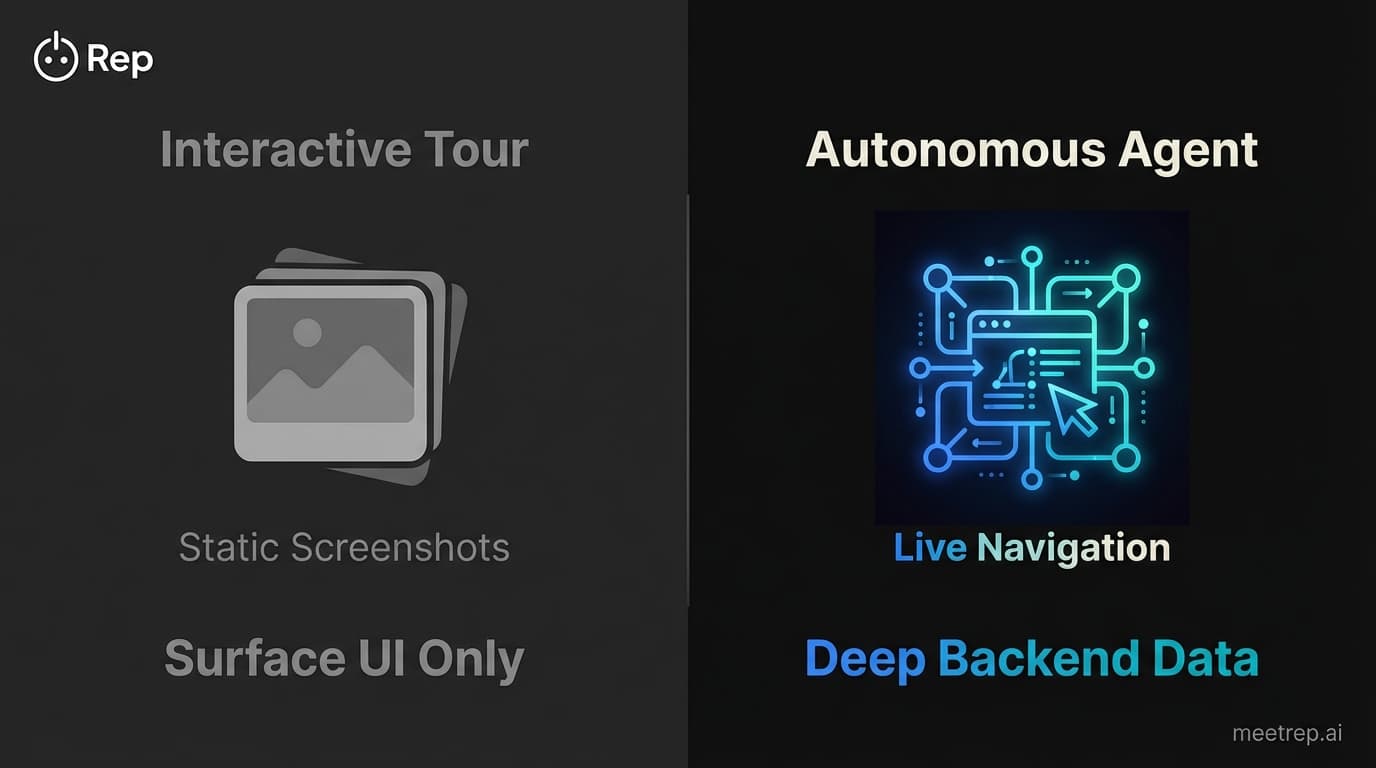
I need to be clear about the difference here. Most "automated demos" (tools like Navattic or Storylane) are actually Interactive Product Tours. They are screenshots linked together with HTML.
For a simple marketing tool? They work great.
For fintech? They often fail.
Fintech buyers—CFOs, Risk Officers, Developers—don't care about your UI colors. They care about data flow. They want to see what happens to the reconciliation report when a transaction fails. They want to see the API logs.
A screenshot cannot show that.
Autonomous Demos for Fintech are fundamentally different. An autonomous agent joins a live video call and navigates the actual software (or a high-fidelity sandbox). It clicks real buttons. It filters real lists. It answers voice questions in real-time.
Here is the breakdown:
| Feature | Interactive Tour (Screenshots) | Autonomous Agent (Rep) |
|---|---|---|
| Medium | Static HTML / Slides | Live Browser Navigation |
| Complexity | Linear (Step 1 → Step 2) | Dynamic (Pivots based on questions) |
| Data Depth | Surface Level (UI only) | Deep (Can show backend/logs) |
| Interaction | Click "Next" | Voice Conversation + Q&A |
| Best For | Marketing Website | Qualified Discovery Calls |
If you are selling complex financial infrastructure, a slideshow feels like you are hiding something. A live agent driving the product proves it actually works.
The Security Elephant: Compliance & PII
This is the part where most Fintech VPs stop reading.
"I can't let an AI touch my demo environment. What if it shows one client's data to another? What if it hallucinates a compliance certification we don't have?"
Valid fears.
According to Software Secured, 41.8% of breaches affecting top fintech companies originate from third-party vendors. You cannot afford to be the vendor that introduces a vulnerability.
When we architected Rep, we knew we couldn't just wrap ChatGPT in a browser and call it a day. The security requirements for banking and payments are binary: you are secure, or you are out.
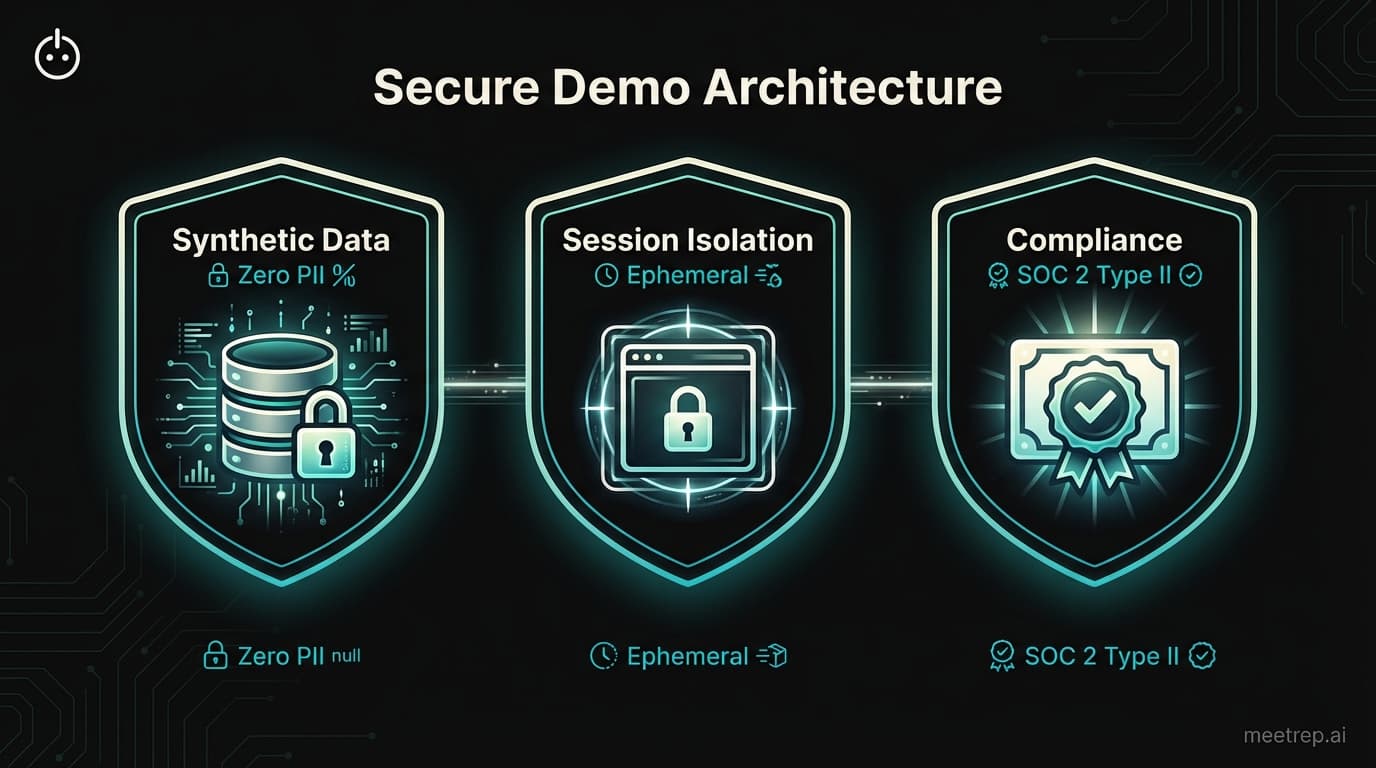
We built the system on three pillars specifically for regulated industries.
1. The Role of Synthetic Data
The only safe way to demo fintech products autonomously is using Synthetic Data.
This is artificial data that mimics the statistical properties of real-world data but contains zero Personally Identifiable Information (PII).
Why we built Rep this way: We don't connect Rep to your production database. We connect it to a sandbox populated with synthetic data. Even if a prospect asks, "Show me the transaction history for User X," the agent shows data that looks real but is mathematically generated. If the system is breached, the hacker steals nothing but random noise.
2. Session Isolation
We enforce Session Isolation. Every time Rep starts a demo, it spins up a fresh browser instance. When the demo ends, that instance is destroyed.
There is no cache shared between Client A and Client B. No "cookie leakage." It’s a clean slate, every single time.
3. SOC 2 Type II Compliance
This isn't just about avoiding bugs. It's about passing the vendor security questionnaire that your buyer's IT team is going to send you. If you can say, "The AI operates in an ephemeral, isolated container using synthetic data and we are SOC 2 Type II certified," you win the trust argument.
Compressing the 98-Day Sales Cycle
Speed is the other half of the equation.
Trintech, a financial close software company, found they had a 14-day delay between a prospect requesting a demo and actually seeing the product.
Two weeks.
In fintech, two weeks is enough time for your champion to leave the company, or for a competitor to swoop in.
Autonomous demos compress this timeline by offering an immediate "off-ramp" for high-intent buyers.
The Workflow Looks Like This:
- Intent: Prospect lands on your site at 8:00 PM.
- Action: Instead of "Book a Meeting" (and wait 3 days), they see "See a Live Demo Now."
- Engagement: Rep joins a video room instantly.
- Qualification: Rep asks the hard questions (Company size? Transaction volume? Current stack?).
- Proof: Rep shows the core value proposition securely using synthetic data.
- Handoff: If qualified, Rep books a meeting with your Senior AE for the deep dive.
The Data:Red Branch Media reports that enterprise fintech CAC has reached $14,774. Every minute a human spends with an unqualified lead adds to that number. Autonomous agents stop the bleeding by filtering out the noise before it hits your calendar.
By automating that first touch, you aren't replacing the sales relationship. You are ensuring your human team only speaks to people who have already seen the product and still want to buy.
Implementation: The "Safe" Path
If you are ready to try this, don't boil the ocean. You don't need your AI agent to handle every edge case of your API documentation.
Start small.
Step 1: The Audit
Look at your current demo environment. Is it stable? More importantly, is the data clean? Common mistake: Teams try to connect AI to a "messy" sandbox where features break half the time. If the product breaks, the AI can't improvise like a human. Fix the environment first using clean, synthetic datasets.
Step 2: Define the "Happy Path"
Identify the 20% of features that drive 80% of your wins. Usually, this is:
- The Dashboard (High-level view)
- The Transaction Log (The "proof")
- The Reporting Tab (The value for the boss)
Train your agent on this path exclusively. If a prospect asks about a niche feature outside this path, teach the agent to say: "That's a great question for our technical team. I've noted it down, and I'll have our Senior Engineer walk you through that specifically."
Step 3: The Handoff
Configure the logic for escalation.
- Scenario A: Prospect is small (<$10M revenue). Agent guides them to self-serve sign up.
- Scenario B: Prospect is Enterprise. Agent immediately offers a calendar slot for your VP of Sales.
My recommendation: Treat the AI as your "Junior SDR." You wouldn't let a Day 1 hire negotiate pricing. Don't let the AI do it either. Give it strict guardrails on what it can show and what it must escalate.
Stop Losing Deals to Scheduling
The era of "growth at all costs" is over. We are in the era of efficient growth.
You cannot afford to spend $1,450 to acquire every customer. You cannot afford to wait 5.7 months for new reps to ramp up. And you certainly can't afford a data breach.
Autonomous demos give you a way out of the paradox. They let you scale your technical presales without scaling headcount, and they give your buyers the instant gratification they demand.
But you have to build it on a foundation of trust.
Don't let a 98-day sales cycle kill your quarter. Let your buyers see the product tonight.

Nadeem Azam
Founder
Software engineer & architect with 10+ years experience. Previously founded GoCustomer.ai.
Nadeem Azam is the Founder of Rep (meetrep.ai), building AI agents that give live product demos 24/7 for B2B sales teams. He writes about AI, sales automation, and the future of product demos.
Frequently Asked Questions
Table of Contents
- The Fintech Efficiency Paradox
- Why "Click-Through" Demos Fail in Fintech
- The Security Elephant: Compliance & PII
- Compressing the 98-Day Sales Cycle
- Implementation: The "Safe" Path
- Stop Losing Deals to Scheduling
Ready to automate your demos?
Join the Rep Council and be among the first to experience AI-powered demos.
Get Early AccessRelated Articles
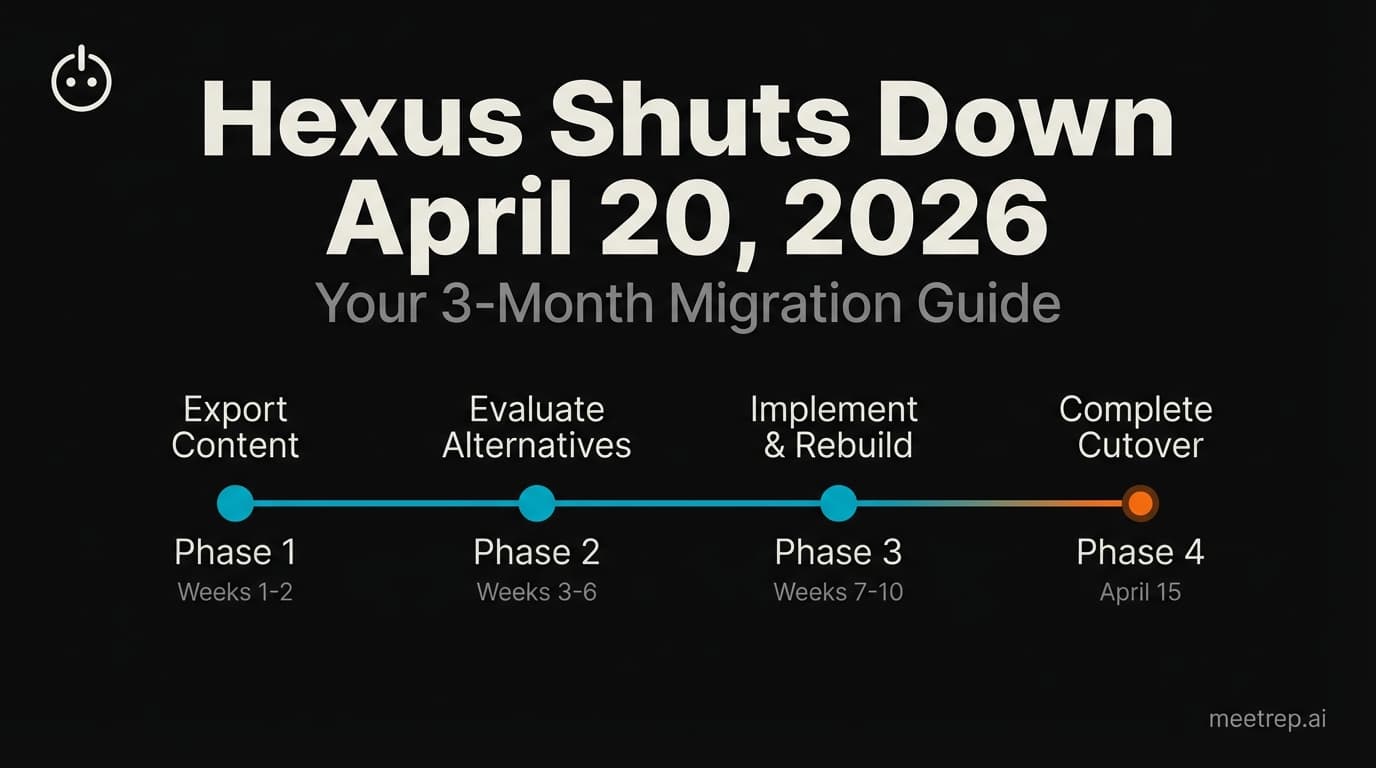
Hexus Acquired by Harvey AI: Congrats & What It Means for Demo Automation Teams
Hexus is shutting down following its acquisition by Harvey AI. Learn how to manage your migration and discover the best demo automation alternatives before April 2026.
Why the "Software Demo" is Broken—and Why AI Agents Are the Future
The traditional software demo is dead. Discover why 94% of B2B buyers rank vendors before calling sales and how AI agents are replacing manual demos to scale revenue.
Why Autonomous Sales Software is the Future of B2B Sales (And Why the Old Playbook is Dead)
B2B sales is at a breaking point with quota attainment at 46%. Discover why autonomous 'Agentic AI' is the new standard for driving revenue and meeting the demand for rep-free buying.