Autonomous Demos for DevTools: How to Scale Technical Depth Without Burning Out Your SEs

Executive Summary
- Static click-through demos convert 7.9x better than product pages—but they're table stakes now, not a differentiator
- Developers are uniquely skeptical: 75% won't endorse tech without API access
- The future is autonomous demos: AI agents that can navigate live products, not pre-recorded screenshots
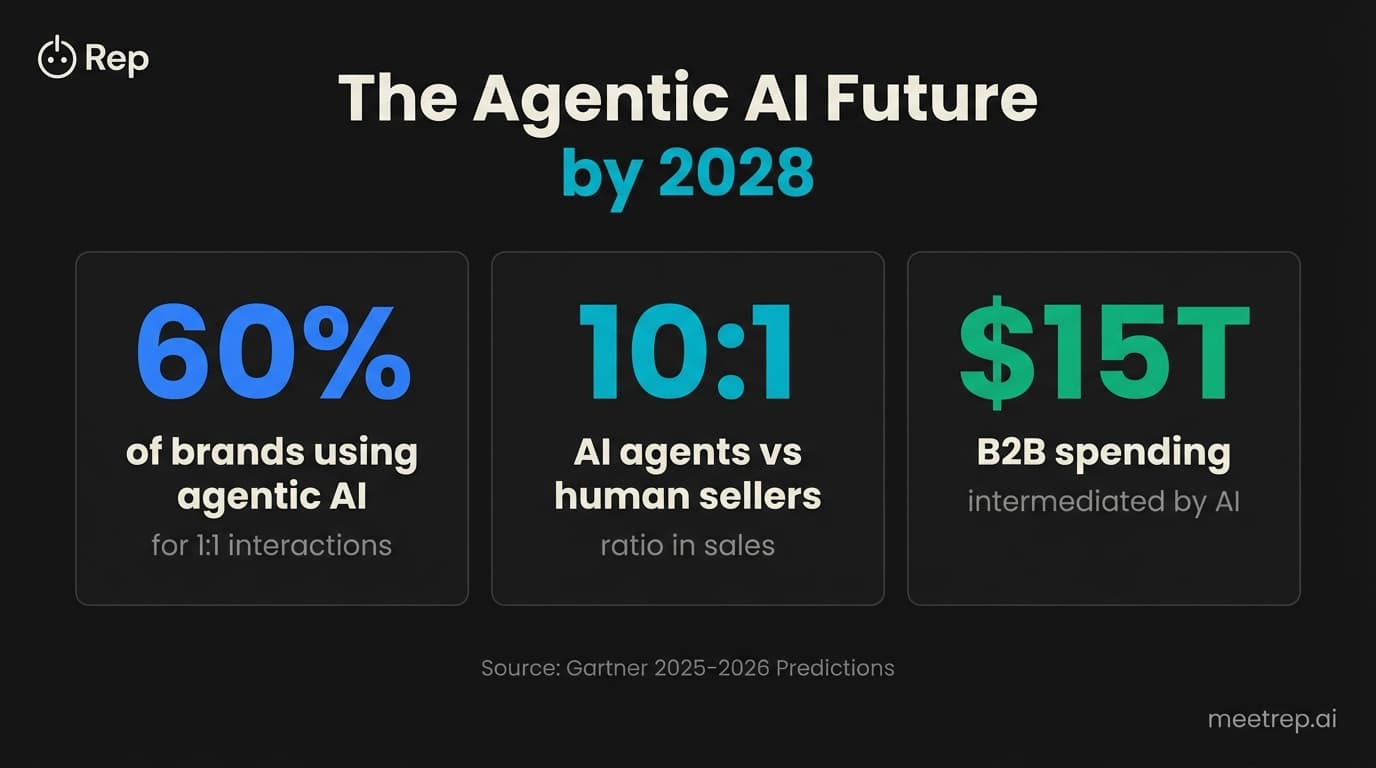
- Gartner predicts 60% of brands will use agentic AI for one-to-one interactions by 2028
Your Sales Engineers are drowning. Not in complex architecture discussions or high-stakes enterprise deals—that's what they signed up for. They're drowning in repetitive intro demos for prospects who may never buy.
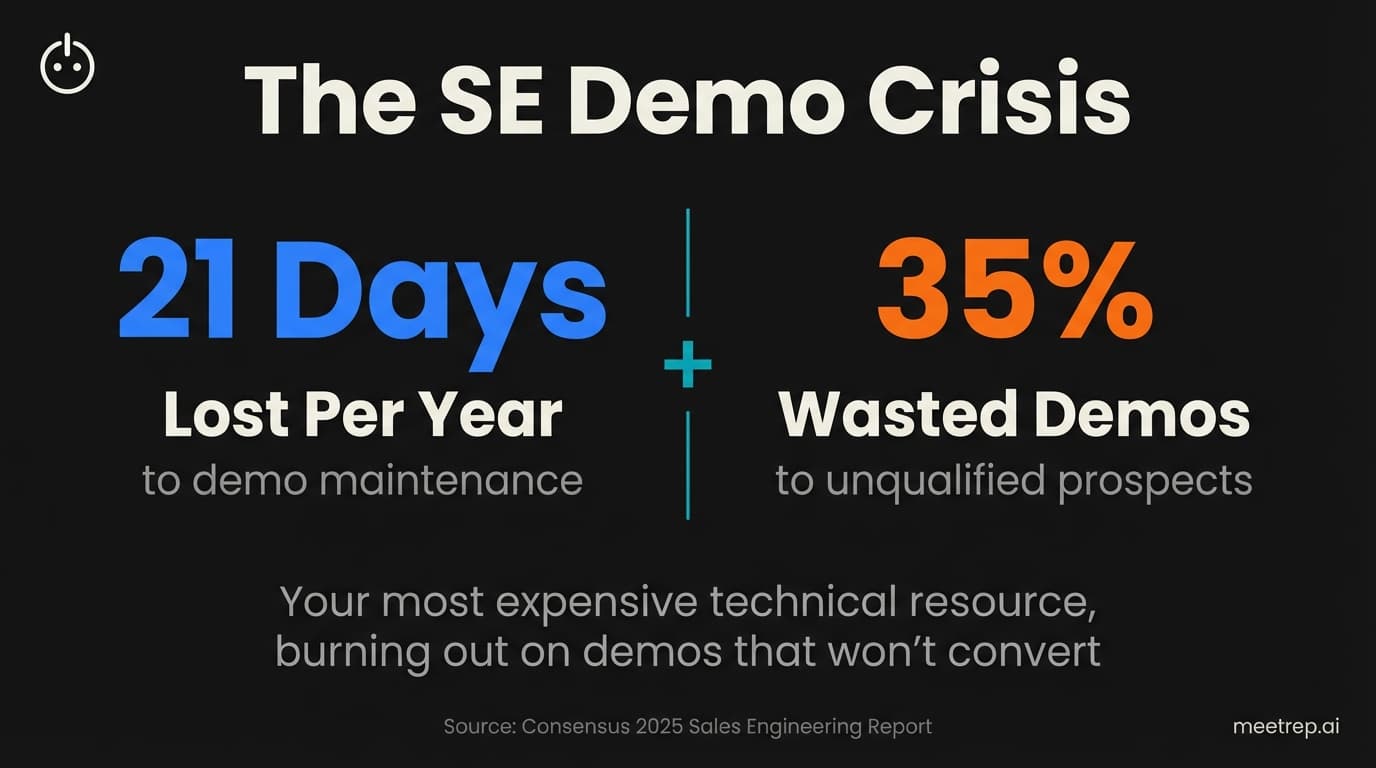
Here's the painful math: 79% of SEs spend more than one hour weekly just cleaning and maintaining demo environments, according to Consensus's 2025 Sales Engineering Report. That's 21 full working days per year lost to demo hygiene alone. And 35% of those demos are unqualified or underqualified prospects. The devtools demo problem is unique—and it's getting worse.
I've spent years building sales automation products—first at GoCustomer.ai, now at Rep. The pattern is consistent: DevTools companies hit a ceiling where demo capacity becomes their pipeline bottleneck. And the old solutions don't work anymore.
Your buyers write code for a living. They'll see through a polished marketing video in seconds. So how do you scale technical depth without sacrificing authenticity?
Why Developer Demos Are Different From Enterprise B2B
A devtools demo fails when it feels like marketing. Developers evaluate products differently than other B2B buyers—they want to see real behavior, not curated screenshots.
Stack Overflow's 2024 Developer Survey found that 75% of developers are more likely to endorse technology that offers real API access. Not a demo of the API. Actual access. This is the mindset you're selling to.
Generic B2B demo automation advice tells you to create "interactive product tours" and gate them behind forms. Try that with developers. Watch your conversion tank.
The Data:92% of developers now use AI tools daily, according to Daily.dev's 2025 survey. They expect instant, technical answers. Making them wait three days for an SDR to schedule a screen-share isn't just inconvenient—it signals that you don't understand how they work.
Here's what makes developer demos different:
| Dimension | Generic B2B Demos | DevTools Demos |
|---|---|---|
| Buyer expectation | Polished presentation | Technical proof |
| Primary question | "What does it do?" | "How does it actually work?" |
| Trust builder | Case studies, ROI numbers | Code examples, API behavior |
| Red flag | Too salesy | Too scripted |
| Time tolerance | 30-60 minutes | Under 10 minutes for intro |
| Decision maker | Executive with budget | Engineer with veto power |
The engineer often has veto power even when they don't have budget authority. Your demo has to pass their smell test before the deal can progress.
The Four Types of Product Demos (And Which Actually Work for DevTools)
Demo automation isn't monolithic. There are distinct categories, each with different tradeoffs for technical products. Understanding these matters because the wrong choice won't just underperform—it will actively hurt your credibility with developer buyers.
1. Static Interactive Tours (Navattic, Arcade, Storylane)
Pre-recorded click-throughs of product screenshots. Users follow a fixed path through HTML/CSS captures of your UI.
Best for: Top-of-funnel marketing pages, product overview for non-technical stakeholders Limitation for DevTools: Can't show real API behavior, terminal interactions, or dynamic responses. Developers know they're looking at screenshots.
2. Sandbox Environments (Demostack, TestBox)
Cloned production environments with sanitized demo data. Prospects explore a real (but walled-off) instance of your product.
Best for: Deep technical evaluation, proof-of-concept trials, late-stage deals Limitation for DevTools: Expensive to maintain, requires engineering resources to keep current, often overkill for initial qualification
3. Video Demos (Consensus)
Recorded walkthroughs with branching logic. Prospects choose their path through pre-recorded video content.
Best for: Explaining complex workflows, reaching multiple stakeholders asynchronously Limitation for DevTools: Can't answer unexpected questions, feels passive to developers who want hands-on interaction
4. Autonomous AI Demos (Emerging category)
AI agents that join video calls, share their screen, and navigate your live product in real-time while conversing naturally with prospects.
Best for: 24/7 availability, handling technical Q&A, qualifying before human handoff Limitation: Emerging technology, requires training on your specific product
My recommendation: Most DevTools companies need a combination. Static tours for website traffic. Sandbox access for serious evaluators. And increasingly, autonomous agents for the middle—qualifying inbound interest without burning SE time.
The data supports this layered approach. Interactive demos convert at 38% versus 18% for generic screen shares, according to Optifai's 2025 benchmark. But that's generic B2B data. Developer products with 5% median free-to-paid conversion—half the rate of non-developer products—need more than pretty click-throughs.
What Makes Autonomous Demos Different From Click-Through Tours
The distinction matters. It's not just marketing terminology—it's a core architectural difference that determines whether developers trust your demo.
An autonomous demo is a product demonstration conducted by an AI agent rather than a human sales representative. The agent uses browser automation to navigate your actual product in real-time, joins a video call, shares its screen, and walks through your software while having a natural conversation with the prospect. When the prospect asks an unexpected question—"What happens if I change this parameter?"—the agent can actually show them.
A click-through tour is a slideshow with extra steps. Useful. But static.
Here's the technical difference:
| Capability | Click-Through Tour | Autonomous Demo |
|---|---|---|
| Product navigation | Pre-recorded paths | Live browser control |
| Q&A handling | Canned responses or none | Natural conversation with knowledge base |
| Adaptability | Fixed branching logic | Dynamic based on prospect questions |
| API demonstration | Screenshots of responses | Actual API calls in real-time |
| Scale | Unlimited simultaneous | One conversation at a time (per agent) |
| Setup complexity | Lower | Higher (requires training) |
When we built Rep, we chose browser automation over screen capture specifically because of the developer audience. An AI agent that can actually click through your product, fill in forms, and show real responses builds trust that screenshots never will.
What we learned building Rep: The hard part isn't the AI conversation—it's giving the agent visual context. The agent needs to understand what's on screen to narrate intelligently. This is why "chatbot + slides" approaches feel disconnected. The agent has to see what the prospect sees.
The SE Time Crisis (And Why It's Getting Worse)
Let's quantify the problem.
According to Consensus's 2025 report, SEs lose the equivalent of nearly a month per year to demo maintenance alone. But that's not even the whole picture. 23% of SEs report that more than half their demos are unqualified prospects. And 39% say sales doesn't share discovery information soon enough.
Your SEs—your most expensive technical sales resource—are spending their time on:
- Resetting demo environments
- Cleaning up test data
- Giving intro demos to tire-kickers
- Repeating the same feature walkthrough for the tenth time this week
That's not what you hired them for.
Synack cut their demo build time from 100+ hours to under 10 after implementing demo automation, according to Demostack's case study. Tim Nordvedt, their Solution Architect, noted they were spending "20% of our week on demo building and maintenance. That's one working day per week on just demo hygiene."
One day per week. Per SE. On hygiene.
The Data:Hunters Security reduced their sales cycle by 50%—from 9 months down to 4—using sandbox demos. The key insight from their VP Sales: prospects could explore autonomously rather than waiting for scheduled demo slots.
The economics force a decision. You can hire more SEs (expensive, slow to ramp—average SDR ramp time is 3.0 months). You can limit demos to only the most qualified leads (leaves money on the table). Or you can automate the repeatable parts so SEs focus on complex technical discussions that actually need human judgment.
How to Demo API-First Products (When There's No UI to Screenshot)
This is where most demo automation tools fall apart.
If your product is primarily an API—think Stripe, Twilio, or most developer infrastructure—traditional demo platforms don't work. They're built to capture visual interfaces. A click-through tour of API documentation isn't a demo. It's a link to your docs.
For API-first devtools demos, you need approaches that show actual behavior:
Option 1: Live coding demonstrations Show actual API calls in a terminal or code editor. The challenge: this doesn't scale without live humans or autonomous agents that can execute code.
Option 2: Sandbox environments with playgrounds Provide a Postman-like interface where prospects can make real (but sandboxed) API calls. The challenge: requires engineering investment to maintain.
Option 3: Recorded videos with code walkthroughs Show pre-recorded examples of integration. The challenge: feels passive, can't adapt to questions.
Option 4: Autonomous agents with browser automation An AI agent that can navigate your documentation, execute example code, and answer questions about behavior. The challenge: emerging technology, requires training.
None of these are perfect. But the worst option is pretending your API product fits into a screenshot-based demo tool. Developers will see through it immediately.
My view on this trade-off: For early-stage DevTools companies, start with sandbox environments plus recorded walkthroughs. As you scale past 50 demo requests per month, the economics shift toward autonomous options.
Attention Economics: Why Your 30-Minute Demo Wastes Everyone's Time
Here's a stat that should change how you structure demos: prospects spend just 6.5 minutes on average viewing demos, according to Walnut's 2024 report.
Six and a half minutes.
If your standard demo is 30 minutes, you're losing attention 80% of the time. And for developers—who are notoriously protective of their time—those 6.5 minutes might be generous.
This has structural implications:
For intro demos: Front-load value ruthlessly. Within the first 2 minutes, show the "aha moment" for your product. Don't build up to it.
For technical deep-dives: These can run longer (45-60 minutes for architecture discussions with senior engineers), but only when the prospect has already indicated strong interest. These are SE-led conversations, not repeatable demos.
For website visitors:89% will interact with a product demo if it's available on the landing page, according to Arcade's research. Give them something to click immediately. Don't make them fill out a form first.
Key Insight:71% of top-performing demos do NOT begin with a form gate, according to Navattic's 2025 State of Interactive Demo report. The friction of a form costs you conversions. Especially with developers, who viscerally hate being gated.
The Agentic AI Shift: What Gartner's Predictions Mean for DevTools Sales
We're at an inflection point. And I don't say that lightly—"inflection point" is one of the most overused phrases in tech. But the data is striking.
Gartner predicts that by 2028, 60% of brands will use agentic AI for one-to-one interactions. Not chatbots. Not conversational AI. Agentic AI—systems that take autonomous actions, not just respond to prompts.
In a separate November 2025 report, Gartner forecasted that AI agents will outnumber human sellers 10-to-1 by 2028. And that $15 trillion of B2B spending will be intermediated by AI agents—representing 90% of B2B buying.
For DevTools companies specifically, this creates an opportunity. Your buyers already embrace AI (92% of developers use AI tools). They're not scared of talking to an AI agent—they're annoyed by the alternative of waiting days for a human.
But here's the caveat. Less than 40% of sellers report that AI agents have actually improved their productivity, according to Gartner. The tools exist. The integration into actual workflows hasn't caught up.
This is why at Rep, we focused on one specific workflow: the demo call. An AI agent that joins meetings, shares its screen, navigates your product, and answers questions. Not a general-purpose assistant. A specialist.
Building Your Demo Stack: A Framework for VP Sales
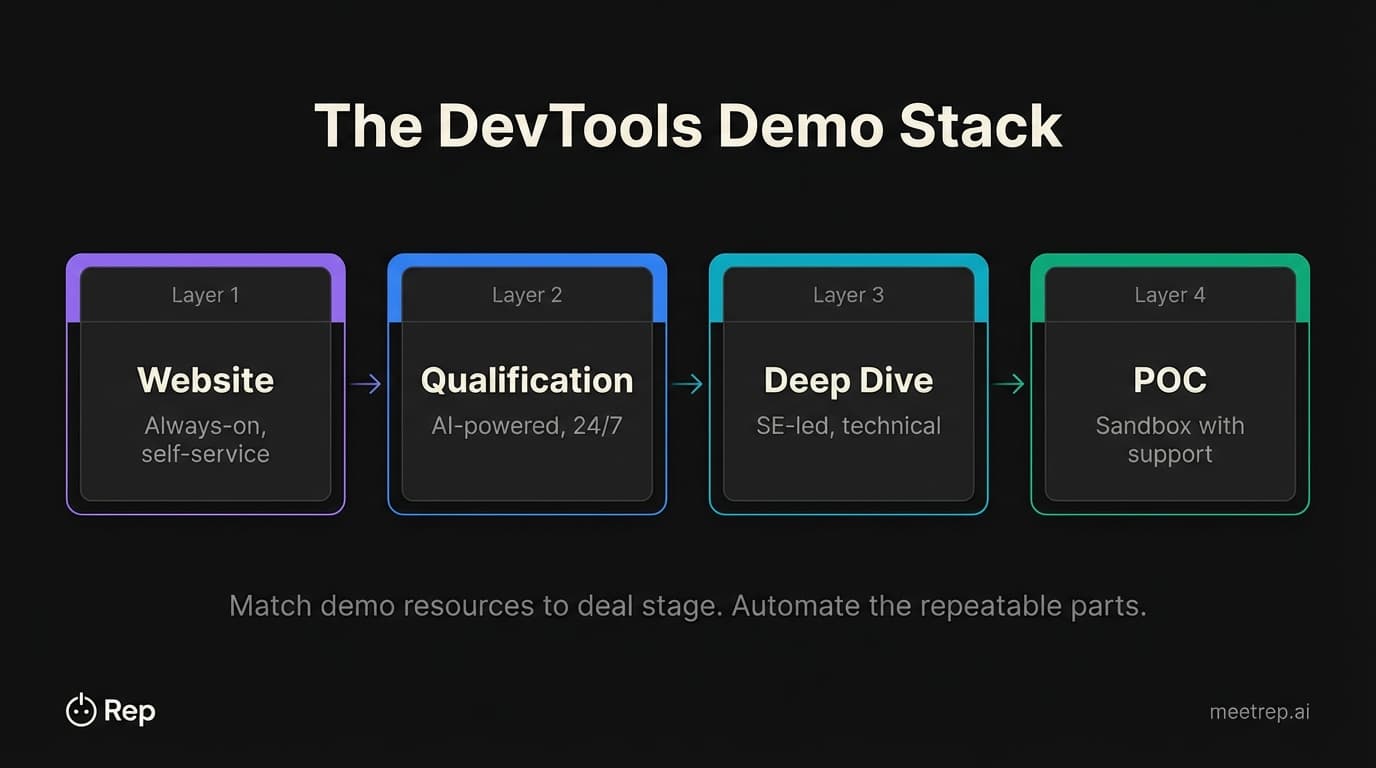
So how do you actually implement this? Here's my framework for running sales at a DevTools company today.
Layer 1: Website (always-on, self-service)
- Ungated interactive tour on your homepage
- Goal: Capture the 89% who will engage immediately
- Tools: Navattic, Arcade, Storylane
Layer 2: Initial qualification (semi-automated)
- Autonomous demo agent for inbound requests
- Goal: Answer technical questions 24/7, qualify before SE handoff
- Tools: Rep (or emerging competitors in this space)
Layer 3: Deep technical evaluation (human-led)
- SE-led architecture discussions and custom demos
- Goal: Win the technical decision-maker with nuanced expertise
- Tools: Your SEs, armed with insights from earlier layers
Layer 4: Proof of concept (self-service with support)
- Sandbox environment with real data
- Goal: Let serious buyers validate technical fit
- Tools: Demostack, TestBox, or custom-built
Not every DevTools company needs all four layers. Smaller teams might start with layers 1 and 3, adding automation as they scale. But the principle holds: match demo resources to deal stage, and automate the repeatable parts.
What we learned at GoCustomer.ai: Automation without authenticity backfires. We tried fully automated email sequences and saw response rates crater. The lesson applied to demos too: you can automate the mechanics, but the substance has to feel real. For DevTools, that means showing actual product behavior, not polished marketing.
The devtools demo problem isn't going away. Your buyers are technical, skeptical, and time-strapped. They want to see your product actually work—not a curated slideshow of what it might look like.
The companies that figure this out will have a structural advantage. While competitors burn SE time on intro calls, they'll be closing the deals that matter. We're building Rep because we believe autonomous demos are part of that future—AI agents that can navigate your product live, answer technical questions, and qualify prospects around the clock.
If you're tired of the demo bottleneck, see how Rep handles live product demonstrations. Or keep watching your SEs drown in tire-kickers. Your call.

Nadeem Azam
Founder
Software engineer & architect with 10+ years experience. Previously founded GoCustomer.ai.
Nadeem Azam is the Founder of Rep (meetrep.ai), building AI agents that give live product demos 24/7 for B2B sales teams. He writes about AI, sales automation, and the future of product demos.
Frequently Asked Questions
Table of Contents
- Why Developer Demos Are Different From Enterprise B2B
- The Four Types of Product Demos (And Which Actually Work for DevTools)
- What Makes Autonomous Demos Different From Click-Through Tours
- The SE Time Crisis (And Why It's Getting Worse)
- How to Demo API-First Products (When There's No UI to Screenshot)
- Attention Economics: Why Your 30-Minute Demo Wastes Everyone's Time
- The Agentic AI Shift: What Gartner's Predictions Mean for DevTools Sales
- Building Your Demo Stack: A Framework for VP Sales
Ready to automate your demos?
Join the Rep Council and be among the first to experience AI-powered demos.
Get Early AccessRelated Articles
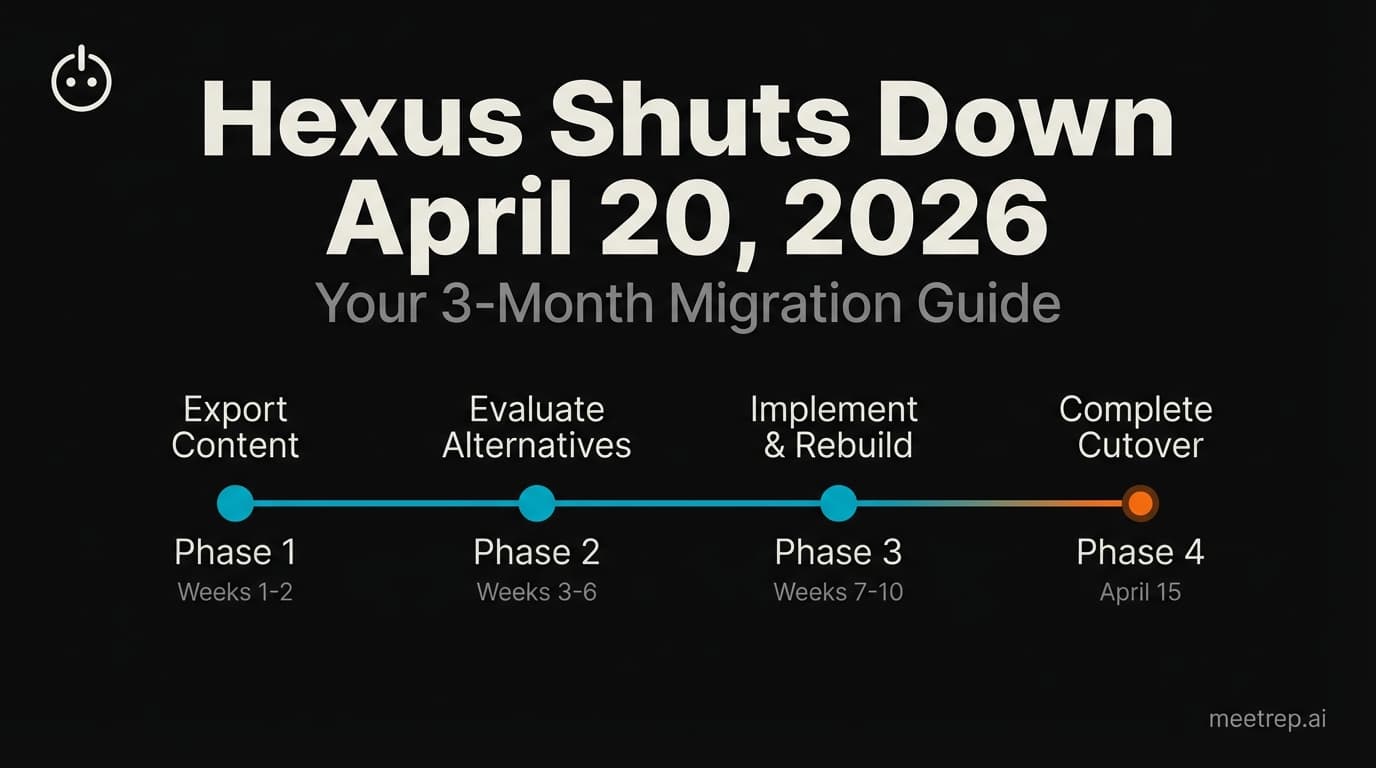
Hexus Acquired by Harvey AI: Congrats & What It Means for Demo Automation Teams
Hexus is shutting down following its acquisition by Harvey AI. Learn how to manage your migration and discover the best demo automation alternatives before April 2026.
Why the "Software Demo" is Broken—and Why AI Agents Are the Future
The traditional software demo is dead. Discover why 94% of B2B buyers rank vendors before calling sales and how AI agents are replacing manual demos to scale revenue.
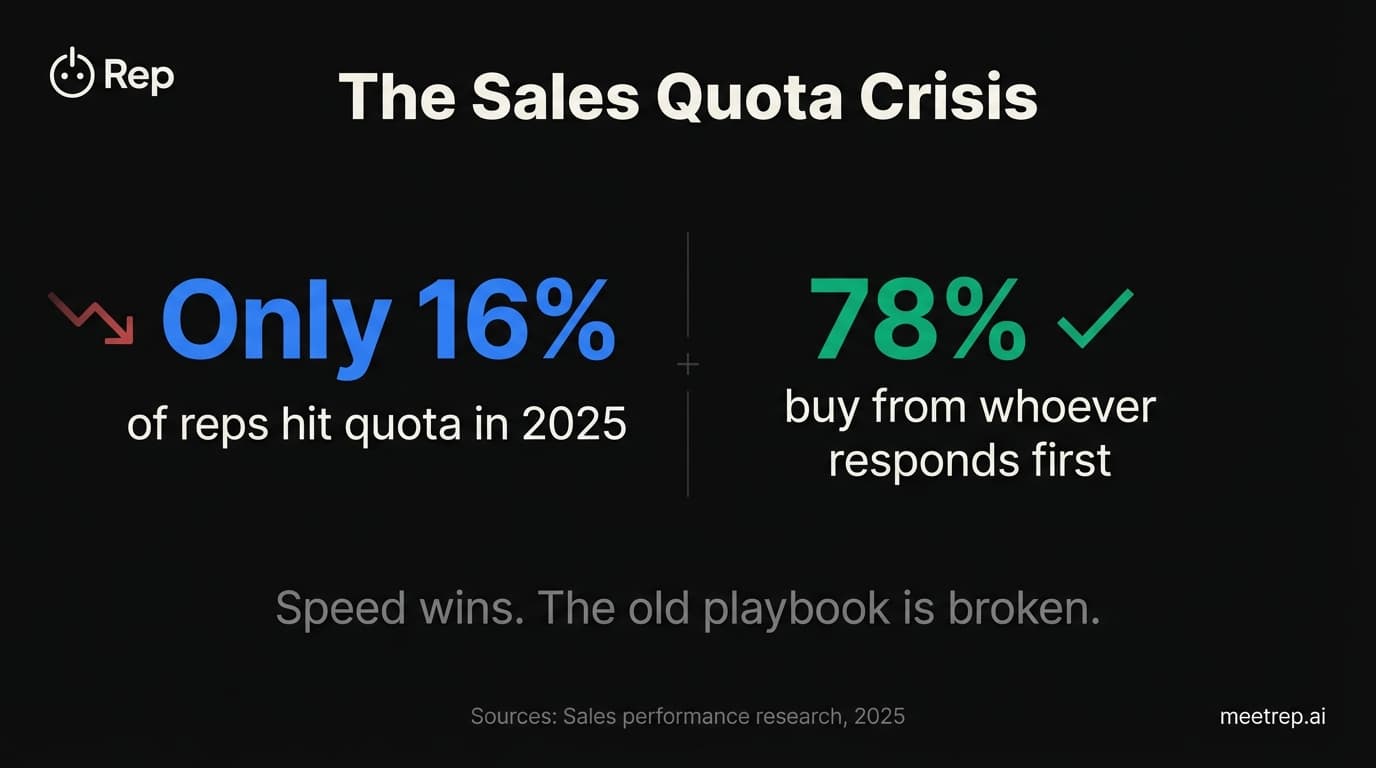
Why Autonomous Sales Software is the Future of B2B Sales (And Why the Old Playbook is Dead)
B2B sales is at a breaking point with quota attainment at 46%. Discover why autonomous 'Agentic AI' is the new standard for driving revenue and meeting the demand for rep-free buying.