Automated Sales Demos: The Complete Implementation Guide

Executive Summary
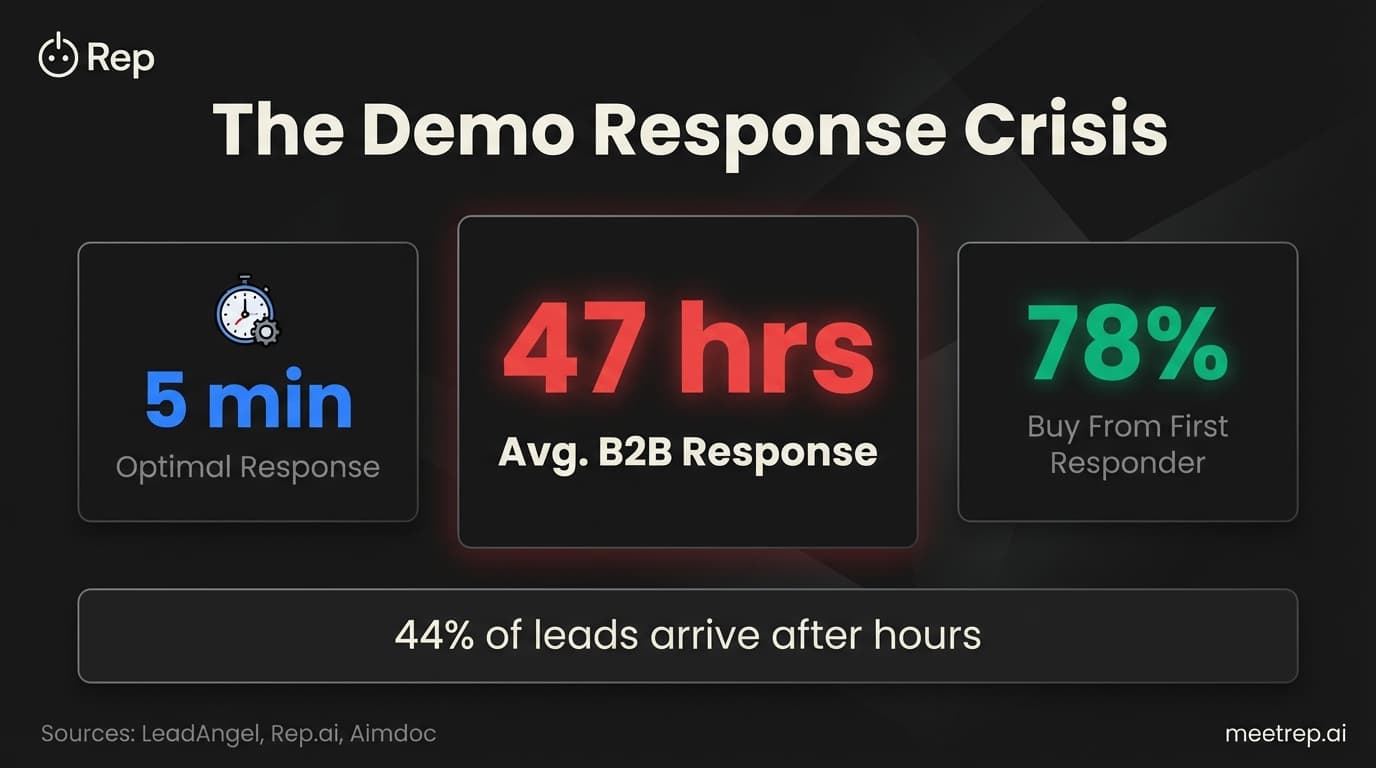
- 78% of buyers choose the vendor that responds first—speed wins deals
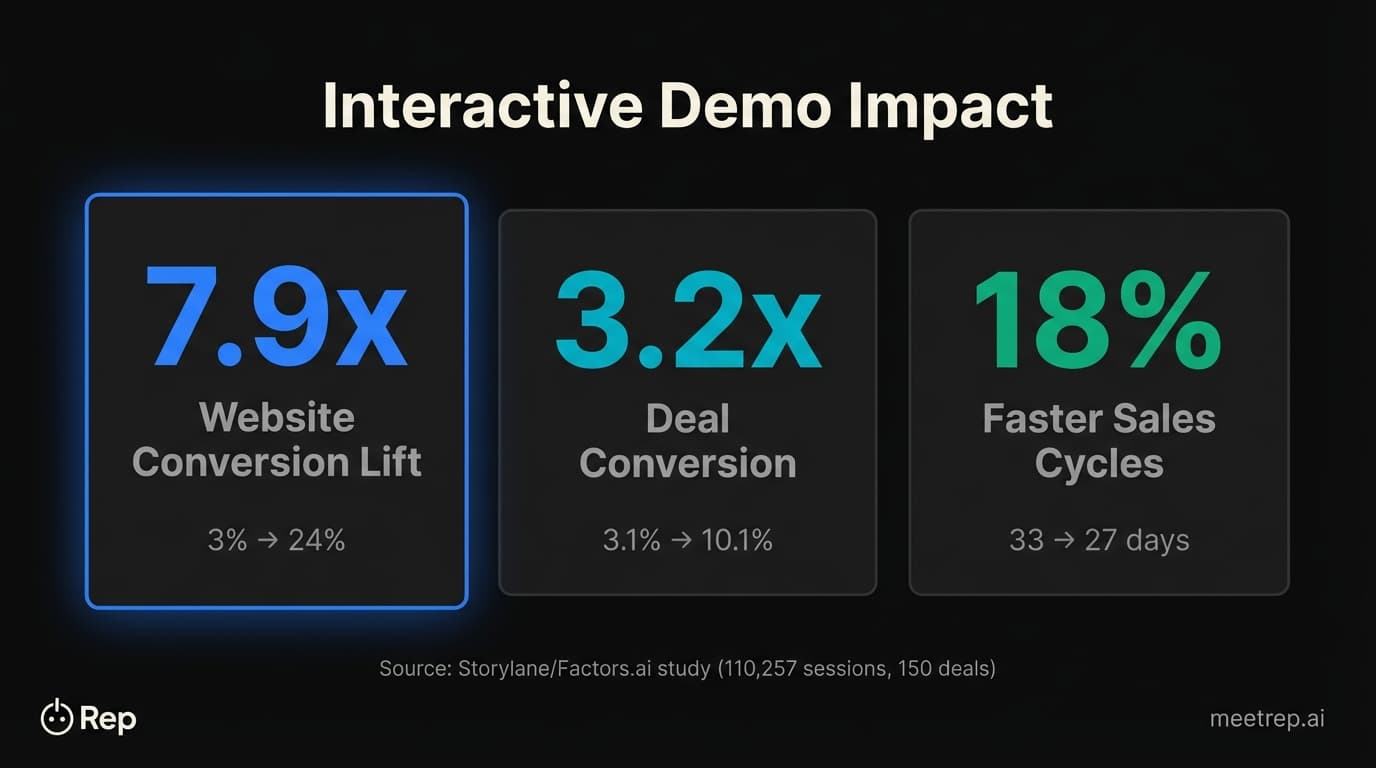
- Interactive demos lift website conversion 7.9x (from 3% to 24%)
- The real ROI isn't fewer reps—it's capturing the 44% of leads that arrive after hours
- Implementation takes 30-90 days depending on complexity, but start with one use case
- Agentic AI (live browser navigation) is replacing static click-through tours
Your sales team is losing deals right now. Not because your product is worse. Not because your pricing is off. But because while your reps sleep, your competitors respond.
Here's what's actually happening: 44% of your leads arrive outside business hours. And the average B2B company takes 47 hours to respond to a demo request. By then? The prospect has already seen three competitor demos.
I've spent years building sales automation tools—first at GoCustomer.ai, now at Rep. And I can tell you the gap between companies that implement automated sales demos well and those that fail comes down to understanding one thing: this isn't about replacing your sales team. It's about making sure a qualified prospect never waits for a human to wake up.
What Are Automated Sales Demos, Really?
Automated sales demos are interactive product experiences that let prospects explore your software without a live sales rep. But that definition hides a massive range of what "automated" actually means.
At the basic end, you have click-through tours—screenshots strung together with tooltips. Fine for awareness. Terrible for qualification.
At the advanced end, you have Agentic AI—systems that navigate your actual product live, answer questions in real-time, and handle objections through voice conversation. These aren't slideshows. They're AI reps.
Gartner's 2025 Market Guide breaks demo automation into four categories:
| Category | Examples | Best For |
|---|---|---|
| Video-Based | Consensus, Loom | Async buying committee enablement |
| Screen Capture | Navattic, Storylane, Arcade | TOFU website embeds, self-guided exploration |
| Front-End Cloning | Demostack, Saleo | Complex enterprise demos with simulated data |
| Live Product + Simulated Data | Reprise, TestBox | Technical evaluation, sandbox POCs |
What Gartner's guide doesn't fully capture yet: a fifth category is emerging. AI voice agents that join video calls, share their screen, and walk through your actual product live. Not pre-recorded. Not click-through. Live.
Key Insight: The difference between static demos and Agentic AI is like the difference between a brochure and a conversation. One informs. The other qualifies.
By 2028, 60% of brands will use Agentic AI for one-to-one interactions. That's not a prediction from some random analyst. That's Gartner, January 2026.
Why Buyers Prefer Self-Serve (And What That Means for You)
Here's a number that should change how you think about your sales motion: 61% of B2B buyers now prefer rep-free buying experiences.
Let that sink in. The majority of your prospects don't want to talk to your sales team. At least not initially.
But it gets more interesting. According to 6sense's 2025 Buyer Experience Report, the point of first contact with sales shifted from 69% of the buyer journey in 2024 to 61% in 2025. Buyers are reaching out earlier—but primarily to validate AI capabilities and pricing. They've already done their research.
And here's the kicker: 80% of deals are still won by the vendor selected before this contact occurs.
So what does this mean for your team?
If you're not in the buyer's shortlist before they request a demo, you've probably already lost. G2's 2024 Buyer Behavior Report found that 49% of B2B buyers have only 1-3 products on their shortlist—up from 33% in 2023. The consideration set is shrinking.
The Data: Buyers now average just 2.5 vendor engagements before purchase, down 22% from 3.2 previously. If you're not one of those 2.5 vendors, you're not in the running.
Automated demos solve this by letting prospects experience your product the moment they're interested. No scheduling. No waiting. No friction.
The Speed-to-Lead Crisis That's Killing Your Pipeline
I need to be blunt here. The data on response time is brutal.
78% of customers buy from the company that responds first. Not the company with the best product. Not the best price. The fastest response.
And responding within 5 minutes makes you 21x more likely to qualify a lead compared to waiting 30 minutes. Twenty-one times. Not 21%. Twenty-one times.
Now here's the problem: the average B2B lead response time is 47 hours.
That's not a typo. Two full days.
So you've got a prospect who just requested a demo. They're interested. They're ready. And your system says "Thanks! Someone will reach out within 24-48 hours."
By then, they've seen two competitor demos, downloaded three comparison guides, and probably already have a favorite.
What we learned at GoCustomer: When we tracked our own inbound demo requests, we found 40% came between 6pm and 9am. Our response time for those leads? Over 14 hours on average. We were losing deals in our sleep—literally.
But wait, it gets worse. Even when demos do get scheduled, 23% of prospects no-show when the demo is booked 8+ days out. The baseline no-show rate is 6.5%, which is annoying. But stretch that scheduling window and you're looking at nearly one in four prospects ghosting.
Sound familiar?
Automated sales demos fix this. Prospect clicks link. Demo starts. No scheduling. No waiting. No no-shows on automated demos—because there's nothing to no-show to.
The Five Types of Demo Automation (And When to Use Each)
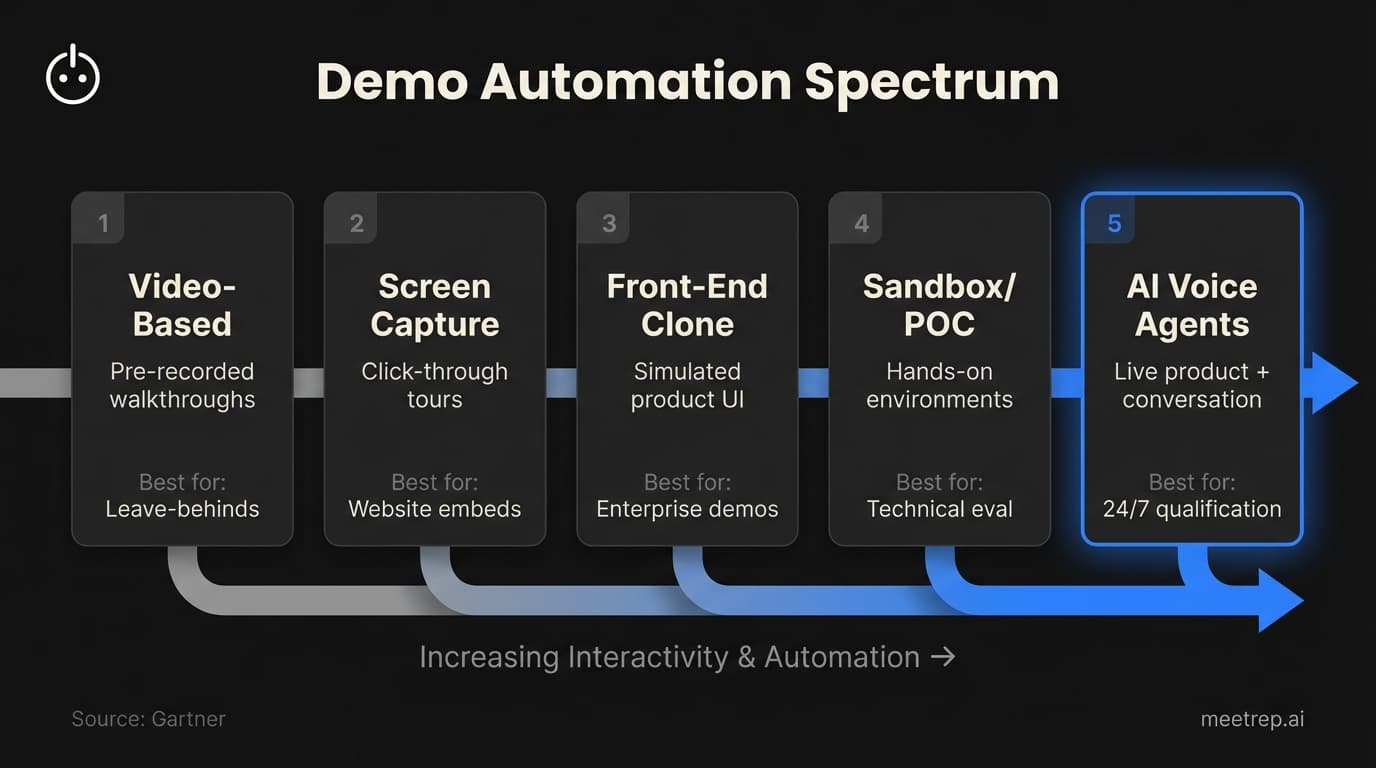
Not all demo automation is created equal. Here's how to match the right type to your use case:
1. Video-Based Demos (Consensus, Loom, Sendspark)
Pre-recorded product walkthroughs. Good for buying committee enablement—when your champion needs to share something internally. Not great for qualification or real-time engagement.
Best for: Leave-behinds, internal champion selling, async communication across time zones.
2. Screen Capture Tours (Navattic, Storylane, Arcade, Supademo)
Screenshots with guided overlays and hotspots. Prospects click through at their own pace.
According to Arcade's benchmark data, the top 1% of interactive demos achieve 67% click-through rates vs. 8% median. And adding an intro chapter increases play rate by 72%.
Best for: Website embeds, TOFU qualification, product awareness.
3. Front-End Cloning (Demostack, Saleo)
Your product's interface with simulated data. Looks and feels real without touching production.
Hunters achieved a 50% reduction in sales cycle—from 9 months to 4 months—using Demostack's sandbox environments.
Best for: Complex enterprise demos, multiple product lines, data-sensitive environments.
4. Sandbox/POC Platforms (Reprise, TestBox, CloudShare)
Actual product environments for hands-on testing. Technical buyers can explore features without SE involvement.
Best for: BOFU technical evaluation, proof of concept, competitive bakeoffs.
5. AI Voice Agents (Rep, Sierra)
This is the emerging category. AI joins the actual video call, shares screen, navigates your live product, and has a real conversation with the prospect.
Brex uses Sierra's agents to handle 90% of queries without humans, saving 15,000 hours annually. And that's customer support—imagine the impact on sales demos where the stakes are even higher.
Best for: 24/7 live interaction, after-hours coverage, high-volume inbound, qualification.
My recommendation: Most companies need a layered approach. Screen capture tours on your website for awareness. AI voice agents for instant demo requests. Sandbox environments for technical evaluation. Match the tool to the funnel stage.
The Real ROI: What to Expect and How to Measure It
Let's talk numbers. And I mean real numbers—not vendor marketing math.
Storylane's study with Factors.ai analyzed 110,257 web sessions and 150 deals. Here's what they found:
| Metric | Without Interactive Demo | With Interactive Demo | Lift |
|---|---|---|---|
| Website Conversion | 3.05% | 24.35% | 7.9x |
| Deal Conversion | 3.1% | 10.1% | 3.2x |
| Sales Cycle Length | 33 days | 27 days | 18% faster |
That 7.9x website conversion lift is staggering. But I'd argue the sales cycle reduction matters more for enterprise deals. Six fewer days per deal adds up fast.
And here's a stat that hits close to home for anyone managing an SE team: 30% of demos are delivered to unqualified prospects. Nearly a quarter of SEs report that more than half their weekly demos go to buyers who were never going to close.
That's not a demo problem. That's a qualification problem. And automated demos solve it by letting tire-kickers self-serve while your humans focus on deals that actually matter.
The Data:Gainsight saw an 8% increase in close-win rates after implementing Demostack-powered demos. Their demo response time dropped from 48 hours to under 1 hour.
But here's my honest take: the biggest ROI isn't in the metrics that vendors show you. It's in the leads you're currently missing entirely.
44% of leads arrive after hours. If you're not responding to those immediately—automatically—you're losing nearly half your potential pipeline. Not to bad demos. To no demos.
Implementation Roadmap: The 30/60/90 Day Framework
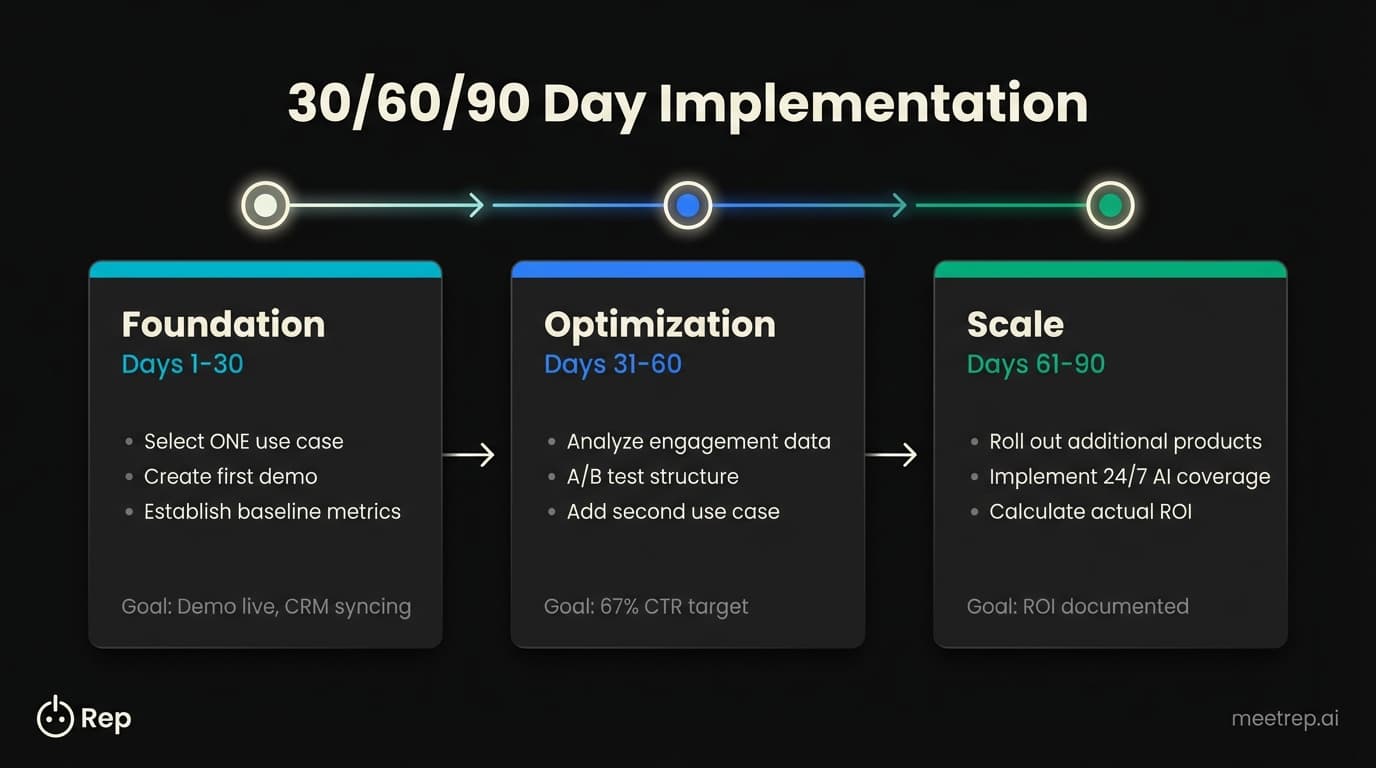
I've seen too many companies buy demo automation tools that become shelfware. Here's how to avoid that.
Days 1-30: Foundation (Start Small)
The mistake most teams make? Trying to automate everything at once. Don't.
Pick ONE use case. I'd recommend starting with website embed demos for your highest-traffic product page. Measure engagement. Prove the concept works before expanding.
Week 1-2:
- Select your platform based on primary use case (not feature lists)
- Identify your most-requested demo flow
- Create your first demo (target: under 2 minutes for tours, focused on top 3 features)
Week 3-4: 4. Embed on one high-traffic page 5. Set up CRM integration 6. Establish baseline metrics: current page conversion, demo request volume, response time
Success criteria: Demo published, CRM syncing, baseline metrics documented.
Days 31-60: Optimization
Now you have data. Use it.
Week 5-6:
- Analyze engagement (where do prospects drop off?)
- A/B test demo structure (Arcade found intro chapters boost engagement 72%)
- Add second use case (email sequences, outbound cadences)
Week 7-8: 4. Train team on demo analytics 5. Create playbooks for different personas 6. Set up lead scoring based on demo engagement
Success criteria: 67% CTR benchmark targeted (top 1% of Arcade demos), team actively using analytics.
What we learned at GoCustomer: Our first implementation took 6 weeks longer than planned because we tried to automate 12 demo variants at once. When we relaunched with a single, focused demo, we hit our engagement targets in 3 weeks.
Days 61-90: Scale
With proof points in hand, expand.
Week 9-10:
- Roll out across additional product lines
- Implement 24/7 AI agent coverage for inbound requests
- Build demo library organized by use case
Week 11-12: 4. Connect demo engagement to pipeline reporting 5. Calculate actual ROI vs. baseline 6. Present results to leadership with expansion plan
Success criteria: Pipeline influence measured, ROI documented, expansion approved.
Selecting the Right Platform for Your Team
Here's a decision framework based on company size and GTM motion:
By Company Size:
| Size | Recommended Approach | Budget Range |
|---|---|---|
| SMB (<100) | Screen capture tours (Navattic, Arcade) | $200-500/mo |
| Mid-Market (100-1,000) | Tours + one sandbox tool | $500-2,000/mo |
| Enterprise (1,000+) | Full stack: tours + environments + AI agents | $2,000-10,000+/mo |
By GTM Motion:
- Product-Led Growth: Screen capture tours on website, self-serve everywhere. Target that 7.9x conversion lift.
- Sales-Led: AI agents + live environments. Focus on speed-to-lead and SE leverage.
- Hybrid: Layered approach. Tours for awareness, AI for qualification, humans for closing.
Key Insight:57% of buyers expect ROI within 3 months. If your implementation timeline is longer than that, you're setting yourself up for internal pressure. Start small, prove value fast.
Overcoming the Fear Factor: Adoption and AI Risk
I'd be lying if I said this stuff just works. There are real risks.
Risk 1: AI Hallucination
This is the big one. 11x.ai faced significant backlash when their AI agents sent inaccurate information to prospects. Gartner even predicts 40% of agentic AI projects will be canceled by 2027 due to unclear value or risk management failures.
The solution? Guardrails. Deterministic workflows for critical information. Human review gates for edge cases. Don't let AI improvise on pricing or legal claims.
Risk 2: Sales Team Resistance
According to Monday.com research, sales teams showed the lowest AI adoption rate at just 51%—lower than any other department.
This isn't irrational. Reps worry about job security. And frankly, some AI tools have been overhyped and underdelivered.
The reframe that works: automation handles the 44% of leads that arrive when you're asleep. It handles the 30% of demos that go to unqualified buyers. It doesn't replace your best reps—it gives them better leads.
Risk 3: Becoming Shelfware
Every VP of Sales has tools they bought and never used.
Prevention: Start with one use case. Assign an owner. Track weekly. If you're not seeing engagement in 30 days, something's wrong with implementation—not the category.
The window for competitive advantage in demo automation is closing. Right now, only 31% of top B2B SaaS companies use interactive demos. That means 69% don't. Early adopters are capturing market share while competitors wait.
But by 2028, when 60% of brands use Agentic AI, this won't be a differentiator anymore. It'll be table stakes.
My honest take after building in this space for years: the companies that win aren't necessarily the ones with the best demo automation technology. They're the ones that implement it well, measure results, and actually use the data to improve. Start with one use case. Prove it works. Then scale.
If you want to see what live AI demos look like in practice, Rep shows you exactly how an AI voice agent can navigate your product, answer questions, and qualify prospects 24/7. No slideshows. No pre-recorded videos. Just your product, demoed live, whenever your prospect is ready.

Nadeem Azam
Founder
Software engineer & architect with 10+ years experience. Previously founded GoCustomer.ai.
Nadeem Azam is the Founder of Rep (meetrep.ai), building AI agents that give live product demos 24/7 for B2B sales teams. He writes about AI, sales automation, and the future of product demos.
Frequently Asked Questions
Table of Contents
- What Are Automated Sales Demos, Really?
- Why Buyers Prefer Self-Serve (And What That Means for You)
- The Speed-to-Lead Crisis That's Killing Your Pipeline
- The Five Types of Demo Automation (And When to Use Each)
- The Real ROI: What to Expect and How to Measure It
- Implementation Roadmap: The 30/60/90 Day Framework
- Selecting the Right Platform for Your Team
- Overcoming the Fear Factor: Adoption and AI Risk
Ready to automate your demos?
Join the Rep Council and be among the first to experience AI-powered demos.
Get Early AccessRelated Articles
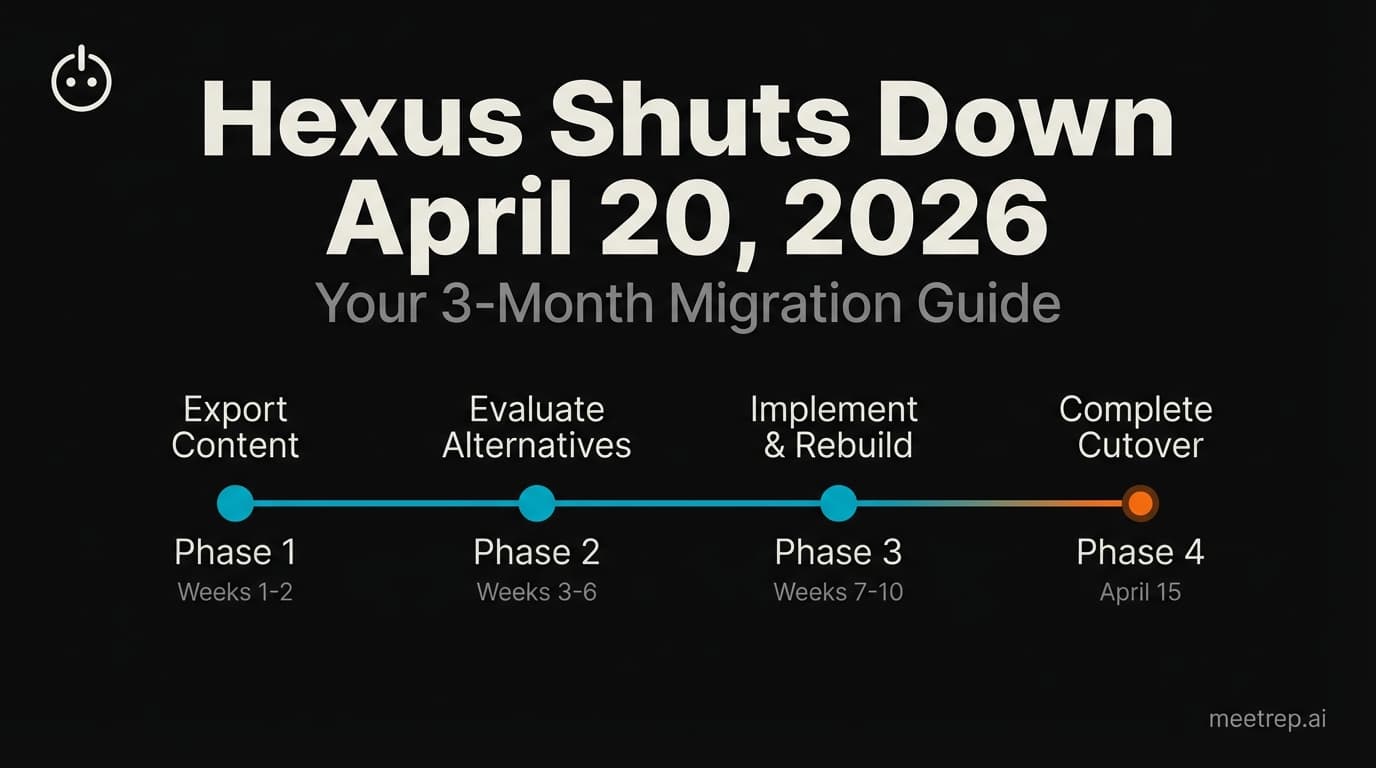
Hexus Acquired by Harvey AI: Congrats & What It Means for Demo Automation Teams
Hexus is shutting down following its acquisition by Harvey AI. Learn how to manage your migration and discover the best demo automation alternatives before April 2026.
Why the "Software Demo" is Broken—and Why AI Agents Are the Future
The traditional software demo is dead. Discover why 94% of B2B buyers rank vendors before calling sales and how AI agents are replacing manual demos to scale revenue.
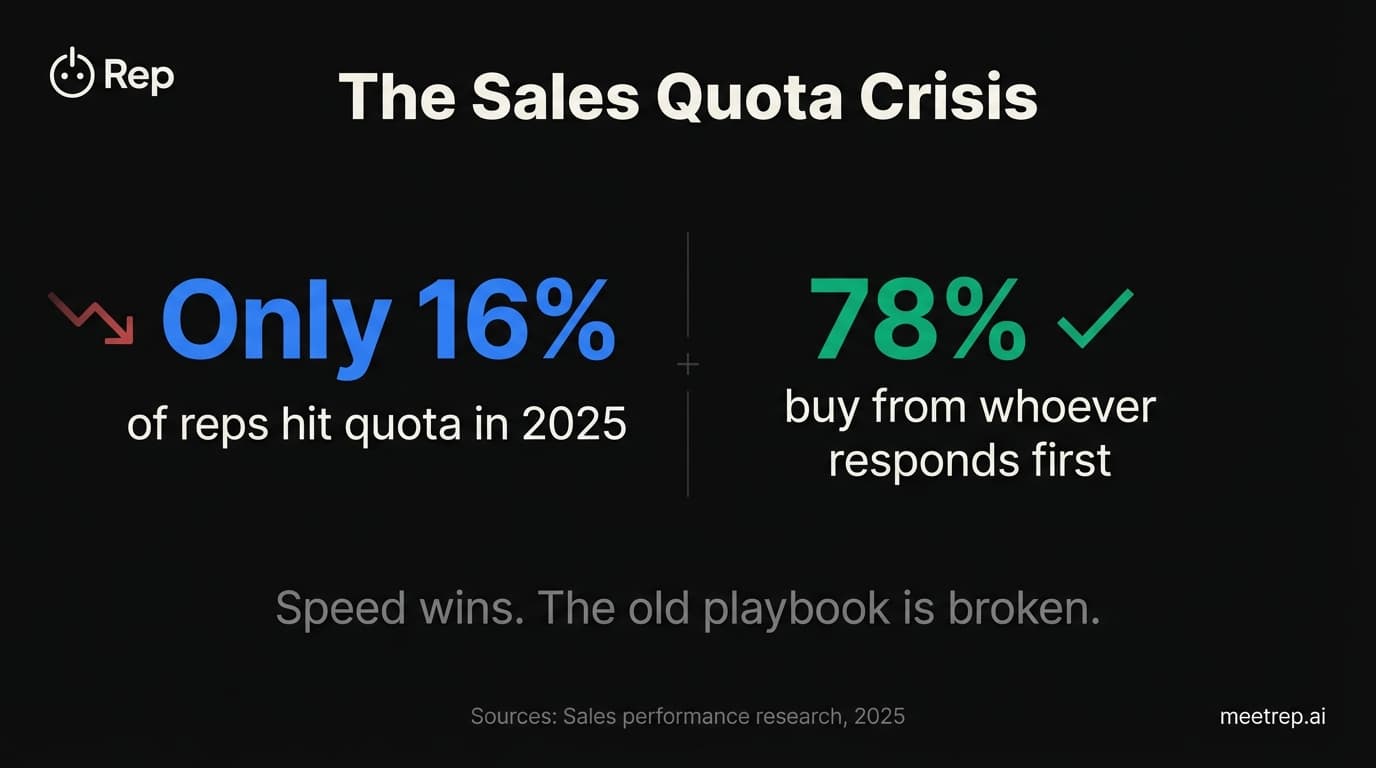
Why Autonomous Sales Software is the Future of B2B Sales (And Why the Old Playbook is Dead)
B2B sales is at a breaking point with quota attainment at 46%. Discover why autonomous 'Agentic AI' is the new standard for driving revenue and meeting the demand for rep-free buying.