AI SDR vs Human SDR: The Complete Comparison for 2026

Executive Summary
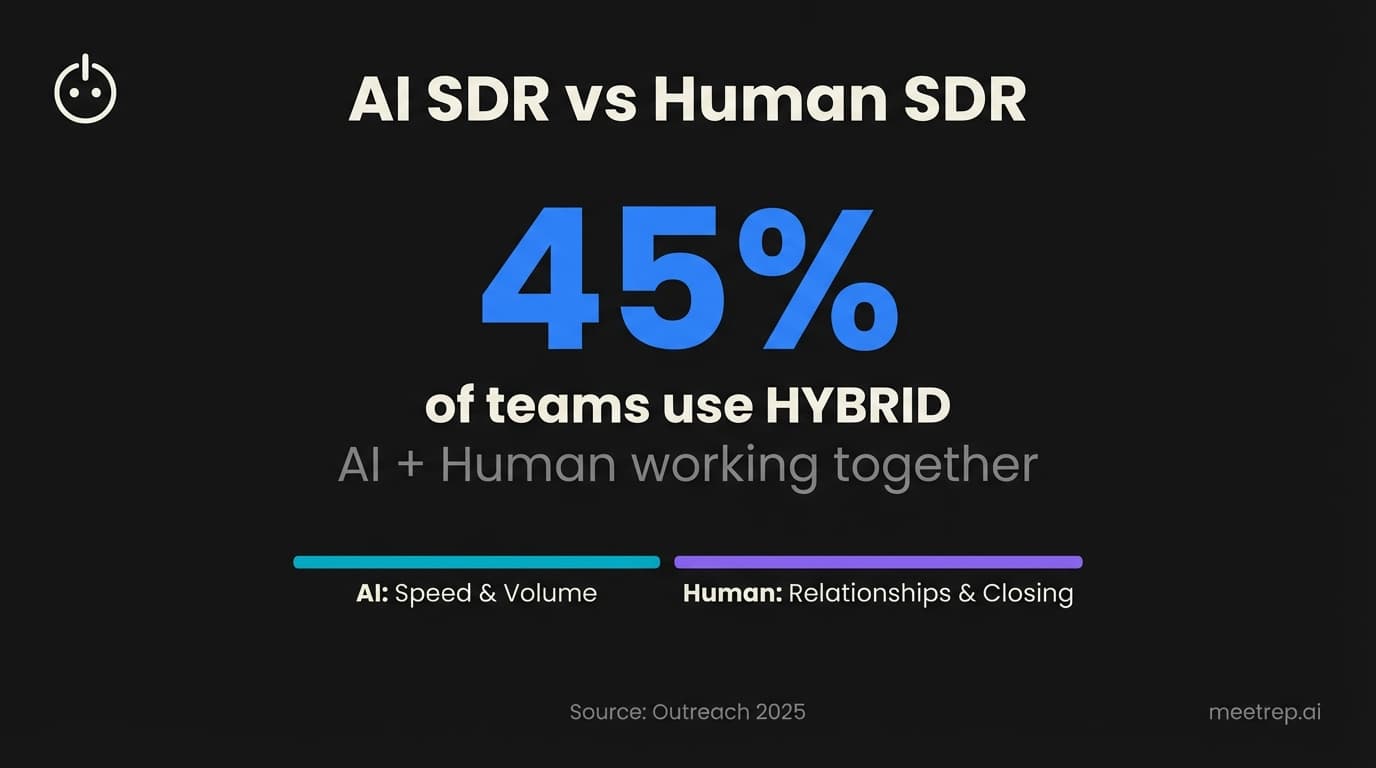
- 45% of teams now use a hybrid model (AI + Human)—not full replacement
- AI SDRs cost ~83% less than humans (~$500/mo vs ~$6,000/mo fully loaded)
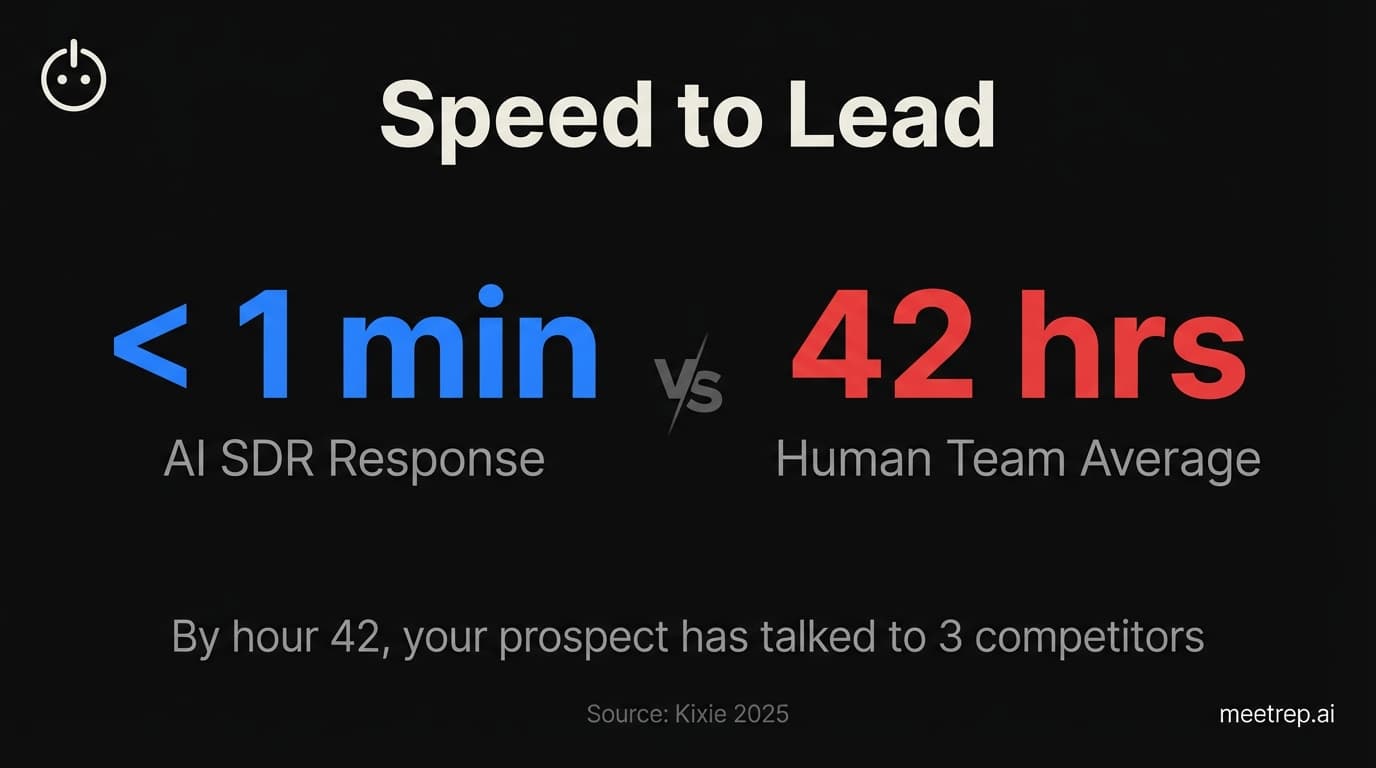
- AI responds in under 1 minute vs. 42 hours for human teams
- But only 47% of AI investments see positive ROI—implementation matters
- The winning formula: AI for speed and volume, humans for relationships and closing
Here's a number that should make you uncomfortable: 36% of B2B companies cut their SDR headcount in 2025—the highest reduction among all sales roles. That's not a prediction. That already happened.
And this guide cuts through the vendor hype to give you the data you need to make the right call for your team. But here's what the AI SDR vendors won't tell you: only 47% of companies achieve positive ROI from AI investments. So while some teams are scaling with AI SDRs, others are burning cash on tools that don't deliver.
I've built sales automation tools at GoCustomer.ai and now at Rep, where we're building AI agents that handle live product demos. I've seen what works. I've seen what fails spectacularly.
What Is an AI SDR and How Does It Actually Work?
An AI SDR is software that automates sales development tasks—prospecting, outreach, lead qualification, and meeting scheduling—that human reps traditionally perform. Unlike basic email automation, modern AI SDRs can generate contextual messages, respond to replies, handle voice conversations, and even conduct live product demos. They operate 24/7, contacting 1,000+ prospects daily compared to 30-50 for human reps.
The technology has evolved fast. Early AI SDRs were glorified mail merge tools. Today's "agentic" AI SDRs do things that seemed impossible two years ago:
- Instant lead response: Engaging inbound leads in under 1 minute via voice or chat
- Autonomous prospecting: Researching and emailing thousands of contacts using AI-powered databases
- Live product demos: Navigating software interfaces and explaining features in real-time
- Technical qualification: Answering complex product questions using knowledge bases (87% accuracy for AI vs. 15% for human SDRs who punt to other team members)
- CRM hygiene: Automatically updating records and logging call outcomes
- Multi-channel coordination: Email, LinkedIn, SMS, and voice campaigns working together
Key Insight: The shift isn't just about email automation anymore. The real disruption is AI agents that can hold conversations, answer technical questions, and show your product live—tasks we assumed required humans until very recently.
At Rep, we've focused specifically on that demo capability. But the broader point stands: AI SDRs have moved far beyond "send more emails faster."
The Real Cost Comparison: AI SDR vs Human SDR
Let's talk money. This is where the math gets interesting.
A fully loaded human SDR costs $90,000-$160,000 per year when you factor in salary, benefits, tools, management overhead, and the space they occupy. That's roughly $6,000-$7,500 per month.
An AI SDR platform typically runs $500-$3,000 per month. Even at the high end, you're looking at $36,000 annually. That's an 83% cost reduction.
But wait. The real cost story is worse for human teams.
| Cost Factor | Human SDR | AI SDR |
|---|---|---|
| Annual compensation (fully loaded) | $90,000-$160,000 | $6,000-$36,000 |
| Ramp time | 3.1-3.2 months | Instant (60-90 day optimization) |
| Average tenure | 14-18 months | N/A (no turnover) |
| Replacement cost | $97,690 per departure | $0 |
| Annual turnover rate | 34% | 0% |
And that's before you factor in the productivity gap during ramp time. You lose 3+ months of output every time you hire. With 34% annual turnover, you're basically replacing your entire SDR team every 18 months.
The Data: When you account for turnover, ramp time, and replacement costs, maintaining a human-only SDR team costs roughly 6X more per lead generated than an AI-augmented model. Source: SalesHive 2025, Bridge Group 2024
I'm not saying fire your SDR team. I am saying the economics have shifted dramatically.
What AI SDRs Can Actually Do in 2026
Let's be specific about capabilities. No vague "AI-powered" nonsense.
Speed: AI SDRs respond to inbound leads in under 1 minute. The average human team takes 42 hours. That's not a typo. Forty-two hours. By then, your prospect has already talked to three competitors.
Volume: AI handles 1,000+ contacts per day. Humans manage 30-50. At SaaStr, their AI agents send 3,000 emails per month compared to 75-285 from human SDRs.
Consistency: AI follows your playbook 100% of the time. No bad days. No forgetting to log notes. No skipping follow-ups because they're tired.
Technical depth: Here's the one that surprised me. AI SDRs answer 87% of technical questions immediately. Human SDRs? Just 15%. The other 73% get punted to someone else. This makes sense when you think about it—AI can access your entire knowledge base instantly. Humans have to remember or look things up.
24/7 availability: Prospects research at 2am. AI is there. Humans aren't.
But here's what AI still struggles with:
- Tricky objections requiring empathy: "We tried this before and failed"
- Complex multi-stakeholder navigation: "I like it but my CFO won't approve"
- Creative problem-solving: Unique situations that don't match the playbook
- Real relationship building: The kind that happens over months, not minutes
What we learned building GoCustomer: AI amplifies your existing process. If your messaging works, AI scales it beautifully. If your messaging is broken, AI scales that too—just faster. You can't automate your way out of a bad value proposition.
The Performance Data: What Actually Happens
Vendor claims are one thing. Independent research is another. Honestly, the gap between what's promised and what's delivered can be huge.
The wins are real, but not universal:
SaaStr deployed AI SDRs for 6 months and closed $1M+ in revenue within 90 days from inbound AI. Their outbound response rate hit 6.7%—double the industry average. But they also invested $200-300K across multiple platforms and dedicated 15-20 hours per week to oversight for just 5 AI agents.
Greenhouse saw 50-70% chat-to-meeting conversion with AI versus 20% for humans. That's a 2-3X improvement.
Sendoso hit 20% reply rates compared to the industry average of 1-2%.
But the failures are real too:
One G2 reviewer spent $20,000 over six months and closed just two deals worth $10,000 total. Negative ROI.
Dashly documented their $35,000, 6-week failure. Their AI bot interrupted natural conversation flow, causing prospect drop-offs.
11x reportedly saw 70-80% customer churn within months due to hallucinations and unrealistic expectations.
Common mistake: "Set and forget" implementations fail almost universally. Jason Lemkin from SaaStr puts it bluntly: "The myth: Buy an AI SDR for $50-100K, it magically generates leads. The reality: AI SDRs scale what's already working. They can't create something from nothing."
So what separates the wins from the losses?
The AI SDR vs Human SDR Comparison Table
Here's the comprehensive breakdown. Every number is sourced.
| Dimension | AI SDR | Human SDR | Source |
|---|---|---|---|
| Availability | 24/7/365 | 40 hours/week | Industry standard |
| Response time | < 1 minute | ~42 hours (avg) | Kixie 2025 |
| Cost (annual) | $6,000-$36,000 | $90,000-$160,000 fully loaded | Cubeo 2026, SalesHive 2025 |
| Volume capacity | 1,000+ contacts/day | 30-50 contacts/day | Industry benchmarks |
| Technical questions answered immediately | 87% | 15% | SaaStr 2025 |
| Consistency | 100% playbook adherence | Variable (mood, fatigue, skill) | Industry analysis |
| Ramp time | Instant (60-90 day optimization) | 3.2 months average | Bridge Group 2024 |
| Turnover | 0% | 34% annual | SalesSo 2025 |
| Meeting-to-opportunity rate | ~15% | ~25% | Industry benchmarks |
| Emotional intelligence | Limited | High | Industry analysis |
| Complex objection handling | Struggles | Excels | Industry analysis |
| Relationship building | Surface-level | Deep, long-term | Industry analysis |
Notice something? AI wins on speed, cost, volume, and consistency. Humans win on quality, relationships, and complex situations.
That's not a flaw in either approach. It's the blueprint for how they should work together.
The Hybrid Model: Why 45% of Teams Chose "Both"
Here's the data point that matters most: 45% of sales teams now use a hybrid approach—AI and human working together. Only 22% have gone fully AI. And 23% still use no AI at all.
The hybrid teams are getting it right.
Think about it this way. You wouldn't have your senior AE do data entry. And you wouldn't have your intern negotiate a $500K deal. Different tasks require different capabilities.
What AI should own:
- Instant response to inbound leads (speed advantage)
- Initial qualification (volume advantage)
- Technical FAQ handling (knowledge base advantage)
- After-hours engagement (availability advantage)
- First-touch product demos (consistency advantage)
What humans should own:
- High-value target accounts (relationship advantage)
- Complex multi-stakeholder deals (navigation advantage)
- Tricky objection handling (empathy advantage)
- Closing and negotiation (judgment advantage)
- Strategic account planning (creativity advantage)
Jason Lemkin describes it perfectly: "The agents are better than a mid-pack AE or SDR or BDR. They're not better than your best performers. But that middle tier? They can't compete."
At Rep, this is exactly how we've designed our AI demo agents. They handle the initial product demo—showing features, answering technical questions, navigating the interface live. Then they hand off to humans for the deeper discovery and closing conversation. AI handles the repetitive volume. Humans handle the relationships that close deals.
My recommendation: Start hybrid. Let AI prove itself on specific use cases before expanding. SaaStr runs 5 different AI SDR platforms for different functions—Artisan for outbound, Qualified for inbound, Agentforce for follow-up. No single platform does everything well yet.
When AI SDRs Fail: The Patterns No One Talks About
I've already mentioned the failures. Let me break down why they happen.
Pattern 1: Deploying AI to fix broken processes
AI scales your existing approach. If your messaging doesn't work with human SDRs, it won't work with AI SDRs. It'll just fail faster and at higher volume.
Before you deploy any AI SDR tool, you need: proven messaging that converts, clean CRM data, and a defined ICP. If you don't have these, fix them first.
Pattern 2: Unrealistic timeline expectations
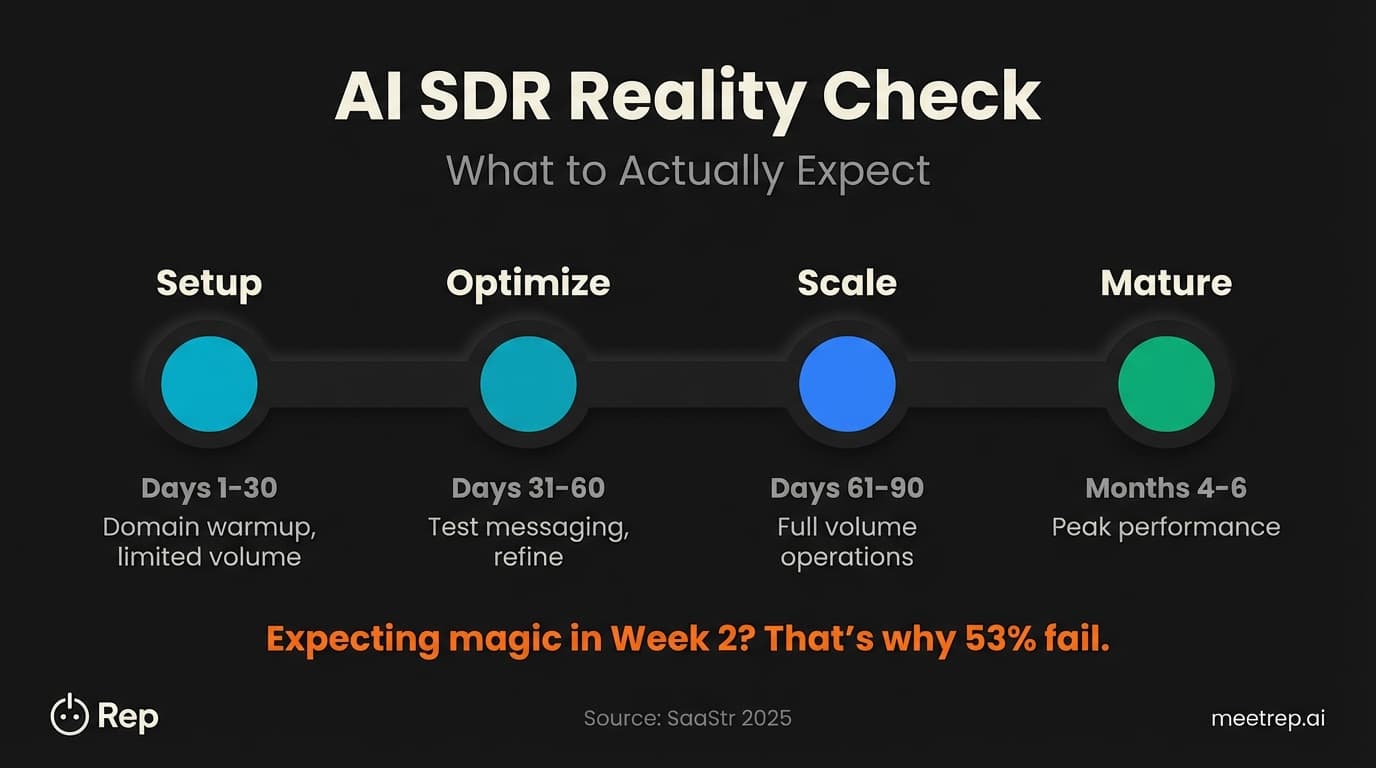
Most failures happen because teams expect results in weeks. The reality:
- Days 1-30: Setup and domain warmup (limited volume)
- Days 31-60: Optimization period (testing messaging)
- Days 61-90: Scaled operations (full volume)
- Months 4-6: Mature performance
SaaStr took 6 months to reach mature performance. If you're expecting magic in week two, you'll be disappointed.
Pattern 3: "Set and forget" deployment
SaaStr dedicates 15-20 hours per week to monitoring and optimizing 5 AI agents. That's 3-4 hours per agent per week.
The AI doesn't run itself. Someone needs to review output quality, catch hallucinations before they damage your brand, adjust messaging based on results, and handle escalations.
Pattern 4: Wrong use case selection
AI SDRs work best for:
- High-volume, lower-complexity outreach
- Technical products where FAQ handling matters
- Companies with proven, repeatable messaging
- Markets where speed-to-lead is critical
They struggle with:
- Enterprise deals requiring deep relationships
- Industries where human touch is expected (luxury, high-end services)
- Companies still figuring out their ICP
- Products requiring heavy customization
How to Evaluate AI SDR Tools
If you're evaluating AI SDR platforms, here's what actually matters.
Must-have features:
- Multi-channel outreach (email + LinkedIn minimum)
- Native CRM integration (not just Zapier workarounds)
- Domain warmup protocols (critical for deliverability)
- Human-in-the-loop escalation (for when AI gets stuck)
- Real analytics (not just "emails sent" vanity metrics)
Red flags:
- "Fully autonomous" claims without oversight features
- No domain warmup guidance
- Vague "AI-powered" descriptions without specifics
- Lock-in contracts without trial periods
- Unable to show you actual customer examples with metrics
Price benchmarks:
- Entry tier: $500-$900/month (AiSDR at $900/mo, Salesforge at $499/mo)
- Mid tier: $1,500-$3,000/month
- Enterprise: $43,500/year average (11x)
For live demo automation specifically, you want an AI SDR agent that can actually navigate your product interface, not just send emails about it. That's where tools like Rep come in—AI that joins video calls, shares its screen, and walks through your product live.
The AI SDR question isn't "should we replace our team?" It's "how do we deploy AI where it's strongest while keeping humans where they're irreplaceable?"
The data is clear. 36% of companies have already reduced SDR headcount. The hybrid model works. Pure replacement mostly doesn't.
My take? Start with one high-volume, repeatable use case. Prove ROI there. Then expand. At Rep, we've seen teams get the fastest wins with AI-powered demos—the AI handles the initial product walkthrough, then humans take over for deeper conversations.
Whatever you choose, don't wait too long. Your competitors are already testing this. And in a market where speed-to-lead is measured in minutes, not hours, waiting is its own risk.

Nadeem Azam
Founder
Software engineer & architect with 10+ years experience. Previously founded GoCustomer.ai.
Nadeem Azam is the Founder of Rep (meetrep.ai), building AI agents that give live product demos 24/7 for B2B sales teams. He writes about AI, sales automation, and the future of product demos.
Frequently Asked Questions
Table of Contents
- What Is an AI SDR and How Does It Actually Work?
- The Real Cost Comparison: AI SDR vs Human SDR
- What AI SDRs Can Actually Do in 2026
- The Performance Data: What Actually Happens
- The AI SDR vs Human SDR Comparison Table
- The Hybrid Model: Why 45% of Teams Chose "Both"
- When AI SDRs Fail: The Patterns No One Talks About
- How to Evaluate AI SDR Tools
Ready to automate your demos?
Join the Rep Council and be among the first to experience AI-powered demos.
Get Early AccessRelated Articles
Hexus Acquired by Harvey AI: Congrats & What It Means for Demo Automation Teams
Hexus is shutting down following its acquisition by Harvey AI. Learn how to manage your migration and discover the best demo automation alternatives before April 2026.
Why the "Software Demo" is Broken—and Why AI Agents Are the Future
The traditional software demo is dead. Discover why 94% of B2B buyers rank vendors before calling sales and how AI agents are replacing manual demos to scale revenue.
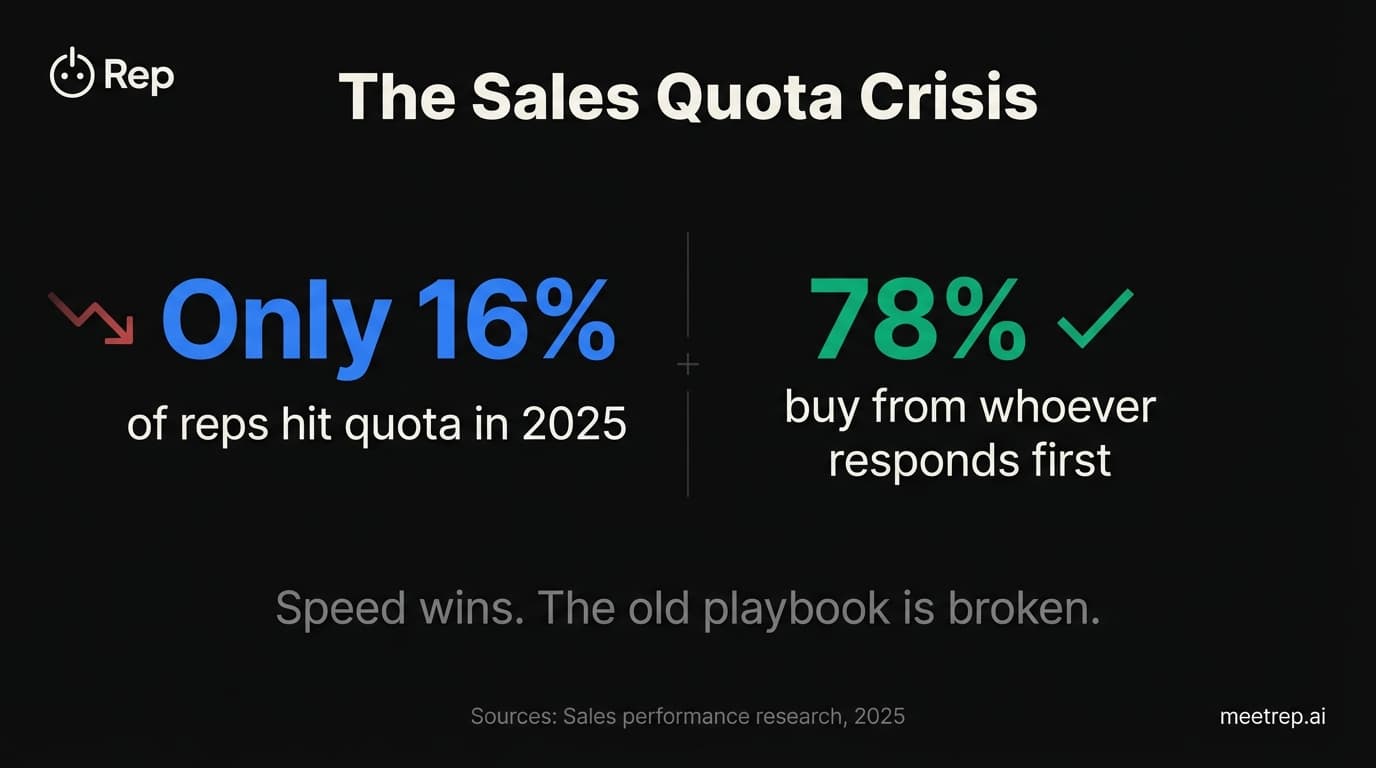
Why Autonomous Sales Software is the Future of B2B Sales (And Why the Old Playbook is Dead)
B2B sales is at a breaking point with quota attainment at 46%. Discover why autonomous 'Agentic AI' is the new standard for driving revenue and meeting the demand for rep-free buying.