AI Sales Enablement in 2026: The Shift from Tools to Autonomous Agents

Executive Summary
- AI sales enablement in 2026 is shifting from "copilots" (assistants) to "agents" (autonomous workers)
- 83% of AI-using sales teams grew revenue vs. 66% without AI—but adoption is the real barrier
- Seven tool categories now exist, from conversation intelligence to autonomous demo agents
- The winners won't be teams with the most tools—they'll be teams whose AI works without reps remembering to use it
Here's the contradiction defining AI sales enablement right now: 81% of sales teams are experimenting with or have fully implemented AI. Yet 80% of B2B leaders say they feel unprepared for its impact.
That's not a technology gap. It's an understanding gap.
I've been building in sales automation since founding GoCustomer.ai, and now with Rep. What I've learned is that most teams buy AI tools expecting transformation. What they get is another login for reps to ignore. The difference between the 20% who feel prepared and everyone else isn't which tools they bought—it's how they think about AI's role.
This guide breaks down what actually matters in AI sales enablement for 2026: the shift from copilots to agents, which tool categories solve which problems, and how to avoid the expensive mistakes I've watched teams make.
What Is AI Sales Enablement?
AI sales enablement is the use of artificial intelligence to automate and improve how sales teams are trained, coached, and supported. It transforms static content libraries and manual processes into responsive systems that deliver the right information, at the right time, without human intervention.
But that definition is already outdated for 2026.
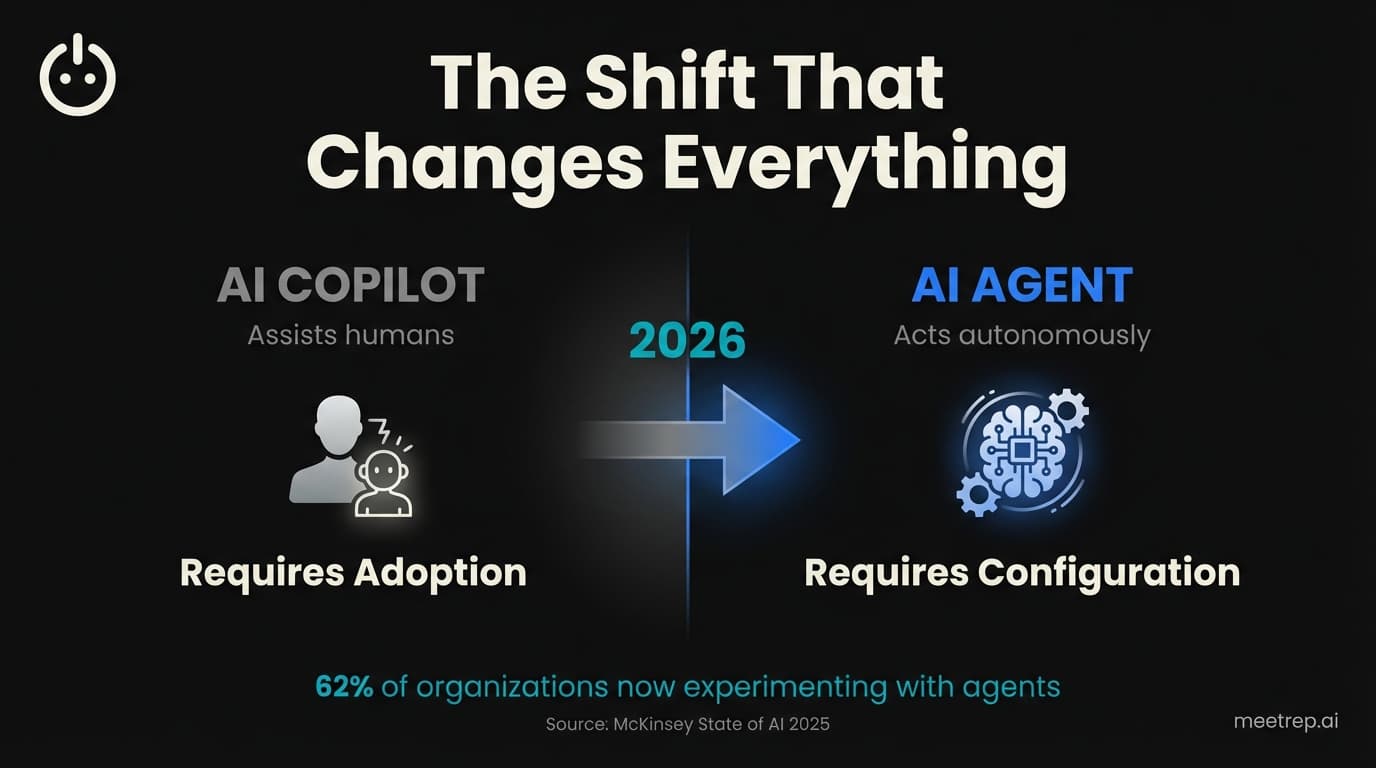
The real shift happening now is from AI that assists humans to AI that acts autonomously. 62% of organizations are now experimenting with AI agents—and 23% are scaling them in at least one business function, according to McKinsey's State of AI 2025 report.
This isn't just terminology. It changes everything about how you evaluate tools.
Key Insight: The question isn't "Does this tool have AI?" anymore. It's "Does this AI work when my reps forget to use it?"
Traditional enablement focused on making reps better. AI enablement in 2026 focuses on making buyers self-sufficient—while capturing insights reps never could. 78% of buyers now prefer self-service over talking to a sales rep. Your enablement strategy needs to meet them there.
The Copilot vs. Agent Distinction (And Why It Matters)
Most AI sales content still treats "copilots" and "agents" as interchangeable. They're not. And confusing them will cost you.
An AI copilot assists a human user. It drafts emails for reps to send. It suggests talking points during calls. It summarizes meetings after they end. The key word is suggests. A human still decides, still acts, still owns the workflow.
An AI agent functions autonomously. It engages a lead, gives a demo, books a meeting—without waiting for a human to log in. The agent doesn't suggest. It does.
| Dimension | AI Copilot | AI Agent |
|---|---|---|
| Trigger | Human initiates | Event or schedule triggers |
| Execution | Human acts on suggestions | Agent completes workflow |
| Adoption risk | High (requires habit change) | Low (works autonomously) |
| Best for | Augmenting experienced reps | Scaling capacity without headcount |
| Example | Gong suggesting next steps | Rep giving live demos 24/7 |
Here's why this matters for your budget: copilots require reps to remember to use them. Every time. And if there's one thing I learned building GoCustomer.ai, it's that "reps need to remember" is where sales tools go to die.
What we learned at GoCustomer: We built features reps loved in demos. Then we watched usage dashboards flatline three weeks after launch. The problem wasn't the features—it was the cognitive load. Reps already have 47 tabs open. Adding one more thing to remember doesn't scale.
Agents sidestep this entirely. They work in the background. They engage leads at 2 AM when your reps are asleep. They don't require adoption—they require configuration.
Gartner predicts that by 2028, AI agents will outnumber sellers 10x. But here's the catch: fewer than 40% will report productivity improvements. Why? Because most teams will deploy agents without rethinking their processes first.
The Seven Categories of AI Sales Enablement Tools
The tool market is fragmenting fast. Here's how to make sense of it:
| Category | What It Does | Key Players |
|---|---|---|
| Conversation Intelligence | Analyzes calls for coaching, patterns, deal risk | Gong, Clari, Chorus (ZoomInfo) |
| Revenue Enablement Platforms | Content, coaching, training in one system | Highspot, Seismic, Mindtickle, Allego |
| CRM AI Add-ons | Predictive scoring, forecasting, automation | Salesforce Einstein/Agentforce, HubSpot Breeze AI |
| AI Sales Assistants | Real-time guidance during calls | Spekit, Aircover, 1up.ai |
| Autonomous Outbound | AI SDRs that prospect without humans | 11x.ai, Artisan, AiSDR |
| Async Demo Platforms | Pre-recorded, click-through demos | Consensus, Walnut, Demostack |
| Autonomous Demo Agents | Live, interactive demos via AI | Rep, Saleo |
The last two categories—demo automation—deserve special attention. They're addressing different problems than most people realize.
Async demos (Consensus, Walnut) solved the "let me see it" problem. Prospects can explore your product without scheduling a call. But they can't ask questions. They can't get answers in real-time. For complex products, that's a limitation.
Autonomous demo agents are the next step. At Rep, we built an AI that joins video calls, shares its screen, navigates your actual product, and answers questions live. It's not a recording. It's a conversation. And it runs 24/7.
This matters because of what I call the "speed-to-demo" problem.
Speed-to-Demo: The Metric That Replaces Speed-to-Lead
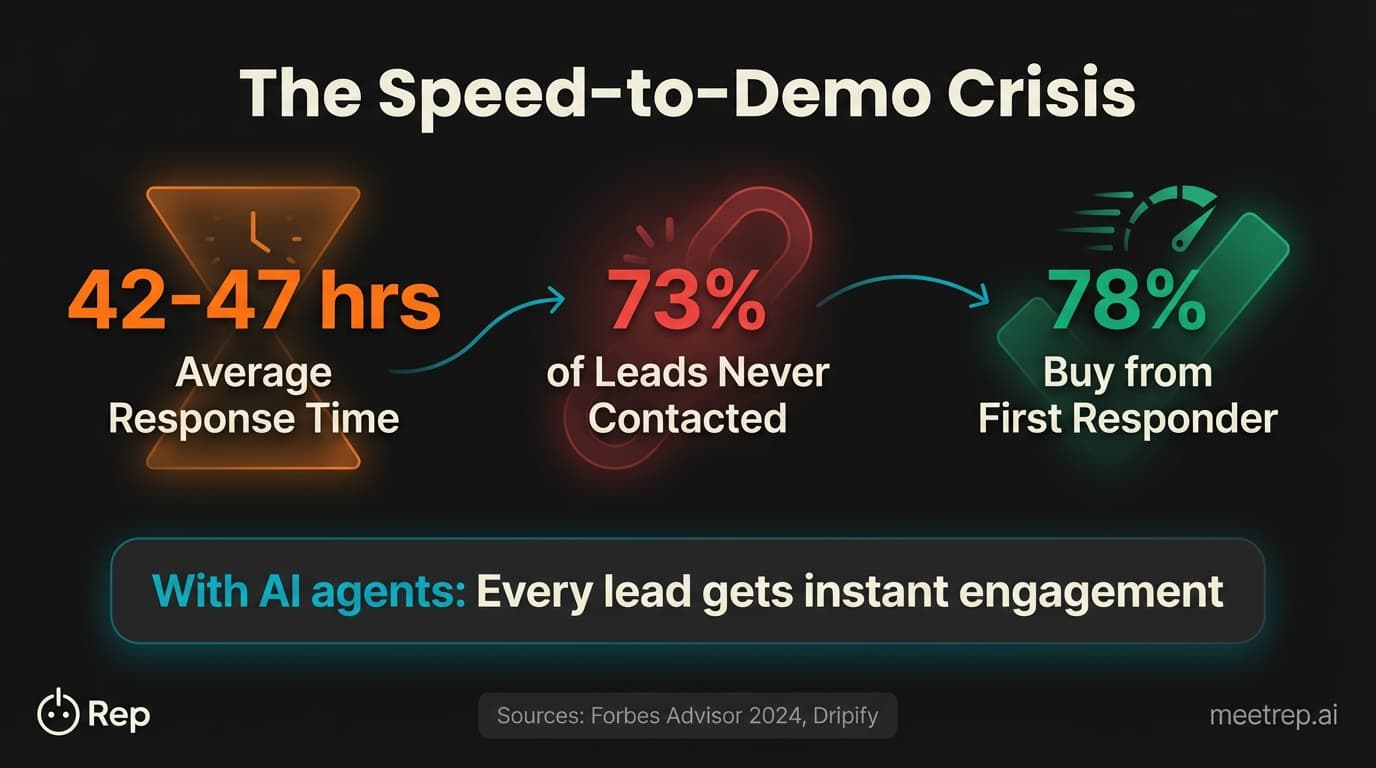
For years, sales teams obsessed over speed-to-lead—how fast you respond to an inquiry. The data was clear: 78% of customers buy from the company that responds first.
But "responding" has changed. Buyers don't want a callback. They want to see your product. Now.
And here's the brutal reality: the average lead response time is 42-47 hours. Nearly two days. By then, your competitor has already given them a demo.
Speed-to-demo is the new metric. It measures the time from buyer interest to product experience. And it's where autonomous agents shine—they collapse that time from days to seconds.
The Data:Only 27% of leads get contacted at all. You're ignoring 73% of your pipeline. With autonomous demo agents, every lead gets immediate engagement.
The ROI Question (With Actual Numbers)
Let's talk money. Because every AI conversation eventually becomes a budget conversation.
The headline stats are compelling:
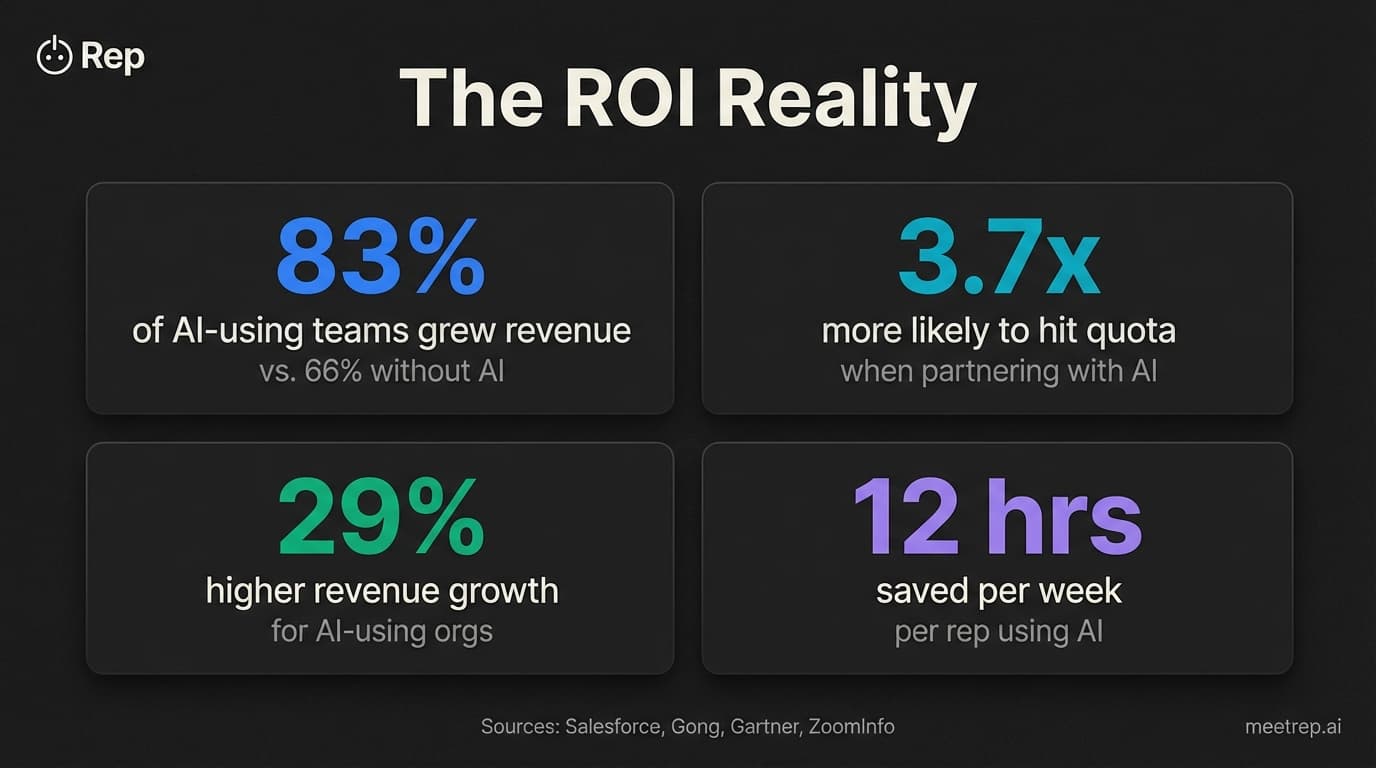
- 83% of sales teams using AI grew revenue vs. 66% without (Salesforce)
- 29% higher revenue growth for AI-using organizations (Gong)
- 3.7x more likely to meet quota when sellers partner with AI (Gartner)
- 47% productivity boost reported by AI users (ZoomInfo)
But I want to highlight a stat that gets overlooked: reps spend only 28-30% of their time actually selling. The rest goes to admin, CRM updates, searching for content, scheduling.
That's 70% of your payroll doing work that doesn't close deals.
AI saves time here. 12 hours per week, according to ZoomInfo. That's 624 hours per year per rep. At even $50/hour loaded cost, you're looking at $31,200 in recovered capacity per person.
The case studies back this up:
- Wrike (via Consensus): Saved 2,100 FTE hours, reduced live demos by 35%
- Iron Mountain (via Gong): 148% improvement in new rep quota attainment
- Employment Hero (via Spekit): 25% reduction in onboarding cycle
These aren't hypothetical projections. They're measured results.
The Adoption Problem Nobody Wants to Talk About
Here's my unpopular take: most AI sales enablement failures aren't technology failures. They're adoption failures.
Hot take: AI doesn't fix bad sales processes. It exposes them faster. If your reps don't trust the data in your CRM, AI-powered insights from that CRM won't help. If your content is a mess, AI content recommendations will surface the mess faster.
87% of sales leaders report direct CEO/board pressure to deploy generative AI. So they buy tools. Then they discover that "deploying AI" and "getting value from AI" are different problems.
The adoption challenge has three layers:
Layer 1: Rep behavior change. Asking reps to use a new tool means asking them to change habits. That's hard. A study of sales tool adoption found that 40% of SaaS licenses still go unused. You're paying for features no one touches.
Layer 2: Data quality. AI is only as good as the data behind it. Garbage in, garbage out. If your CRM is a mess—and let's be honest, most are—your AI will generate confident-sounding insights from flawed inputs.
Layer 3: Process fit. You can't bolt AI onto a broken process and expect transformation. As one analyst put it: "Vendors eager to hit revenue targets focus on selling licenses, not laying the operational groundwork."
This is why agents beat copilots for certain use cases. An agent that runs autonomously doesn't require rep adoption. It requires setup. Once.
Building an Implementation Roadmap That Doesn't Fail
Based on what I've seen work (and not work), here's a realistic timeline:
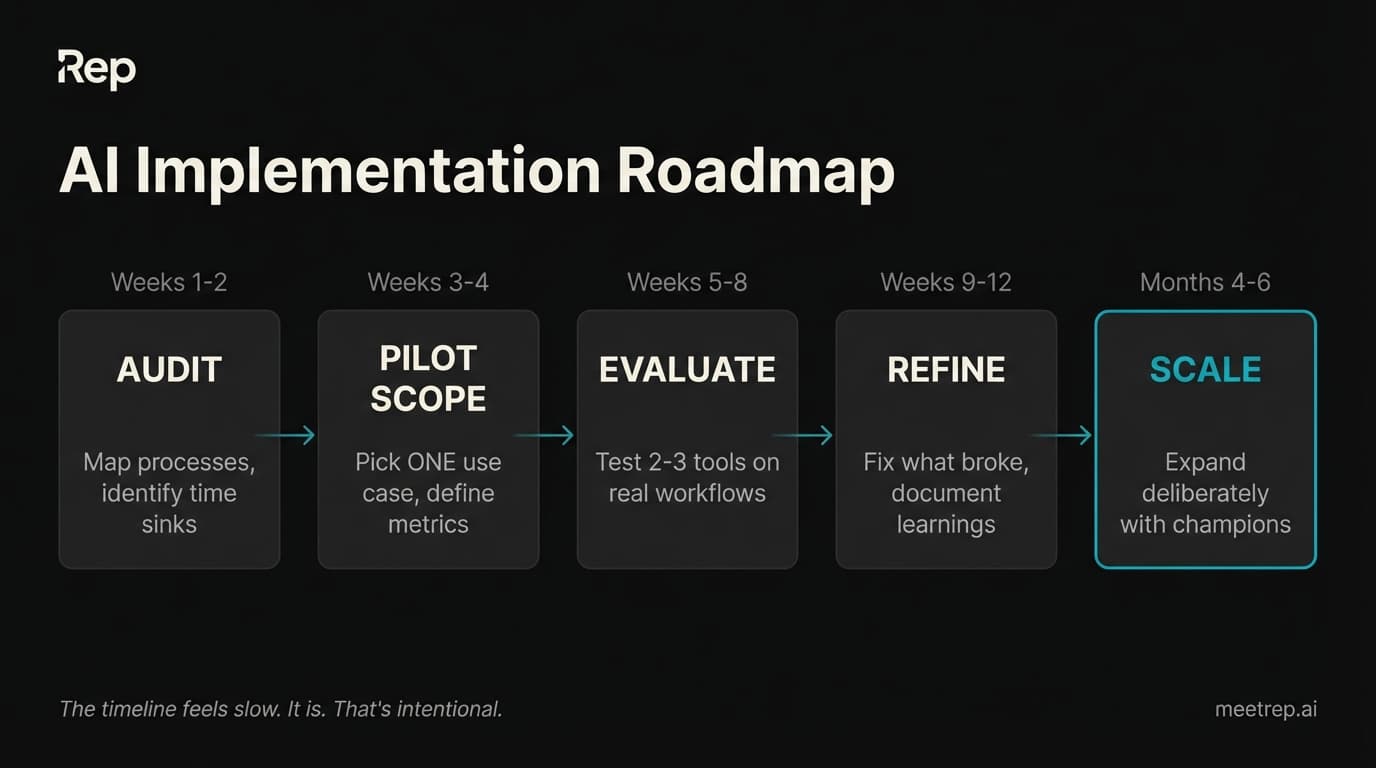
Weeks 1-2: Audit and Prioritize
- Map current processes end-to-end
- Identify the three biggest time sinks
- Talk to your actual reps (not just managers)
Weeks 3-4: Select Pilot Scope
- Pick ONE use case, not five
- Choose a team that's hungry to try, not resistant
- Define success metrics before you start
Weeks 5-8: Evaluate and POC
- Test 2-3 tools, max
- Run them on real workflows, not demos
- Measure what actually changes
Weeks 9-12: Refine and Expand
- Fix what broke in pilot
- Document what worked (and didn't)
- Roll to next team only when pilot team validates
Months 4-6: Scale Deliberately
- Expand to broader org
- Build internal champions, not just top-down mandates
- Measure ROI against baseline you established
The timeline feels slow. It is. And that's intentional. The teams that rush to "deploy AI across the org" are the same teams that end up as cautionary tales in analyst reports.
The AI sales enablement market in 2026 isn't about finding the right tool. It's about understanding the shift from AI-as-assistant to AI-as-worker. The teams winning aren't buying more licenses—they're deploying agents that operate autonomously while humans focus on what only humans can do: building relationships and closing complex deals.
My prediction: within two years, the distinction between "sales enablement" and "sales automation" will disappear. The AI won't just enable your team. It will be part of your team.
If you want to see what autonomous demo agents actually look like, Rep gives live product demos 24/7—real conversations, real screen sharing, real answers. Not a recording. Not a chatbot. An AI rep.

Nadeem Azam
Founder
Software engineer & architect with 10+ years experience. Previously founded GoCustomer.ai.
Nadeem Azam is the Founder of Rep (meetrep.ai), building AI agents that give live product demos 24/7 for B2B sales teams. He writes about AI, sales automation, and the future of product demos.
Frequently Asked Questions
Table of Contents
- What Is AI Sales Enablement?
- The Copilot vs. Agent Distinction (And Why It Matters)
- The Seven Categories of AI Sales Enablement Tools
- Speed-to-Demo: The Metric That Replaces Speed-to-Lead
- The ROI Question (With Actual Numbers)
- The Adoption Problem Nobody Wants to Talk About
- Building an Implementation Roadmap That Doesn't Fail
Ready to automate your demos?
Join the Rep Council and be among the first to experience AI-powered demos.
Get Early AccessRelated Articles
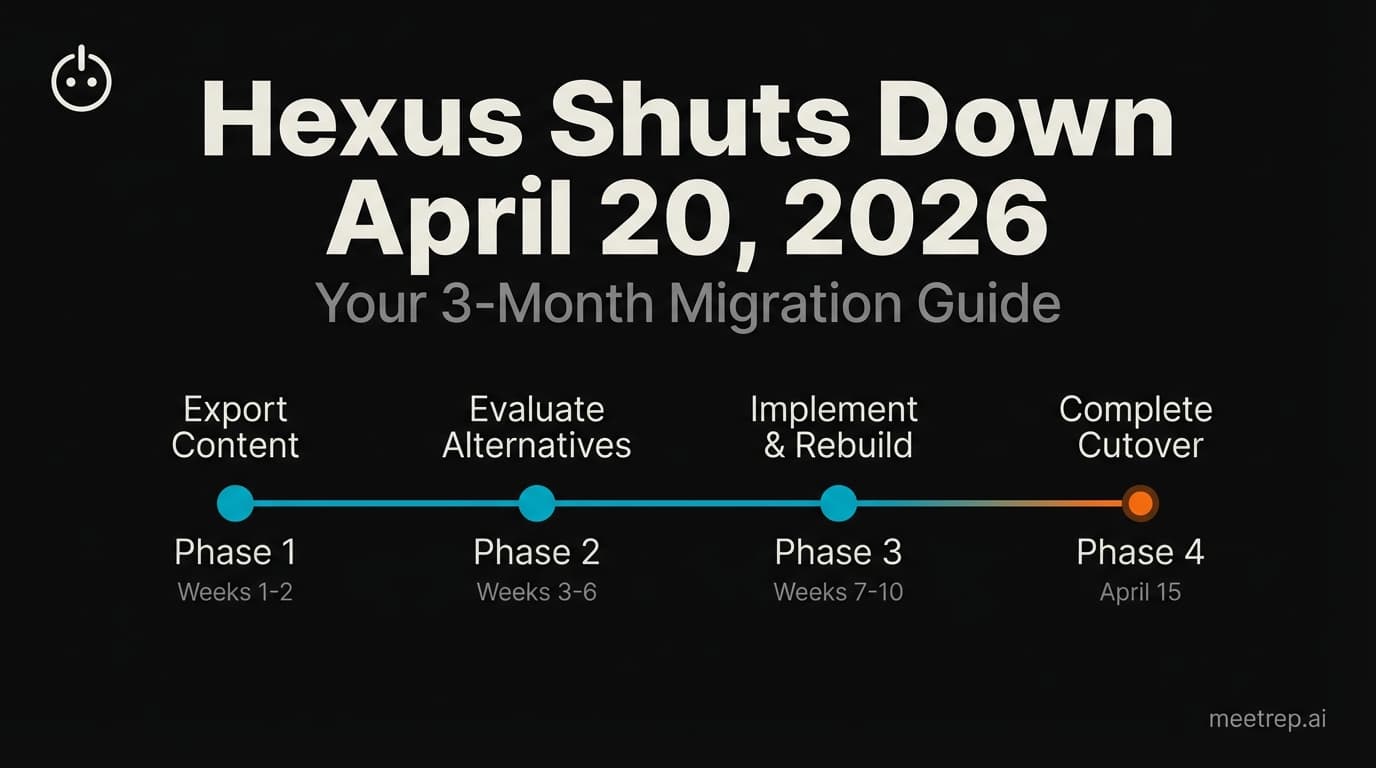
Hexus Acquired by Harvey AI: Congrats & What It Means for Demo Automation Teams
Hexus is shutting down following its acquisition by Harvey AI. Learn how to manage your migration and discover the best demo automation alternatives before April 2026.
Why the "Software Demo" is Broken—and Why AI Agents Are the Future
The traditional software demo is dead. Discover why 94% of B2B buyers rank vendors before calling sales and how AI agents are replacing manual demos to scale revenue.
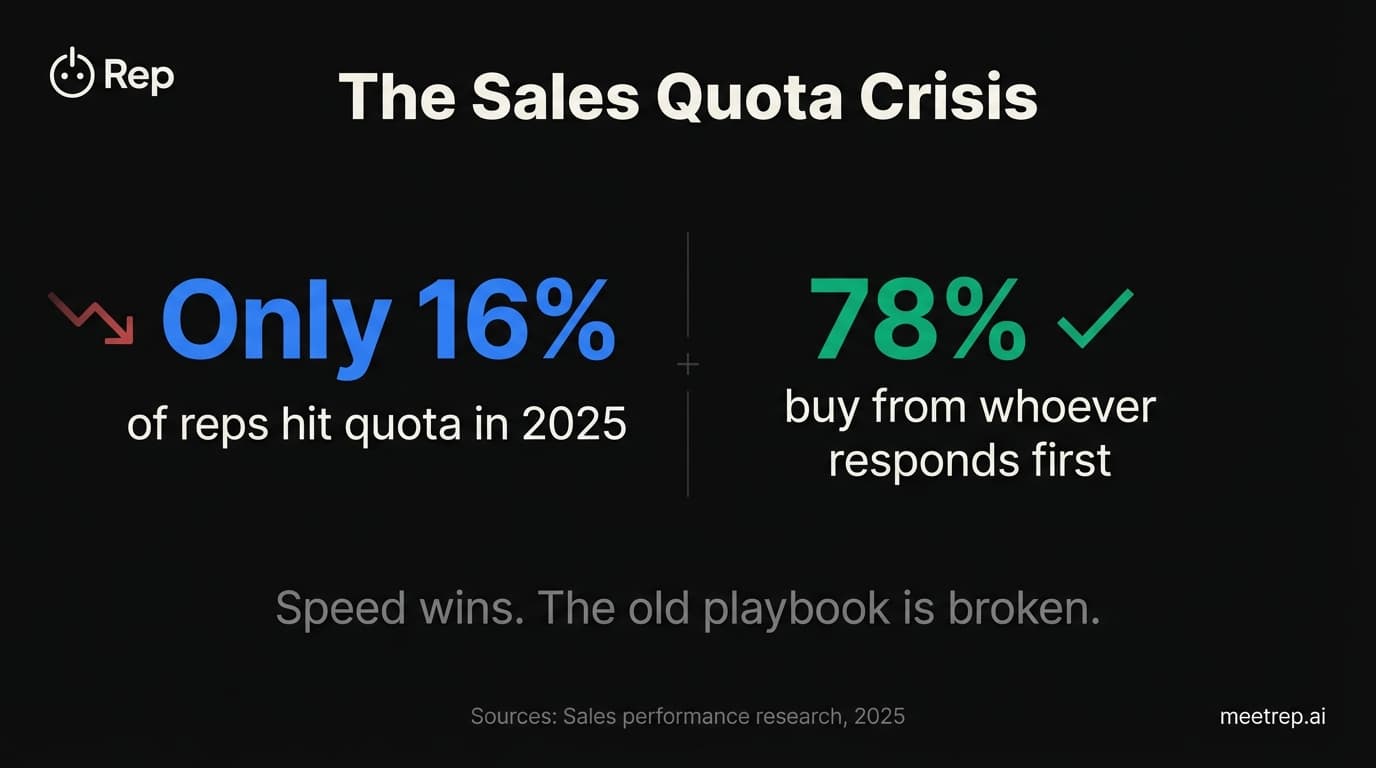
Why Autonomous Sales Software is the Future of B2B Sales (And Why the Old Playbook is Dead)
B2B sales is at a breaking point with quota attainment at 46%. Discover why autonomous 'Agentic AI' is the new standard for driving revenue and meeting the demand for rep-free buying.