AI Sales Automation: The Complete Guide for Revenue Teams (2026)

Executive Summary
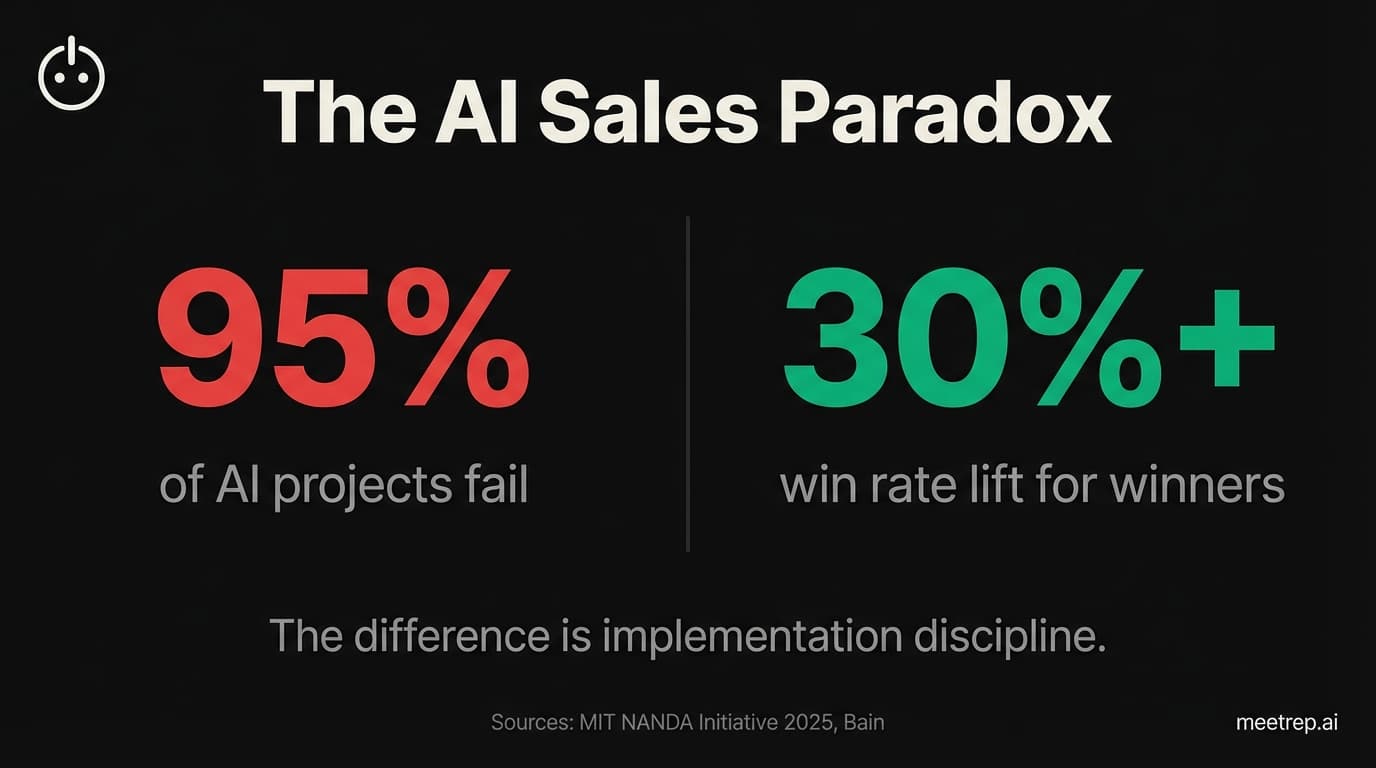
- 95% of AI sales projects fail, but winners see 30%+ win rate improvements
- AI works best as augmentation, not replacement—"AI for heavy lifting, humans for finesse"
- Data quality is the #1 predictor of success (42% of companies don't have enough)
- Implementation should prove ROI within 30 days or you should walk away
- The hybrid model wins: AI for the 61% of buyers who want self-service, humans for the rest
Here's a stat that should make you uncomfortable: 95% of enterprise AI projects fail to deliver measurable ROI. That's not my opinion. That's MIT's NANDA Initiative, 2025.
And yet.
The 5% that succeed? They see win rates jump by 30% or more. They watch revenue per rep climb 41%. They stop losing deals to competitors who figured it out first.
I've been building AI sales automation tools for years now. At GoCustomer.ai, we shipped a sales automation platform and learned—sometimes painfully—what actually works. Now at Rep, we're building AI that joins live video meetings and conducts product demos autonomously. I've seen the hype. I've seen the failures. And I've seen what separates the 5% from everyone else.
This guide is the honest assessment I wish I'd had when I started. No vendor spin. Real stats. A practical roadmap.
What is AI sales automation (and what it isn't)?
AI sales automation uses artificial intelligence to handle repetitive sales tasks—lead scoring, email personalization, meeting scheduling, pipeline forecasting, and follow-up sequences—freeing reps to focus on actual selling. Unlike rule-based automation that follows rigid if-then logic, AI systems learn from your data and adapt over time.
But here's where it gets interesting. The field has shifted dramatically in the past 18 months.
We've moved from "copilots" (AI that assists) to "agents" (AI that acts). The difference matters. A copilot suggests what email to send. An agent sends it. A copilot recommends a demo flow. An agent joins the meeting and runs the demo itself.
Gartner predicts that by 2027, 95% of seller research workflows will begin with AI. That's not a maybe. That's the baseline expectation.
Key Insight: The shift isn't just about automation speed. It's about what gets automated. "Agentic AI" pursues goals and executes tasks autonomously. "Generative AI" just creates content. Most vendors blur this distinction. Don't let them.
So what does modern AI sales automation actually include?
| Category | What It Does | Examples |
|---|---|---|
| Conversation Intelligence | Records, transcribes, and analyzes sales calls | Gong, Chorus.ai, Clari |
| Sales Engagement | Manages outreach sequences and cadences | Outreach, Salesloft, Apollo.io |
| AI SDRs | Books meetings through autonomous outreach | Artisan, 11x, Regie.ai |
| Demo Automation | Delivers product demos without live reps | Consensus, Walnut, Rep |
| CRM Intelligence | Enriches data and predicts outcomes | Salesforce Einstein, HubSpot AI |
The tools in that last category—demo automation—are where I spend most of my time now. At Rep, we build AI that joins video calls, shares its screen, and walks prospects through your actual product. Not a pre-recorded video. A live, interactive conversation with an AI that can answer questions and adapt to what the prospect cares about.
The real state of AI in sales: what the data shows
Let me give you the numbers that actually matter.
81% of sales teams are already experimenting with or have fully implemented AI. That's according to Salesforce's State of Sales Report. You're not early anymore. If you're still on the sidelines, you're behind.
But adoption alone means nothing. What matters is results.
The Data:83% of sales teams with AI saw revenue growth compared to 66% without—a 17 percentage point advantage. (Salesforce, 2024)
Flip that around using loss framing: teams NOT using AI are 17 points less likely to grow revenue. That's the cost of waiting.
The productivity gains are equally stark. Optifai's 2025 benchmark study of 938 sales reps found that AI-augmented reps achieve 41% higher revenue per rep ($1.75M vs $1.24M) with 18% fewer activities. They're working smarter, not harder.
And here's the buyer side of the equation. 61% of B2B buyers now prefer an overall rep-free buying experience. That's Gartner, 2025. Most of your prospects don't want to talk to a salesperson until they're ready to talk to a salesperson. If you force a demo call, you lose the 61%.
Sound familiar?
This is why ai powered sales tools that enable self-service aren't just about efficiency. They're about access. You're meeting buyers where they actually want to be met.
What AI can actually automate (and what it can't)
Here's a comparison that cuts through the noise:
| Process | Manual Approach | AI-Automated Approach | Impact |
|---|---|---|---|
| Lead Research | 2-3 hours per prospect | 5 minutes with AI enrichment | 95% time reduction |
| Email Personalization | Generic templates or manual customization | Dynamic personalization using buyer signals | 30%+ response rate lift possible |
| Follow-up Sequences | Inconsistent, leads slip through cracks | Automated cadences that never miss | Higher conversion, zero dropped leads |
| Pipeline Forecasting | Spreadsheet guesswork | Pattern recognition from historical data | 95% accuracy possible (per Gong case studies) |
| Meeting Scheduling | 5-8 email exchanges | AI scheduling in 1 click | 10+ hours saved weekly |
| Call Analysis | Manual notes, subjective feedback | Auto transcription + AI insights | 60% rep capacity boost |
| Demo Delivery | Live rep required, limits scale | Autonomous or hybrid demos, 24/7 | 35% reduction in live calls needed |
But—and this is important—AI still can't do everything.
Relationship building at the executive level? That needs a human. Complex multi-stakeholder negotiations? Human. Reading the room when a deal is about to go sideways? Human. Handling objections that require genuine empathy? Human.
What we learned at GoCustomer: We tried to automate too much too fast. The result? Prospects felt like they were talking to a robot, because they were. The winning model we eventually landed on: "AI for heavy lifting, humans for finesse." AI handles the volume and the research. Humans handle the nuance and the relationships.
The 30% selling time problem is real. Salesforce found that sales reps spend only 30% of their time actually selling. The other 70% disappears into CRM updates, research, scheduling, and admin. AI should attack that 70%, not try to replace the 30% where humans excel.
Why 95% of AI sales projects fail (and how to avoid it)
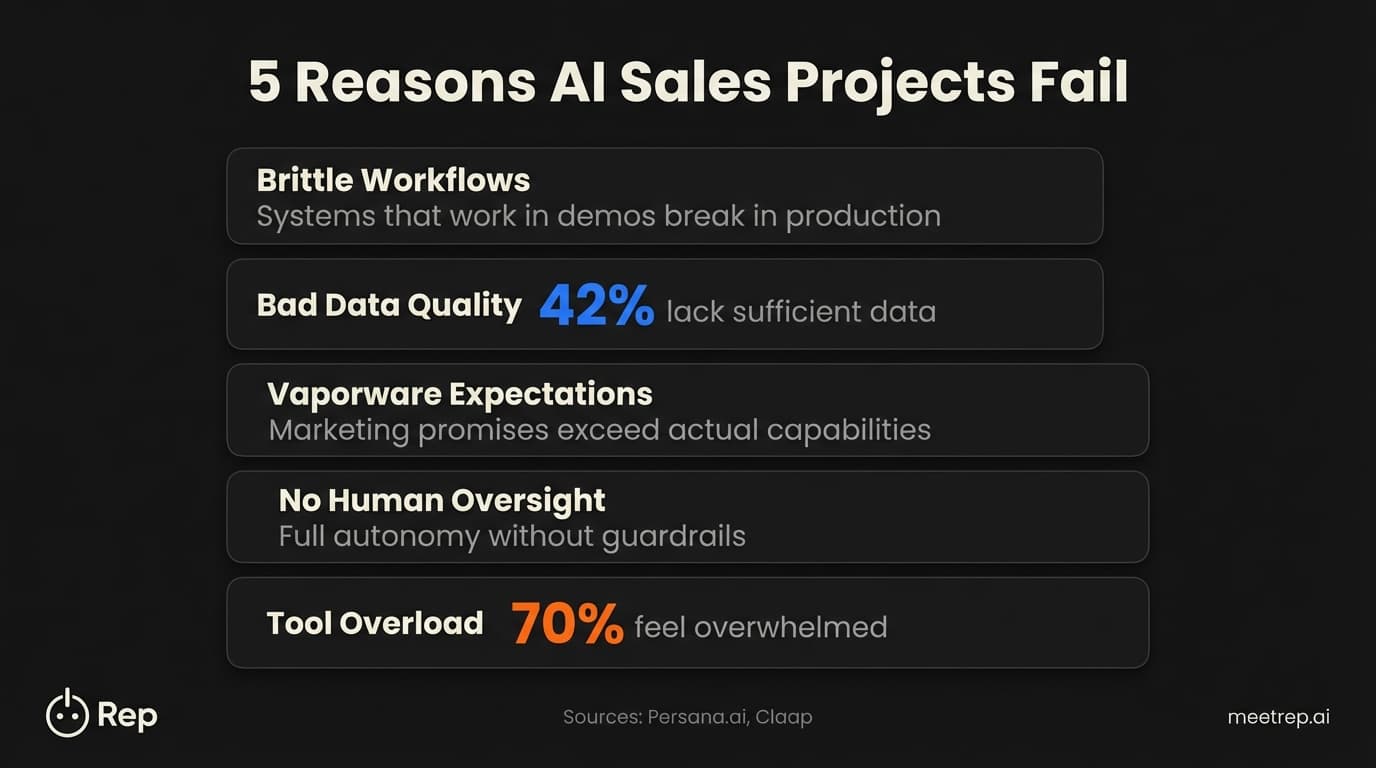
That MIT statistic deserves a deeper look. Why do most implementations fail?
Reason 1: "Brittle" Workflows
AI systems that work perfectly in demos break in production. They're optimized for specific scenarios that don't generalize. When a prospect asks an unexpected question or takes an unusual path, the system falls apart.
Reason 2: Data Quality ("Garbage In, Garbage Out")
42% of businesses say they don't have enough of their own data to train AI effectively. And here's the thing most vendors won't tell you: AI amplifies data problems. Dirty CRM data doesn't just stay dirty—it becomes confidently wrong predictions and embarrassingly off-base personalization.
Common mistake: Buying an AI sales system before cleaning your CRM data is like buying a Ferrari before learning to drive. You're going to crash. Data hygiene comes first. Always.
Reason 3: Vaporware Expectations
The FTC sued Air.ai in August 2025 for deceptive claims about "human-like" performance. The gap between marketing promises and actual capabilities is often enormous. If a vendor promises fully autonomous, "just like a human" performance, be very skeptical.
Reason 4: No Human Oversight
One Reddit user put it perfectly: "An unsupervised AI agent can burn through your entire TAM in a weekend." Full autonomy without guardrails is a recipe for disaster. You need what I call "governed autonomy"—AI that acts independently but within strict boundaries.
Reason 5: Tool Overload
Nearly 70% of sales reps feel overwhelmed by their tool stack. Adding another AI tool on top of a bloated stack—without consolidating—just makes things worse.
The common thread? Teams that fail treat AI as magic. Teams that succeed treat it as a tool that requires discipline, clean data, and thoughtful implementation.
Real results from named companies
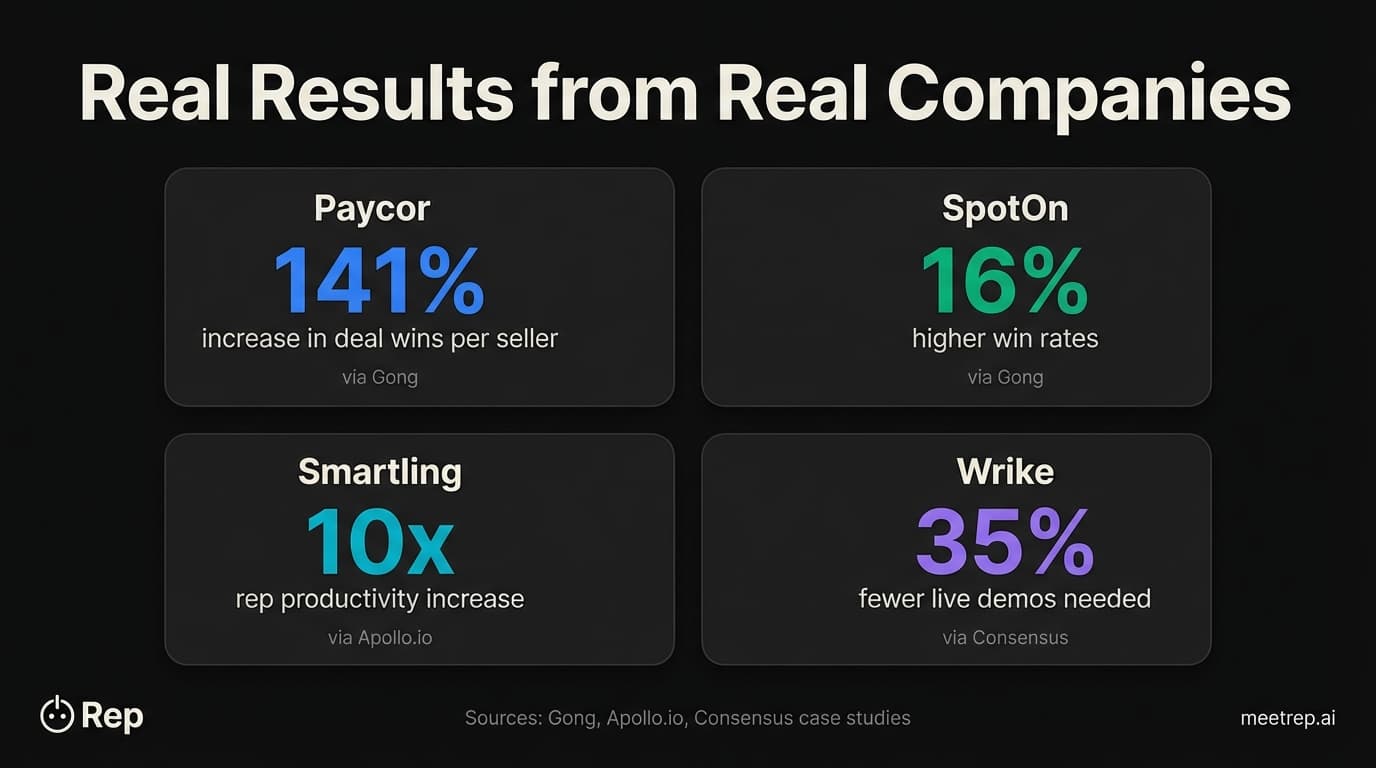
Let me show you what success actually looks like. Not vague "our customers see results" claims. Named companies with specific numbers.
Paycor + Gong:141% increase in deal wins per seller. Revenue intelligence deployment across their sales org.
SpotOn + Gong:16% increase in win rates, 30% increase in revenue per rep, 95% forecast accuracy. Plus 60% reduction in onboarding time.
Smartling + Apollo.io:10x increase in sales rep productivity through AI-powered personalization at scale.
Wrike + Consensus:35% reduction in live introductory demos, saving 2,100 hours of presales time. Added 15% capacity to their solutions consulting team.
Notice a pattern? None of these are "AI replaced our sales team" stories. They're "AI made our sales team dramatically more effective" stories. That's the model that works.
The Data:67% of sales reps don't expect to meet quota this year. 84% missed it last year. AI isn't a nice-to-have. It's how you close the gap.
How to choose the right AI sales tools
I won't pretend to give you an "objective" ranking where my company comes out on top. That's insulting. Here's an actual framework for evaluation:
Question 1: Does it integrate with your existing stack?
If the tool doesn't connect natively to your CRM, your calendar, and your communication platforms, expect a painful implementation. The 70% tool overwhelm problem is real.
Question 2: Can you prove ROI in 30 days?
This is my hard rule. If a tool doesn't show clear value in 30 days, move on. Don't get stuck in "pilot purgatory" where you're eternally testing without deciding. Gartner predicts 40% of agentic AI projects will be canceled by 2027 because of unclear value. Set a deadline.
Question 3: Is it governed autonomy or dangerous autonomy?
Does the tool have guardrails? Playbooks? Approval workflows? Or does it just blast out to your entire TAM with whatever the AI decides to say? The former is ai sales automation. The latter is a reputation risk.
Question 4: Does it address the self-service demand?
Remember that 61% stat. Buyers want to research and explore on their own terms. Does the tool enable that, or does it just make your reps faster at interrupting people?
My recommendation: Start with one high-impact use case. Don't buy a full platform that tries to do everything. Pick your biggest bottleneck—research time? Demo scheduling? Follow-up consistency?—and solve that first.
At Rep, we focused specifically on live product demos because that's where we saw the biggest gap. Most AI handles pre-meeting activities or post-meeting analysis. We wanted to automate the meeting itself. Your priority might be different. Start where the pain is worst.
The 30-60-90 day implementation roadmap
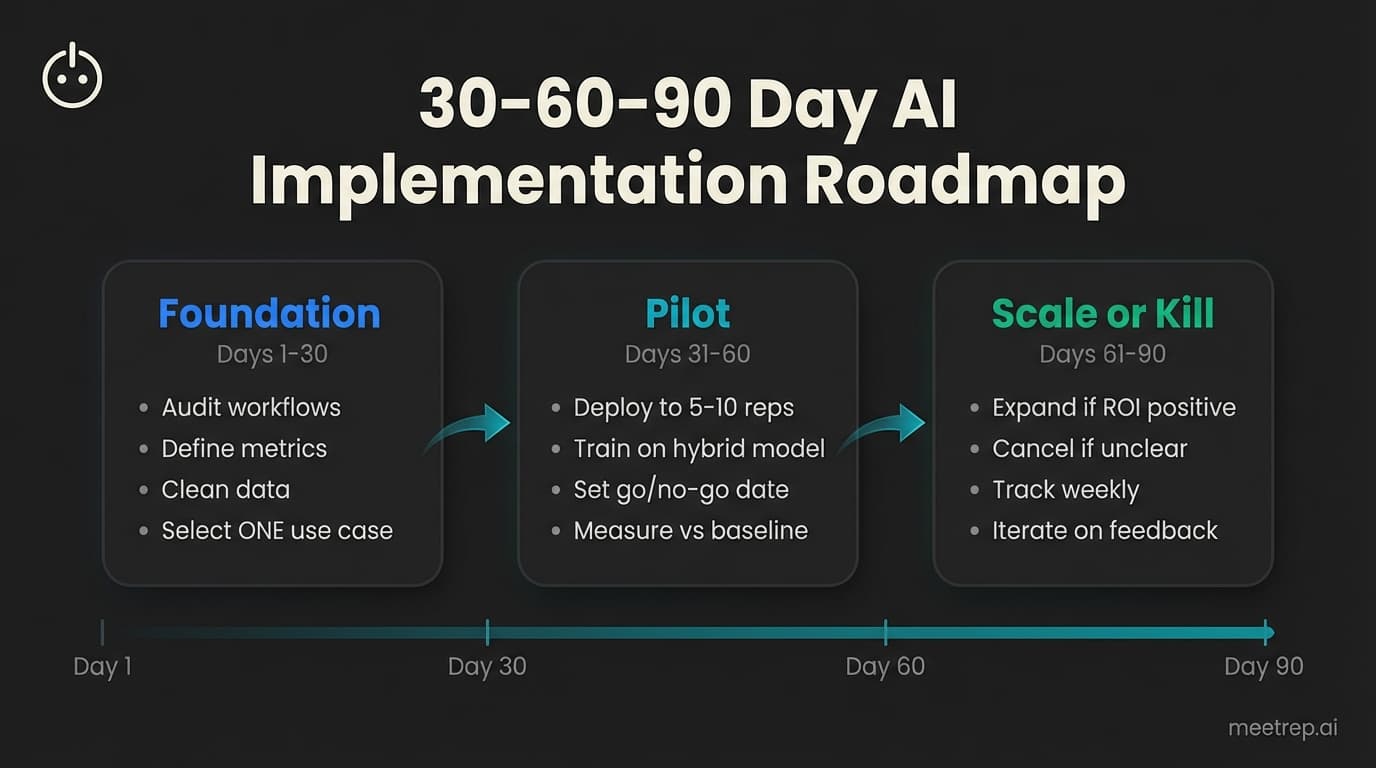
So what does good implementation actually look like? Here's the framework we recommend:
Days 1-30: Foundation
- Audit current workflows. Find where reps lose time. (Hint: it's probably research, scheduling, and CRM updates.)
- Define success metrics before you buy anything. Meetings booked? Win rate? Quota attainment? Pick 2-3.
- Clean your data. This step is boring and essential. Bad data = bad AI.
- Select ONE high-impact use case based on your biggest bottleneck.
Days 31-60: Pilot
- Deploy to a small team (5-10 reps max). Not the whole org.
- Train the team on hybrid workflows. AI handles X, they handle Y. Be explicit.
- Set a hard go/no-go decision date. Write it on the calendar. Avoid pilot purgatory.
- Measure against the baseline you established in days 1-30.
Days 61-90: Scale or Kill
- If ROI positive: expand to full team. Document what worked.
- If ROI negative or unclear: cancel without guilt. The tool wasn't right. That's valuable information.
- Track weekly metrics. Don't set and forget.
- Iterate based on rep feedback and buyer response.
This isn't complicated. But I'm constantly surprised how many teams skip straight to "buy the tool" without steps 1-4. They're shocked when it doesn't work. Don't be that team.
The future: what's coming in 2026-2028
Let me share where I think this is heading.
Gartner predicts that by 2028, AI agents will outnumber sellers 10 to 1. But—and this is the important part—fewer than 40% of sellers will report that AI agents actually improved their productivity.
That's not a contradiction. It's a warning.
More AI doesn't automatically mean more results. The winners will be teams that implement thoughtfully, maintain the hybrid model, and focus on governed autonomy. The losers will be teams that chase every shiny tool without strategy.
The shift from "automatic sales ai" that just sends emails faster to agentic systems that join meetings, navigate products, and have real conversations is already underway. At Rep, that's exactly what we're building—AI that participates in the sales process as an active agent, not just a background assistant.
My prediction: by 2027, the idea of "making prospects wait for a human's calendar" for a standard product demo will feel as outdated as making them fax in a form. The tools exist now. The question is who adopts them first.
The gap between AI winners and losers in sales isn't about which tool you buy. It's about implementation discipline.
Start with clean data. Pick one use case. Prove ROI in 30 days or move on. And remember: AI for the 61% who want self-service, humans for the complex 39%. That's the model that actually works.
At Rep, we built our platform around this philosophy. Our AI joins live meetings and conducts product demos autonomously—not to replace sales reps, but to handle the repetitive demos that eat up their calendars. That frees your best people to focus on the deals that need a human touch.
The 5% of teams that succeed with AI aren't smarter than you. They're just more disciplined about implementation. Be one of them.

Nadeem Azam
Founder
Software engineer & architect with 10+ years experience. Previously founded GoCustomer.ai.
Nadeem Azam is the Founder of Rep (meetrep.ai), building AI agents that give live product demos 24/7 for B2B sales teams. He writes about AI, sales automation, and the future of product demos.
Frequently Asked Questions
Table of Contents
- What is AI sales automation (and what it isn't)?
- The real state of AI in sales: what the data shows
- What AI can actually automate (and what it can't)
- Why 95% of AI sales projects fail (and how to avoid it)
- Real results from named companies
- How to choose the right AI sales tools
- The 30-60-90 day implementation roadmap
- The future: what's coming in 2026-2028
Ready to automate your demos?
Join the Rep Council and be among the first to experience AI-powered demos.
Get Early AccessRelated Articles
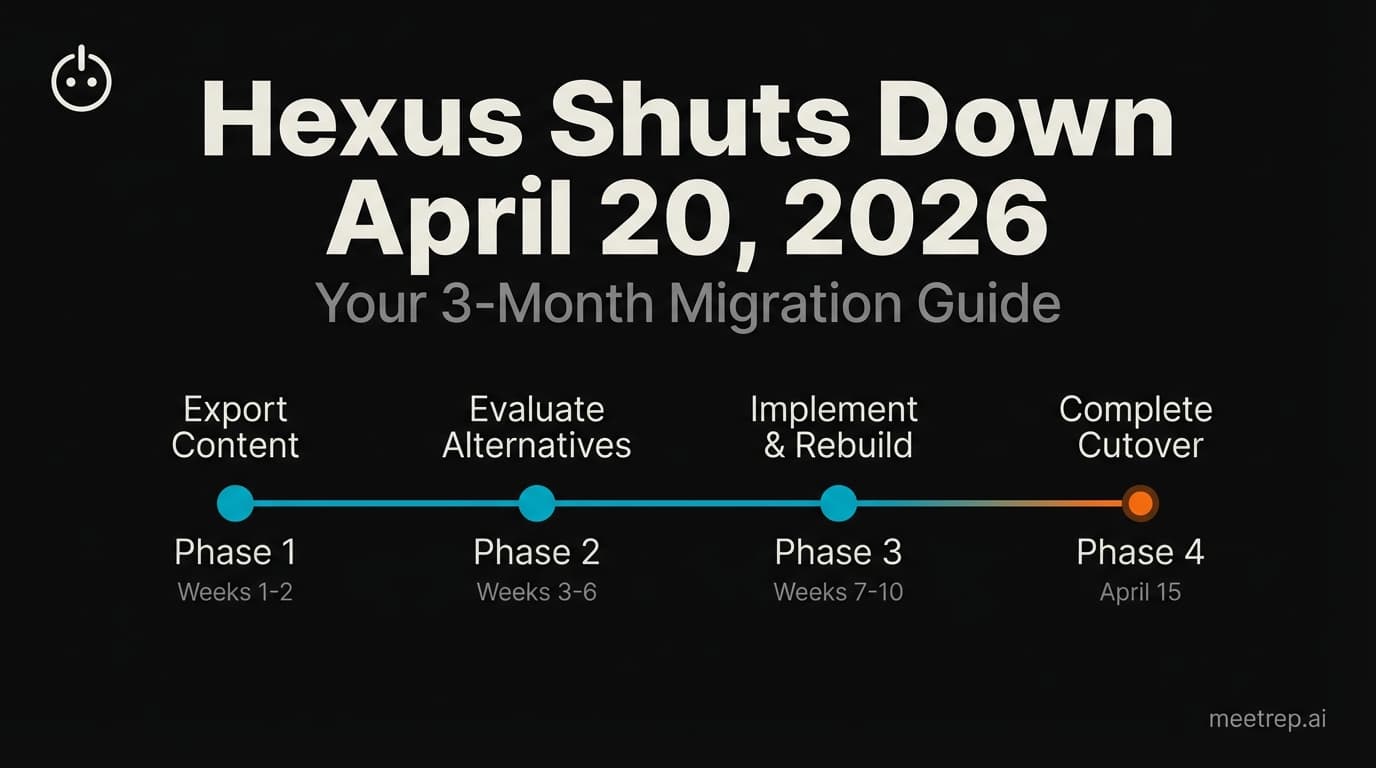
Hexus Acquired by Harvey AI: Congrats & What It Means for Demo Automation Teams
Hexus is shutting down following its acquisition by Harvey AI. Learn how to manage your migration and discover the best demo automation alternatives before April 2026.
Why the "Software Demo" is Broken—and Why AI Agents Are the Future
The traditional software demo is dead. Discover why 94% of B2B buyers rank vendors before calling sales and how AI agents are replacing manual demos to scale revenue.
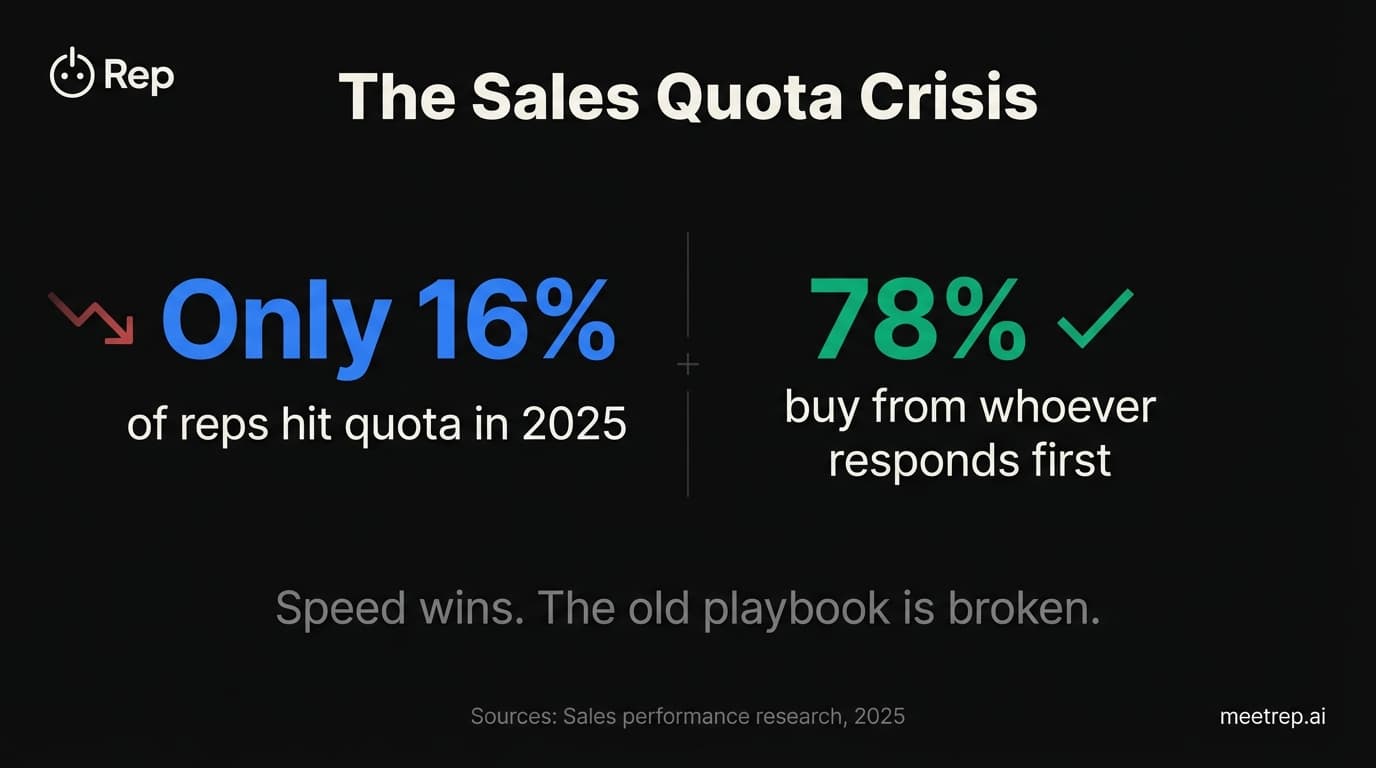
Why Autonomous Sales Software is the Future of B2B Sales (And Why the Old Playbook is Dead)
B2B sales is at a breaking point with quota attainment at 46%. Discover why autonomous 'Agentic AI' is the new standard for driving revenue and meeting the demand for rep-free buying.