The VP’s Guide to AI Sales Assistants: Escaping the "Pilot Purgatory" of 2026

Executive Summary
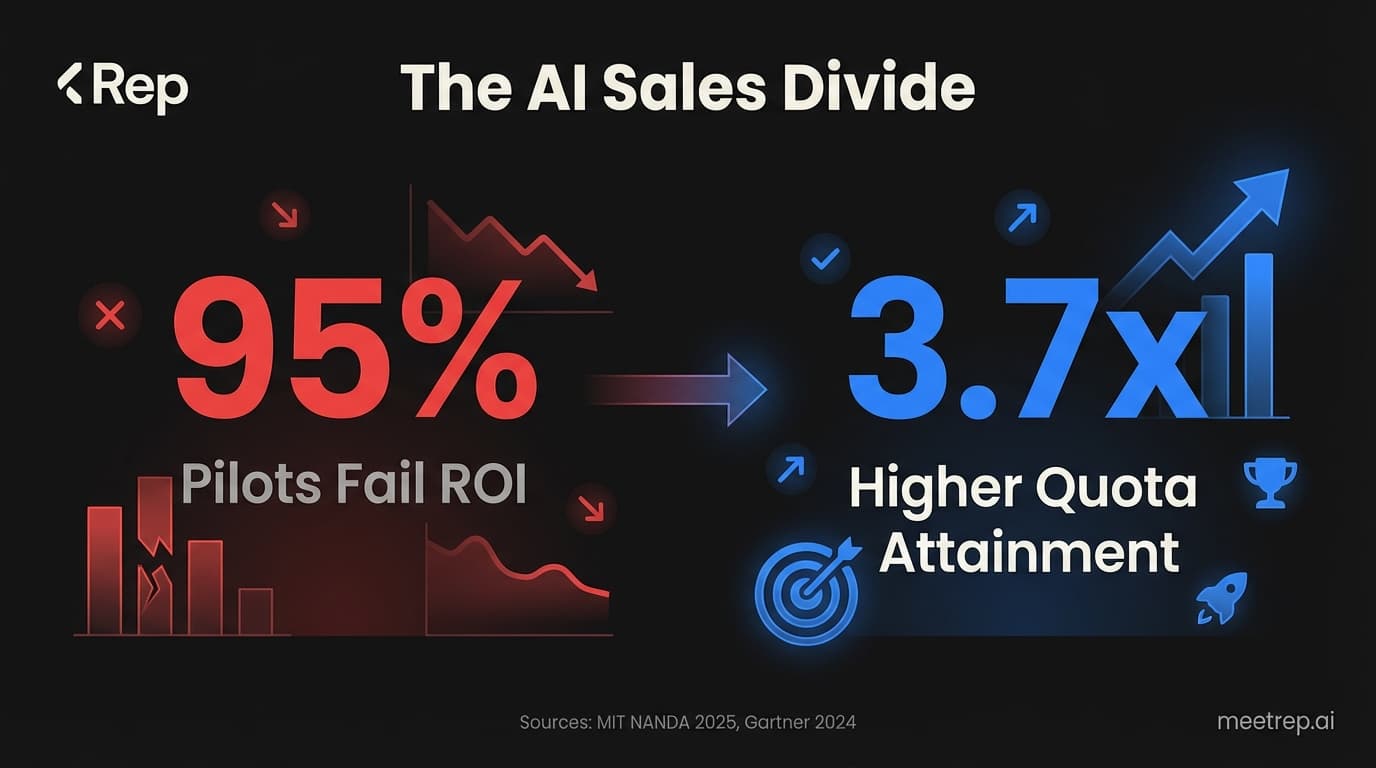
- The Problem: 95% of AI pilots fail because teams layer AI on broken workflows instead of redesigning them.
- The Shift: We are moving from "Copilots" (assistants) to "Agents" (autonomous workers).
- The ROI: High performers using agentic AI see 3.7x higher quota attainment.
- The Fix: Stop automating email drafts. Start automating the "Demo Lag" that kills 25% of your deals.
If you feel like you're drowning in AI tools but seeing zero impact on your P&L, you aren't alone.
By late 2025, 88% of organizations reported using AI in at least one function, according to McKinsey. Yet, most sales leaders I talk to are frustrated. They have "copilots" summarizing calls and writing mediocre emails, but their reps are still bogged down. Their CAC is still too high.
Here is the hard truth nobody puts in the marketing deck: 95% of enterprise AI pilots fail to deliver measurable ROI.
I’ve built sales automation products for years—first at GoCustomer.ai and now at Rep. I’ve seen exactly why that failure rate is so high. It’s not because the AI isn’t smart enough. It’s because most teams are using 2023 tactics in a 2026 world.
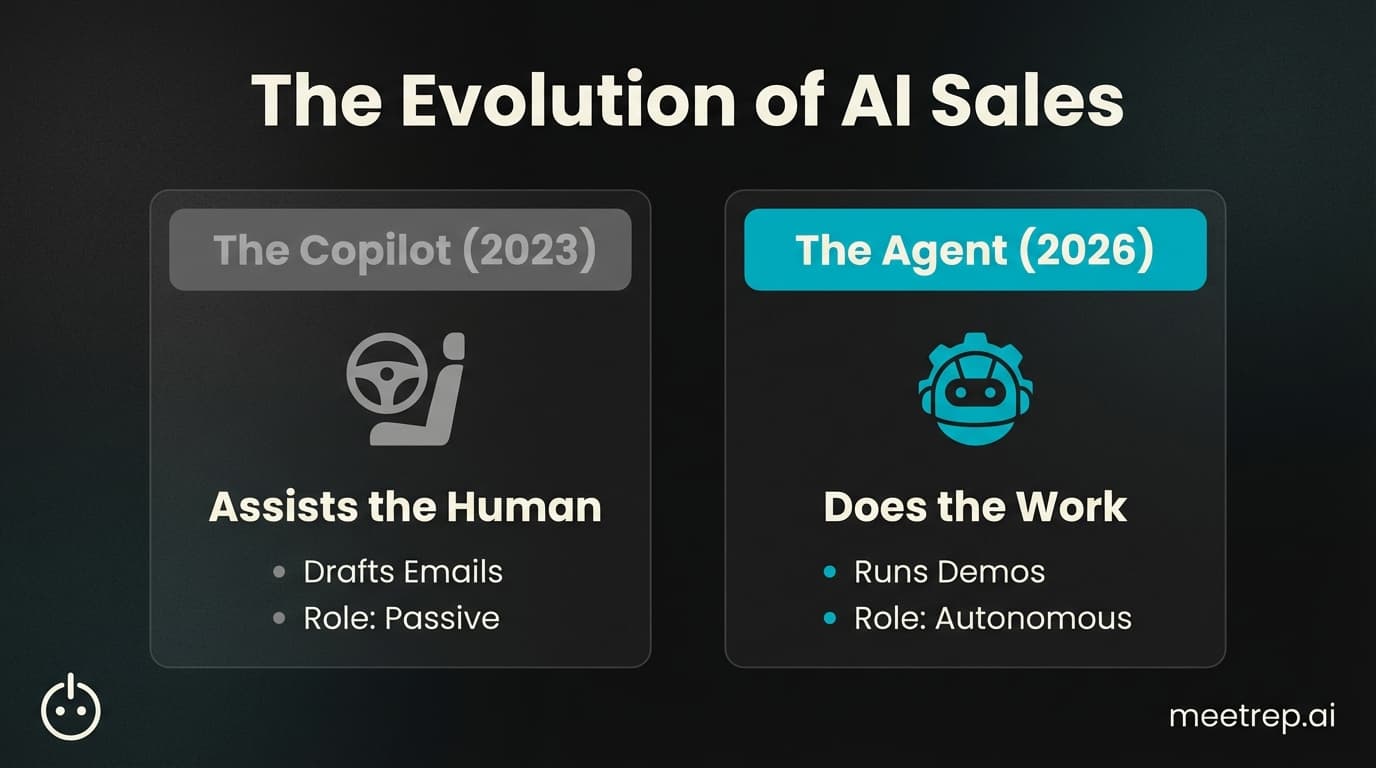
We have shifted from the era of "Copilots" (assistants that nag you) to "Agents" (digital workers that do the job).
This guide is for the VP of Sales who wants to be in the top 5% of performers—the ones seeing 3.7x higher quota attainment—rather than the majority stuck in pilot purgatory.
The "GenAI Divide": Why Most AI Implementations Fail
Why do so many AI projects crash and burn?
The answer lies in what researchers call the "GenAI Divide." A 2025 study from the MIT NANDA Initiative found that while adoption is high, 95% of pilots fail to impact the bottom line.
The reason is simple. Most companies treat an AI sales assistant like a spellchecker. They bolt it onto their existing, messy sales process. They tell reps, "Here's a tool to write emails faster," but they don't change who sends the email, when it’s sent, or why.
Common mistake: Thinking adoption equals value. Just because your reps are logging into a tool doesn't mean you're making money.
The winners—the top 5%—do something different. They engage in workflow redesign. They don't just ask AI to help a human do a task; they ask if the human needs to do that task at all.
In my experience building Rep, I've seen that the biggest gains don't come from making a rep 10% faster at typing. They come from removing the rep from the loop entirely for lower-value tasks (like initial qualification demos) so they can focus on closing.
The Data: According to Gartner's Sales Survey, sellers who effectively partner with AI are 3.7 times more likely to meet quota than those who don't. The gap between the "haves" and "have-nots" is becoming a canyon.
From "Copilots" to "Agents": The 2026 Shift
If you take one thing from this article, let it be this definition.
Agentic AI in sales refers to autonomous systems that can plan, reason, and execute multi-step workflows—such as conducting live product demos or negotiating scheduling—without direct human intervention.
This is distinct from "Copilots," which are passive assistants that require a human driver to prompt them.
As of November 2025, McKinsey reports that 23% of organizations are already scaling agentic AI. This is the new baseline.
Here is how the capabilities compare:
| Feature | GenAI Copilot (2023-2024) | Agentic AI Assistant (2025-2026) |
|---|---|---|
| Primary Function | Content generation & summarization | Task execution & decision making |
| Human Role | Driver (must prompt every step) | Manager (sets guardrails & reviews) |
| Demo Capability | Can write a script for a human | Can give the live demo autonomously |
| Scheduling | Can draft the email invite | Can negotiate times & book the slot |
| Data Context | Limited to current chat window | Retains memory across sessions |
Why we built Rep this way: When we architected Rep, we looked at the "Copilot" model and realized it was flawed for sales. Reps hate admin. Giving them a tool that requires more clicking and prompting just adds friction.
That’s why we built Rep as an agent. It joins the video call. It speaks. It shares its screen. It clicks through the browser. It does the demo. It doesn't just help the human prepare for it.
Solving the "Demo Lag": A Critical Use Case
Let’s get specific. Where should you deploy an AI sales assistant first?
Don't start with email personalization. The market is saturated, and prospects are numb to "AI-personalized" intros.
Start with Demo Lag.
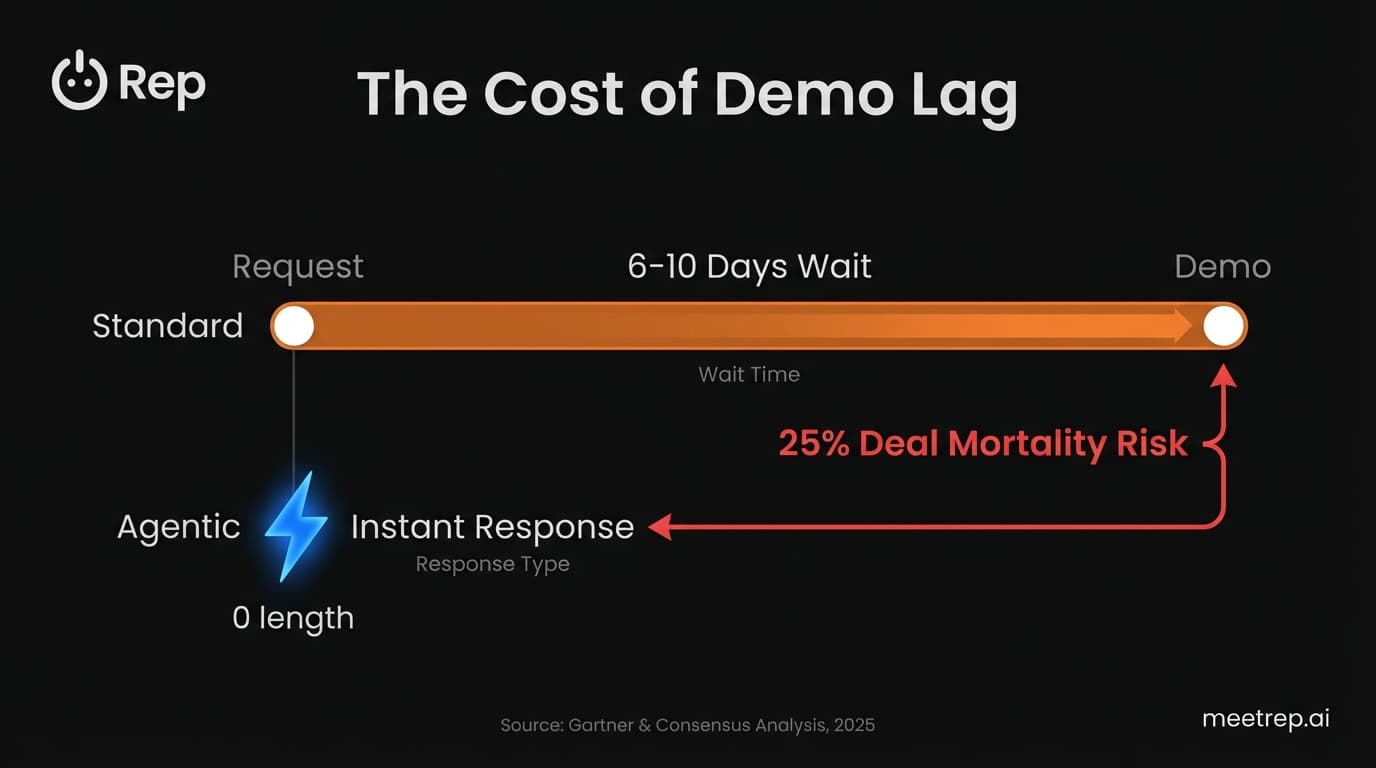
In B2B sales, time kills deals. Yet, according to Gartner and Consensus analysis, the average buyer waits 6–10 business days between requesting a demo and actually getting on a call.
That wait time accounts for roughly 25% of the total decision cycle.
During those 10 days, your prospect is:
- Cooling off.
- Booking demos with your competitors.
- Forgetting why they clicked "Book Now" in the first place.
This is a massive leak in your funnel. And it's one that human teams physically cannot fix without exploding headcount costs. You cannot staff SDRs to give live demos at 2 AM on a Saturday.
My recommendation: Use an agentic AI sales assistant to cover this gap. Tools like Rep can take that inbound request and spin up a live, interactive video demo instantly—24/7.
Key Insight:Demostack and Consensus data suggests that interactive/automated demos can reduce sales cycles by up to 30%. You aren't just saving SDR time; you are compressing the entire deal cycle.
The Human-Agent Hybrid Team
Whenever I talk about "autonomous agents," the first question from VPs is usually: "So, are we firing the sales team?"
Not exactly.
The goal isn't replacement; it's what Salesforce calls "Digital Labor." It's about offloading the grunt work so your expensive humans can do what they are actually paid for: strategy, negotiation, and relationship building.
Right now, your reps spend up to 70% of their time on non-selling activities, according to Salesforce's State of Sales report. That is a productivity tax you are paying every single day.
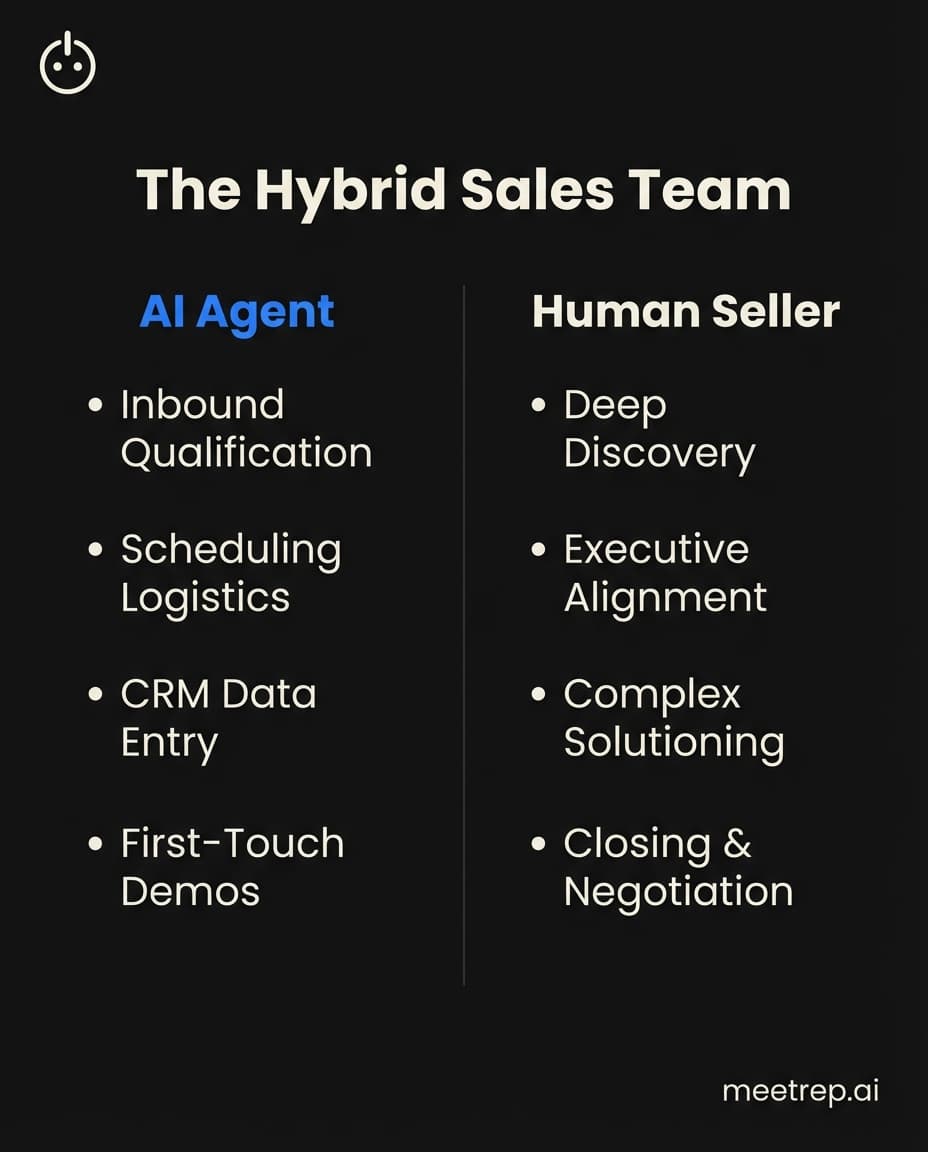
When you introduce AI agents, you flip that ratio. The agent handles:
- Inbound qualification
- The "Show up and throw up" overview demos
- Scheduling logistics
- CRM data entry
The human handles:
- Deep discovery
- Custom solutioning
- Executive alignment
- Closing
Hot Take: I believe the SDR role as we know it—primarily an appointment setter—is dead. But the people aren't going away. They are evolving into "full-cycle" junior AEs who use agents to handle the top of the funnel.
In fact, Salesforce data shows that teams with AI are more likely to increase headcount (68%) than those without (47%). You don't fire the team; you make them lethal.
Implementation Checklist for Leaders
If you want to avoid the "GenAI Divide" and actually see ROI, don't just buy a login for everyone and hope for the best.
Follow this workflow:
- Map the Deal Killers: Look at your funnel. Where do deals stall? Is it the 6-day wait for a demo? Is it the qualification call that 50% of people no-show?
- Redesign, Don't Overlay: Do not just add AI to the existing mess. If you use an agent for demos, remove the qualification step from your human SDR's calendar entirely.
- Define "Human-in-the-Loop" Guardrails: Agentic AI is powerful, but you need governance. Define exactly what the agent can say and when it must hand off to a human. (At Rep, we use verified Knowledge Bases so the AI never invents features).
- Measure Outcomes, Not Activity: Forget "emails sent." Measure "Time to Value." Did the demo lag drop from 6 days to 6 minutes? Did the sales cycle shorten by 20%?
Conclusion
The "Copilot" era was a nice experiment. But in 2026, we are playing for keeps.
The gap between the teams that figure out Agentic AI and those that don't is widening every quarter. You can continue paying the "productivity tax" of having humans do robot work—scheduling, qualifying, reciting standard scripts—or you can evolve.
My advice? Stop looking for tools that help your reps write emails faster. Start looking for agents that can actually sell.
If you want to see what a fully autonomous AI sales agent looks like—one that can join your calls and demo your product 24/7—see Rep in action here.

Nadeem Azam
Founder
Software engineer & architect with 10+ years experience. Previously founded GoCustomer.ai.
Nadeem Azam is the Founder of Rep (meetrep.ai), building AI agents that give live product demos 24/7 for B2B sales teams. He writes about AI, sales automation, and the future of product demos.
Frequently Asked Questions
Table of Contents
- The "GenAI Divide": Why Most AI Implementations Fail
- From "Copilots" to "Agents": The 2026 Shift
- Solving the "Demo Lag": A Critical Use Case
- The Human-Agent Hybrid Team
- Implementation Checklist for Leaders
- Conclusion
Ready to automate your demos?
Join the Rep Council and be among the first to experience AI-powered demos.
Get Early AccessRelated Articles
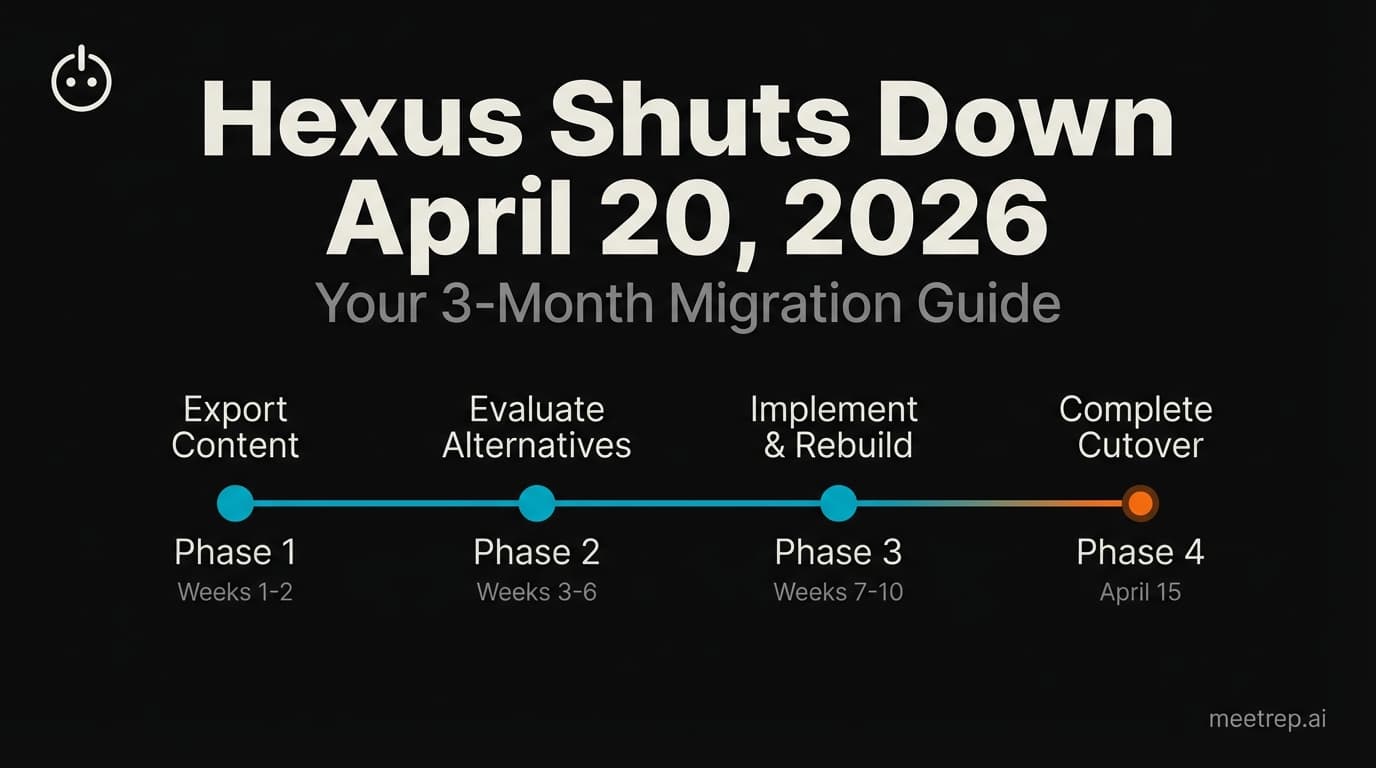
Hexus Acquired by Harvey AI: Congrats & What It Means for Demo Automation Teams
Hexus is shutting down following its acquisition by Harvey AI. Learn how to manage your migration and discover the best demo automation alternatives before April 2026.
Why the "Software Demo" is Broken—and Why AI Agents Are the Future
The traditional software demo is dead. Discover why 94% of B2B buyers rank vendors before calling sales and how AI agents are replacing manual demos to scale revenue.
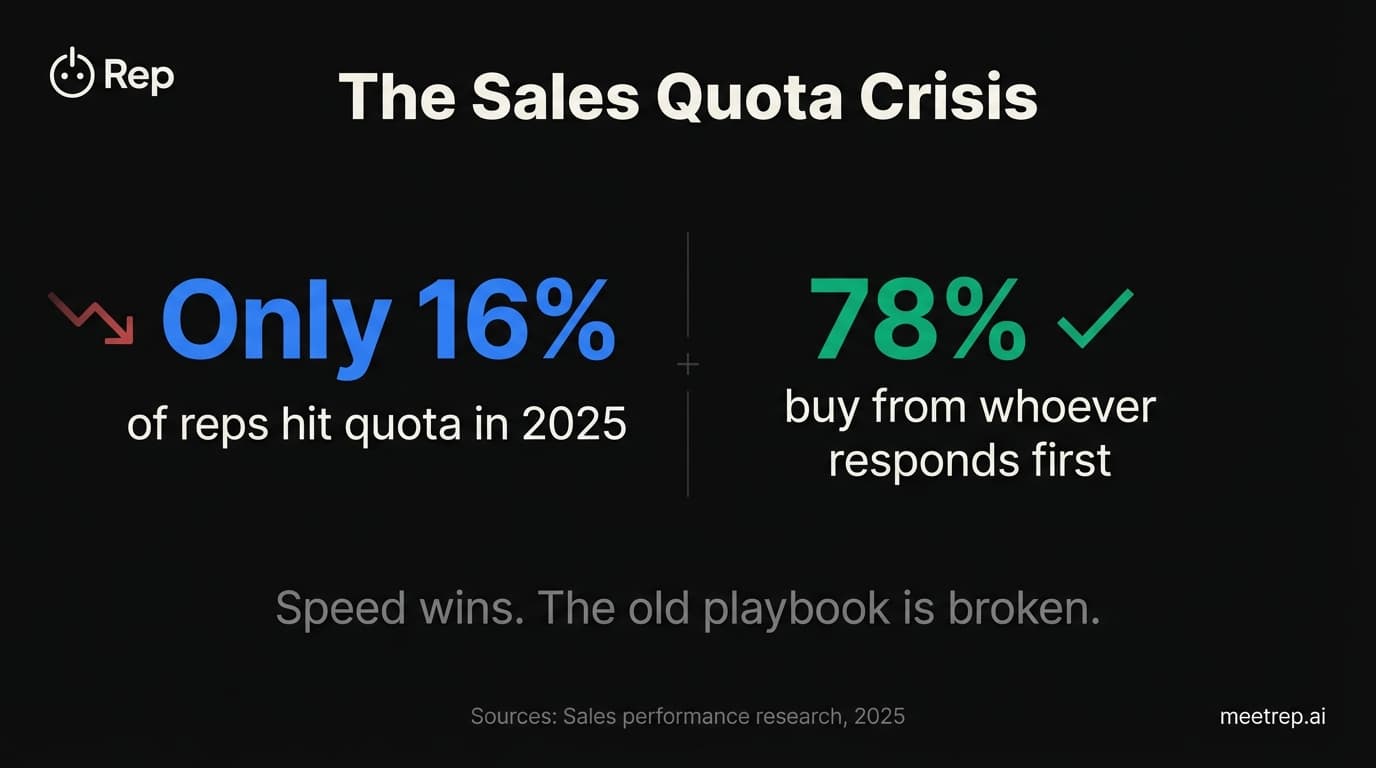
Why Autonomous Sales Software is the Future of B2B Sales (And Why the Old Playbook is Dead)
B2B sales is at a breaking point with quota attainment at 46%. Discover why autonomous 'Agentic AI' is the new standard for driving revenue and meeting the demand for rep-free buying.