AI Prospecting Tools: How to Scale Outreach Without Burning Your Brand

Executive Summary
- 81% of sales teams now use AI tools, but most are drowning in fragmented stacks that kill productivity
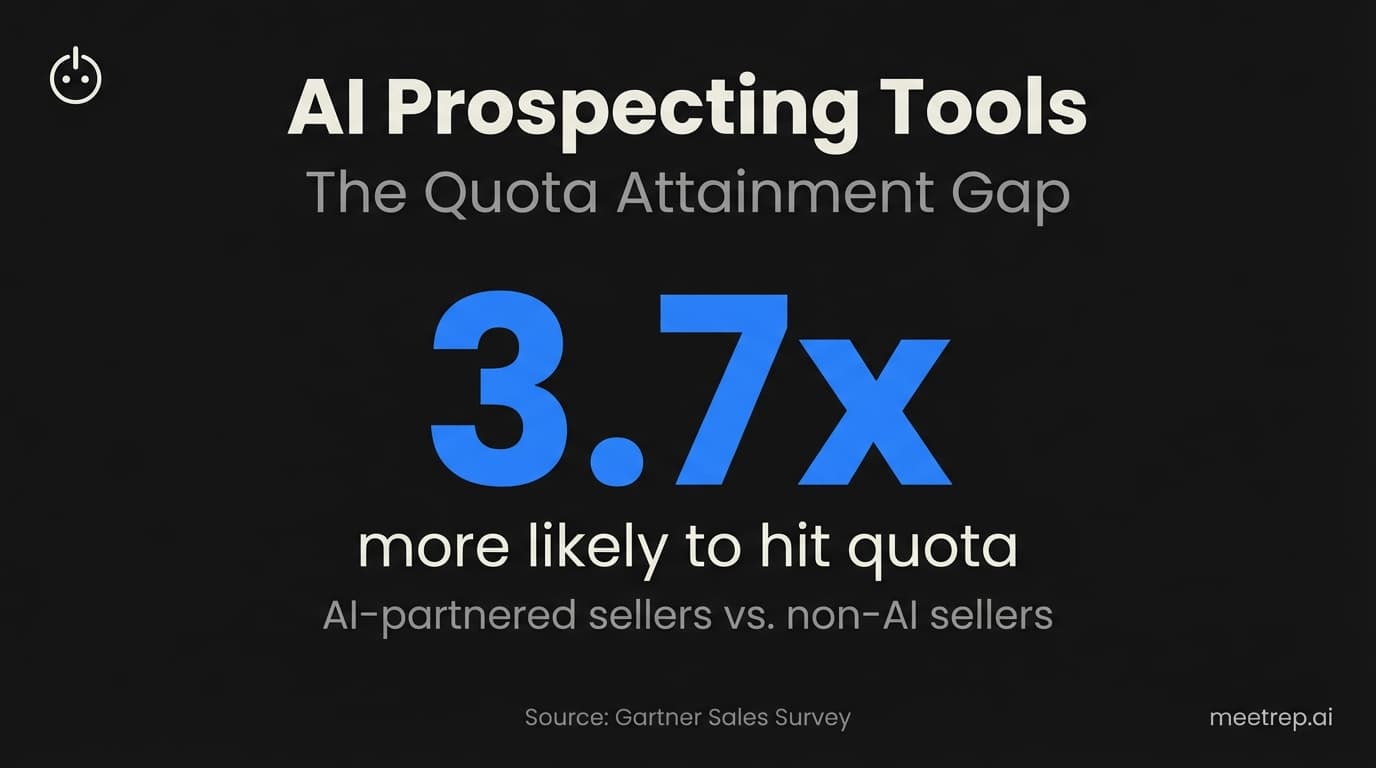
- AI-partnered sellers are 3.7x more likely to hit quota—the gap is widening fast
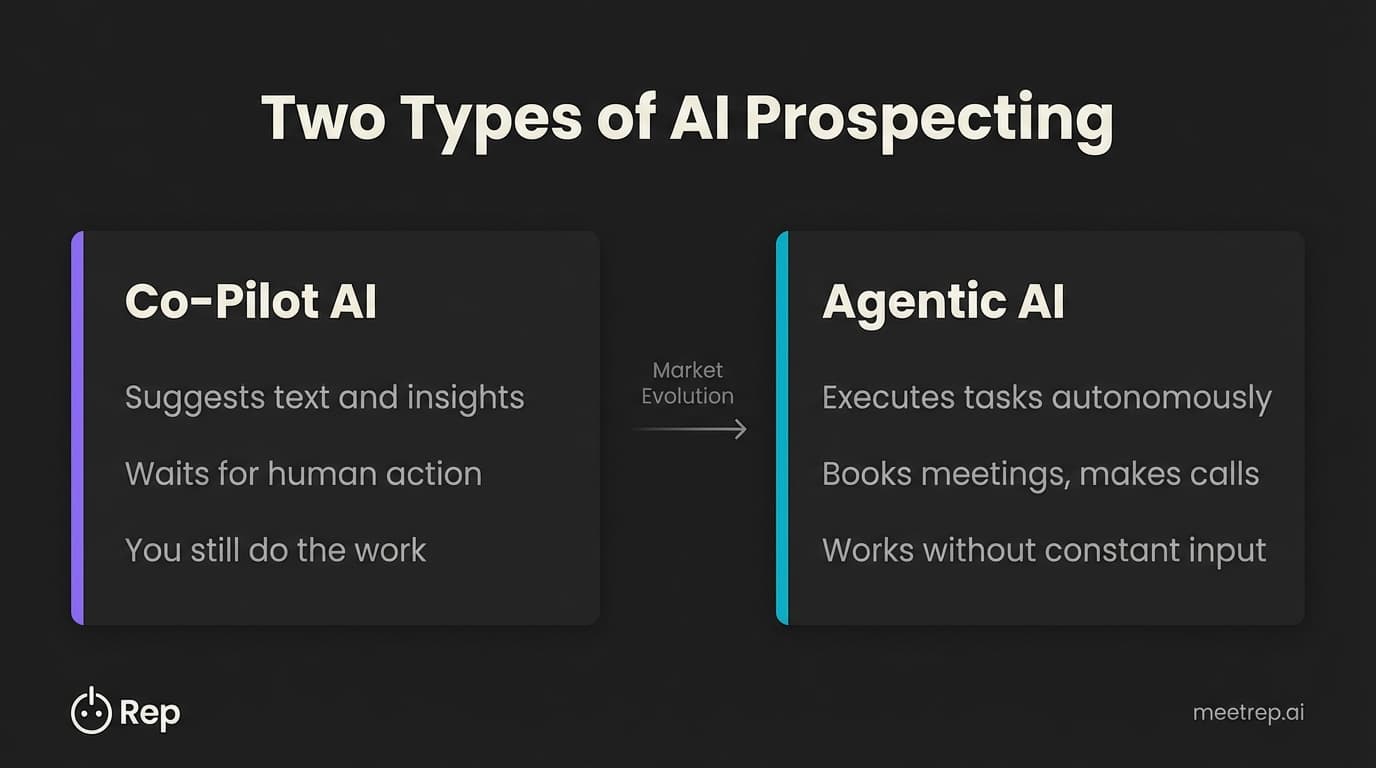
- The market is shifting from "co-pilots" (tools that suggest) to "agents" (tools that execute)
- Pick tools by team size: SMB (Apollo, Instantly), Mid-Market (Clay, Nooks), Enterprise (ZoomInfo, Outreach)
Here's a number that should make you uncomfortable: 84% of sales reps missed quota last year. And 67% don't expect to hit it this year either.
The response from most sales leaders? Add another tool to the stack. That's exactly backward.
I've built sales automation products—first GoCustomer.ai, now Rep. What I've learned is that more tools rarely mean more pipeline. The teams winning right now aren't the ones with fifteen AI tools that don't talk to each other. They're the ones who picked two or three that actually work together.
This guide breaks down which AI prospecting tools actually deliver, which ones are overhyped, and how to implement without wasting three months on a failed pilot.
What Are AI Prospecting Tools?
AI prospecting tools are software that uses machine learning, natural language processing, and predictive analytics to automate how sales teams find and engage potential customers. Unlike basic automation (think: mail merge with a schedule), these tools learn from data to prioritize leads, personalize outreach at scale, and predict which prospects are most likely to convert.
The technology breaks down into three core capabilities:
| Technology | What It Does | Example |
|---|---|---|
| Machine Learning | Analyzes historical data to predict conversion likelihood | Lead scoring in Apollo |
| Natural Language Processing | Understands and generates human-like messages | AI email writing in Regie.ai |
| Predictive Analytics | Identifies buying signals and optimal outreach timing | Intent signals in 6sense |
But here's what matters for 2025: the market is splitting into two categories.
Co-pilot tools suggest text, provide insights, and wait for you to act. They're assistants.
Agentic AI actually executes. It navigates browsers, books meetings, conducts conversations—without waiting for human approval on every step.
Key Insight: The shift from co-pilots to agents isn't marketing fluff. It's architectural. At Rep, we built an agent that joins video calls, shares its screen, and demonstrates products live. That's a fundamentally different approach than a tool that drafts emails for you to send.
Most "AI prospecting tools" on the market today are still co-pilots. That's not necessarily bad—but know what you're buying.
Why SDR Leaders Are Scrambling for These Tools Right Now
The pressure is real. And it's not just quota targets.
According to the Salesforce State of Sales Report, reps spend only 28-30% of their time actually selling. The other 70%? Admin work. Data entry. Searching for contacts. Remembering to follow up.
That's brutal. But it gets worse.
The SaaStr Beyond Benchmarks Report found that 36% of B2B companies decreased SDR/BDR headcount in 2025—the highest reduction among all sales roles. Only 19% increased.
So you're being asked to do more with fewer people while your reps spend two-thirds of their day not selling. That's the math driving the rush toward AI prospecting tools.
The Data: Teams NOT using AI are 17 percentage points less likely to achieve revenue growth. 83% of AI-using teams saw growth vs. 66% without. | Source: Salesforce State of Sales Report, April 2024
The gap isn't closing. It's widening.
The Quota Attainment Gap: What the Data Actually Shows
Let me be direct about what the research says.
Sellers who effectively partner with AI tools are 3.7x more likely to meet quota than those who don't. That's from Gartner's Sales Survey, and it's been reconfirmed through 2025.
Not 20% more likely. Not twice as likely. 3.7 times.
And the HubSpot 2025 State of Sales Report backs this up from a different angle: 84% of reps say AI saves time and optimizes processes, while 83% say it helps personalize interactions.
Here's my take on why the gap is so large: it's not that AI tools are magic. It's that they're eliminating the 70% of wasted time. When your reps can actually spend most of their day selling—instead of searching LinkedIn or updating Salesforce—quota becomes achievable.
Key Insight: The 3.7x multiplier isn't about AI being smarter than humans. It's about AI reclaiming the 70% of time humans were wasting on tasks machines handle better.
But I need to be honest about something. These stats come from teams who implemented well. The tools don't work if you pick wrong, skip training, or add them to an already-broken process.
Quick Comparison: AI Prospecting Tools by Team Size
Stop evaluating tools based on feature lists. Start with team size and use case.
| Tool | Best For | Price Range | Key Strength | Watch Out For |
|---|---|---|---|---|
| Apollo.io | SMB, Mid-Market | $50-150/user/mo | All-in-one with 275M contacts | Data accuracy lower than enterprise tools |
| ZoomInfo | Enterprise | $15K-100K+/yr | Premium data quality, buying committee mapping | Complex setup, enterprise pricing |
| Clay | Technical teams | $149-800+/mo | 100+ data providers, highly customizable | Requires technical skills to maximize |
| Outreach | Mid-Market, Enterprise | Custom quote | AI sequencing, conversation intelligence | Overkill for small teams |
| Salesloft | Mid-Market, Enterprise | Custom quote | Rhythm AI for deal insights | Similar overkill concerns |
| Nooks | Phone-heavy teams | Custom quote | Parallel dialing, virtual sales floor | Phone-specific, not multi-channel |
| Instantly.ai | SMBs, high-volume email | $30-50/mo | Unlimited accounts, deliverability focus | Basic integrations |
| Cognism | EU/GDPR-focused | Custom quote | Phone-verified mobiles, EU-compliant | Primarily European data strength |
| 11x | Volume outbound | $3K-5K/mo | Autonomous Digital SDR | 2025 controversy—pilot carefully |
Common Mistake: Picking the most "powerful" tool regardless of team size. I've seen 10-person sales teams buy enterprise platforms that take 3 months to configure. By month 4, nobody's using them. Match the tool complexity to your operational maturity.
My recommendation: if you're under 50 reps, start with Apollo or Instantly. Get wins. Then evaluate whether you need more.
How to Actually Implement AI Prospecting (Without Wasting 3 Months)
Here's the implementation approach that works. I've done this wrong enough times to know what to skip.
Step 1: Define Your ICP Before You Touch a Tool
Seriously. Don't skip this. If you feed garbage criteria into AI, you get garbage leads at scale. Document firmographics (company size, industry, revenue), technographics (what tools they use), and behavioral signals (job changes, funding announcements).
Step 2: Start With One Channel, Not Three
Multi-channel sounds great in demos. In practice, it creates chaos. Pick email OR phone OR LinkedIn. Master one. Then expand.
Step 3: Pilot With 2-3 Reps for 30 Days
Don't roll out to everyone. Pick your most adaptable reps, give them clear metrics (meetings booked, response rates), and measure hard results. No "it feels good" assessments.
Step 4: Connect to Your CRM From Day One
The Nimble Sales Automation Guide calls this the "Fragmentation Tax"—productivity drain from disconnected tools. If your AI prospecting tool doesn't sync bidirectionally with Salesforce or HubSpot, you're creating more admin work, not less.
Step 5: Build Feedback Loops
Review what's working weekly. Which subject lines get opens? Which sequences get replies? AI tools learn from data—but only if you're feeding them outcomes.
The Data: Poor data quality costs organizations an average of $12.9 million every year. | Source: Gartner Data Quality Research, October 2025
That stat isn't about prospecting specifically. But it explains why "garbage in, garbage out" kills AI implementations. Clean your CRM before you automate it.
Realistic Timeline Expectations:
| Tool Tier | Time to Initial Results | Time to Full Optimization |
|---|---|---|
| Basic (Apollo, Instantly) | 2-4 weeks | 90 days |
| Mid-tier (Clay, Nooks) | 4-6 weeks | 90-120 days |
| Enterprise (ZoomInfo, Outreach) | 6-12 weeks | 6 months |
Anyone promising instant results is lying to you.
AI vs. Manual Prospecting: When Each Wins
This isn't about AI replacing humans. It's about knowing which approach fits which situation.
| Factor | AI Prospecting | Manual Prospecting |
|---|---|---|
| Speed | Thousands of prospects in minutes | 50-100 per day per rep |
| Personalization | Good at scale (15+ data points) | Excellent for individuals |
| Cost per Lead | $5-15 per qualified lead | $20-50 per qualified lead |
| Complex Deals | Struggles with complex situations | Excels at relationship building |
| Response Rates | Consistent but capped | Higher ceiling with skilled reps |
So when should you use which?
AI wins for: High-volume outbound, initial qualification, data enrichment, follow-up sequences, 24/7 coverage for inbound.
Manual wins for: Enterprise deals with multi-stakeholder buying committees, accounts requiring deep relationship building, industries with strict compliance requirements.
My Recommendation: "AI gets you in the room. Your team still wins the deal." Use AI for the first touch and qualification. Use humans for discovery, demos, and closing. That's the hybrid model that actually works.
And honestly? Once AI books the meeting, you face a different bottleneck: the demo itself. That's why we built Rep—to handle live product demonstrations so human reps can focus on high-value conversations. But that's a different stage of the funnel than what prospecting tools address.
What Happens Next: Predictions Through 2028
Gartner predicts that by 2027, 95% of seller research workflows will begin with AI. Not "include AI." Begin with it.
That's a fundamental shift. Research used to be a human skill. Soon it'll be table stakes that AI handles while humans focus on judgment and relationships.
I think the bigger shift is this: the distinction between "tool" and "worker" is collapsing. We're moving from AI that helps reps do tasks to AI that does tasks itself. At Rep, we're building an AI that literally joins video calls and gives demos. Nooks built an AI that dials in parallel. 11x built an AI that runs entire outbound sequences autonomously (though they've had issues—do your diligence).
This isn't speculation. 81% of sales teams already use AI. The question isn't whether to adopt. It's whether you're using tools that execute or tools that just suggest.
The teams winning with AI prospecting tools aren't the ones with the biggest tech stack. They're the ones who picked tools that match their team size, implemented with realistic timelines, and built feedback loops that actually improve performance.
The data is clear: 3.7x quota attainment difference. 17-point revenue growth gap. This isn't optional anymore.
If you're evaluating tools, start with the comparison table above. Match your team size. Pilot before you commit. And remember that prospecting is only one piece—once you're booking meetings, you'll face the demo bottleneck next.
That's a problem we're solving at Rep. But wherever you are in the funnel, pick fewer tools that work together over more tools that don't.

Nadeem Azam
Founder
Software engineer & architect with 10+ years experience. Previously founded GoCustomer.ai.
Nadeem Azam is the Founder of Rep (meetrep.ai), building AI agents that give live product demos 24/7 for B2B sales teams. He writes about AI, sales automation, and the future of product demos.
Frequently Asked Questions
Table of Contents
- What Are AI Prospecting Tools?
- Why SDR Leaders Are Scrambling for These Tools Right Now
- The Quota Attainment Gap: What the Data Actually Shows
- Quick Comparison: AI Prospecting Tools by Team Size
- How to Actually Implement AI Prospecting (Without Wasting 3 Months)
- AI vs. Manual Prospecting: When Each Wins
- What Happens Next: Predictions Through 2028
Ready to automate your demos?
Join the Rep Council and be among the first to experience AI-powered demos.
Get Early AccessRelated Articles
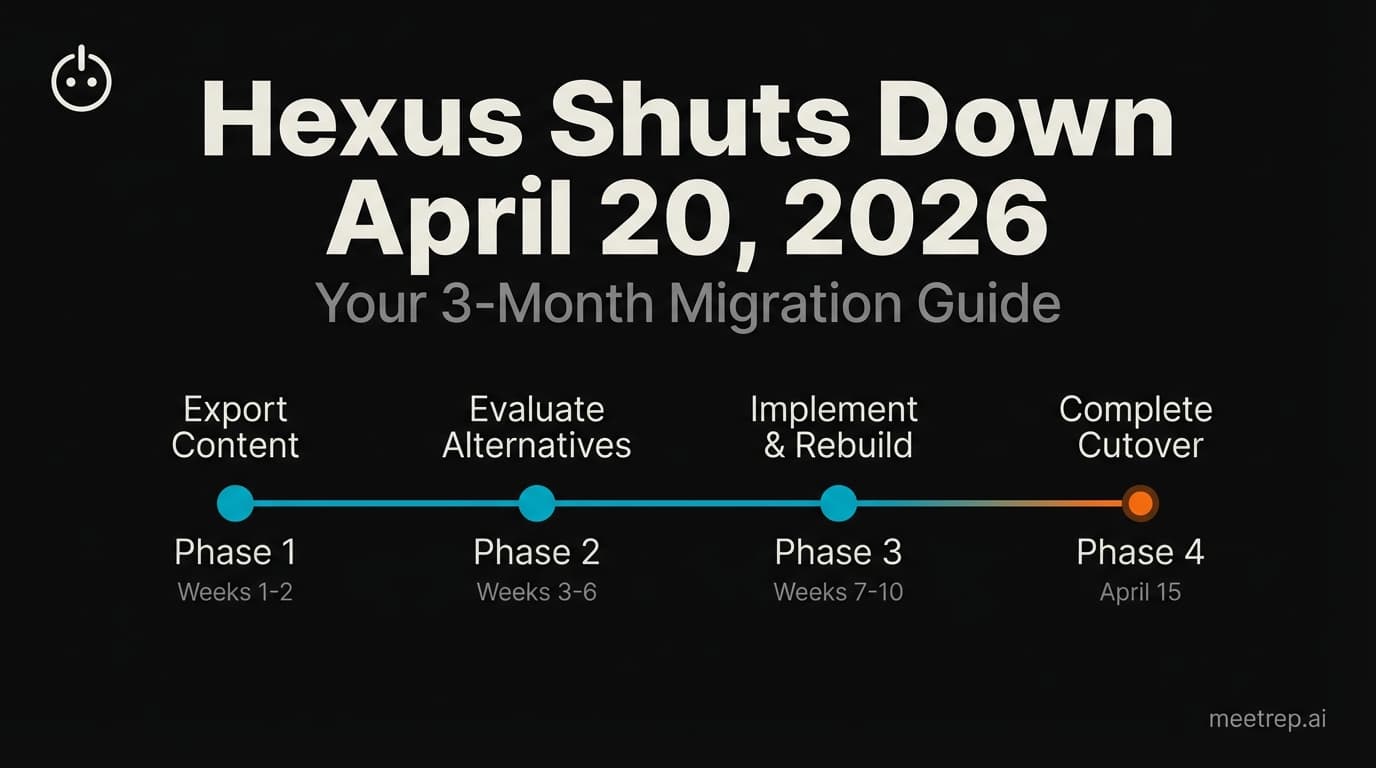
Hexus Acquired by Harvey AI: Congrats & What It Means for Demo Automation Teams
Hexus is shutting down following its acquisition by Harvey AI. Learn how to manage your migration and discover the best demo automation alternatives before April 2026.
Why the "Software Demo" is Broken—and Why AI Agents Are the Future
The traditional software demo is dead. Discover why 94% of B2B buyers rank vendors before calling sales and how AI agents are replacing manual demos to scale revenue.
Why Autonomous Sales Software is the Future of B2B Sales (And Why the Old Playbook is Dead)
B2B sales is at a breaking point with quota attainment at 46%. Discover why autonomous 'Agentic AI' is the new standard for driving revenue and meeting the demand for rep-free buying.