AI Product Review Video Generator Guide: The Founder’s Take

Executive Summary
- Avatar-based tools (HeyGen, Synthesia) are excellent for announcements but often trigger the "Uncanny Valley" in product reviews.
- Navigation-based tools (Rep) interact with your live software to create authentic walkthroughs.
- B-Roll tools (InVideo) are for hype, not functional reviews.
- Trust is physical: If the AI looks 99% human but moves 1% robotically, trust plummets.
- The future isn't video files. It's interactive, navigable experiences that happen live.
Making high-quality product videos is a nightmare.
I say that as a founder who has built two SaaS platforms. You usually have two bad options. Option A: Pay an agency $15,000 and wait six weeks for a polished video. It looks great, but it becomes obsolete the moment your engineering team pushes a UI update. Option B: Record it yourself on Loom. You stumble over your words. You pause too long. It looks... well, like a screen recording.
But there’s a third way emerging.
An AI product review video generator promises to automate this mess. It turns scripts into videos, navigates software automatically, and speaks with human-like intonation. But the market is flooded with tools. They range from "incredible" to "downright creepy."
Having architected Rep to solve this exact problem, and having exited GoCustomer.ai before that, I’ve spent years looking at the code behind these tools. I know where the bodies are buried.
Here is the honest breakdown of how these generators work, which architecture fits your use case, and why we built Rep differently.
What Is an AI Product Review Video Generator?
An AI product review video generator is software that uses artificial intelligence to create video content demonstrating or reviewing a product without requiring cameras, actors, or manual editing.
These tools take text inputs—like scripts, URLs, or prompts—and output video files. They handle the voiceover, the visual assets, and sometimes generate the presenter itself.
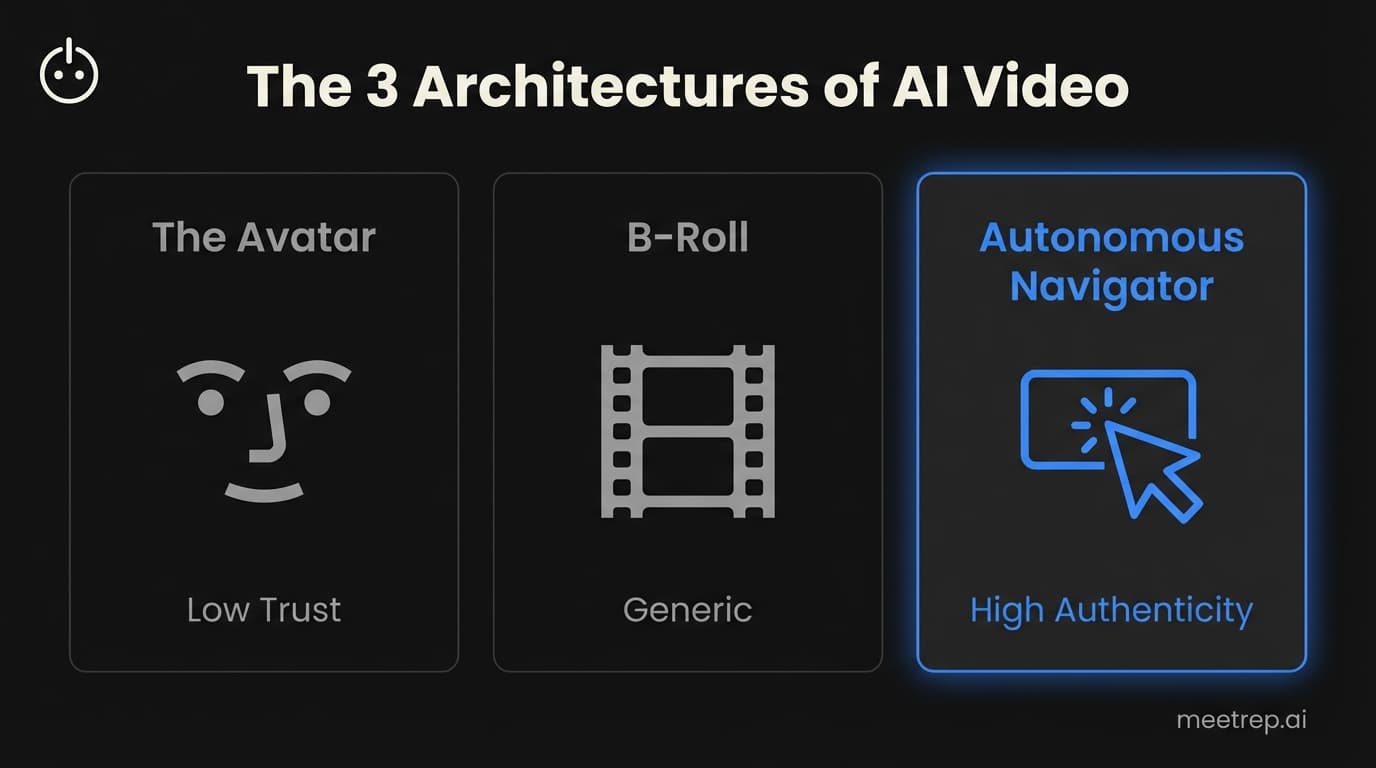
But "generator" is a broad term. In 2025, these tools fall into three distinct architectural categories. If you pick the wrong one, you waste money. Or worse, you damage your brand.
The Three Architectures of AI Video
Not all AI video is built the same. When we started building Rep, we analyzed the entire market. We saw three distinct approaches. Each has massive trade-offs.
1. The "Talking Head" Avatar
You've seen these. A photorealistic avatar stands in front of a green screen and reads your script.
- Tools: Synthesia, HeyGen.
- How it works: Uses Generative Adversarial Networks (GANs) to lip-sync audio to a static image or video loop of an actor.
- Best for: Internal training, HR announcements, personalized sales outreach at scale.
- My take: For product reviews? Be careful. When a prospect sees a "perfect" human who never breathes quite right, they focus on the fake face. They stop looking at your product.
2. The B-Roll Generator
These tools scrape your website or take a prompt and stitch together stock footage with text overlays.
- Tools: InVideo, Runway.
- How it works: Large Language Models (LLMs) analyze your text to select relevant stock clips and generate transitions.
- Best for: Social media hype videos, high-level marketing fluff.
- My take: Useless for software. You can't review a complex SaaS product using stock footage of a guy typing on a laptop in a coffee shop. Buyers need to see your interface.
3. The Autonomous Navigator
This is the category we’re building in. Instead of generating a fake video file, the AI actually uses your product.
- Tools: Rep.
- How it works: The AI hooks into your browser (DOM). It clicks buttons, types text, and navigates your live app while narrating.
- Best for: Deep product dives, how-to guides, and authentic reviews.
- My take: This builds the most trust. It shows the actual product working, not a video edit.
Key Insight: Buyers don't want to see a spokesperson (AI or human). They want to see the product. The most effective AI video tools get out of the way and show the interface.
Why "Perfect" Avatars Kill Trust
I need to be honest about something that drove us crazy at GoCustomer.
We experimented with early AI avatars for sales. The logic seemed sound: people buy from people, so let's put a digital person on the screen.
It failed. Hard.
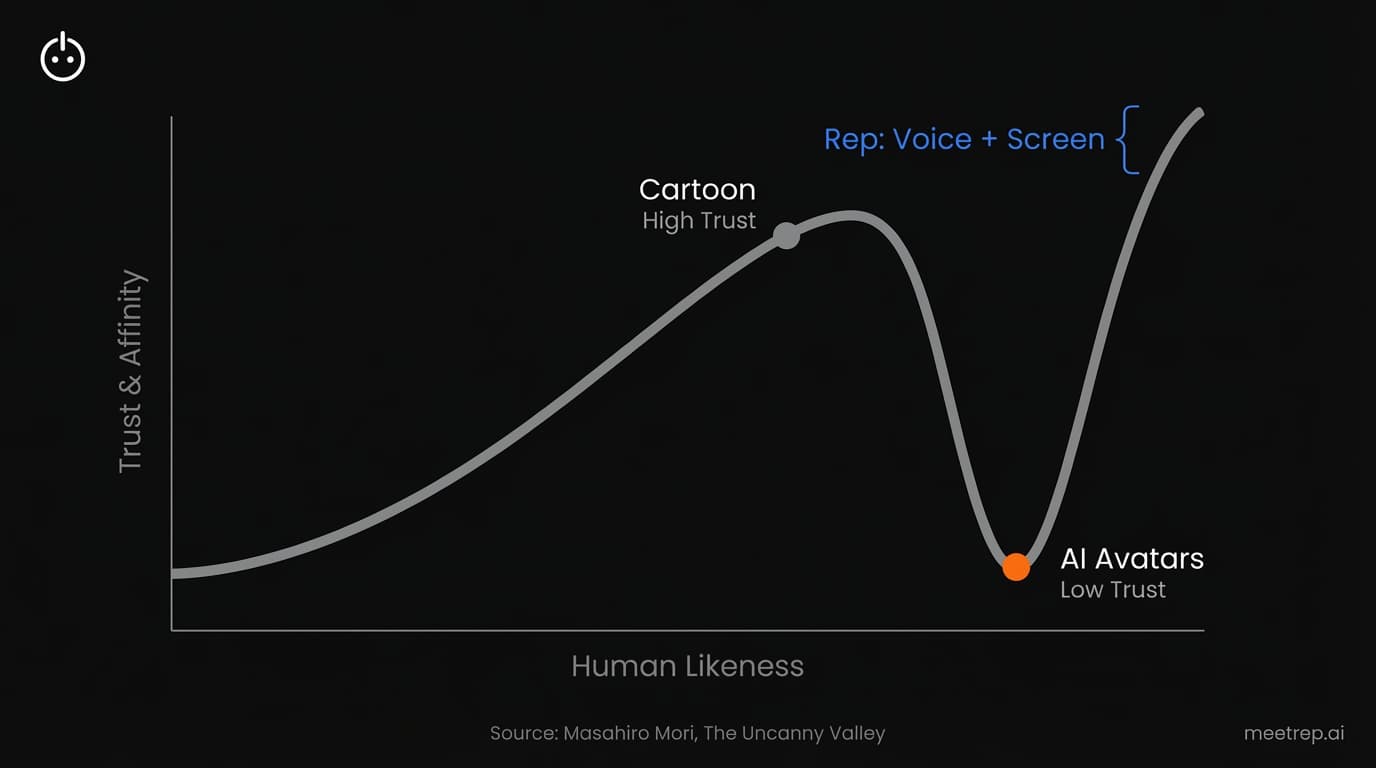
The problem is the Uncanny Valley. This is a concept in robotics and aesthetics. It suggests that when a human replica looks almost—but not exactly—like a real human, it causes a response of revulsion among observers.
When you use a hyper-realistic AI avatar for a product review, your viewer's brain enters a defensive state. They are subconsciously looking for the glitch. Did the eye twitch?Is the mouth sync off?Why don't they blink?
Once they are in that skeptical mode, they aren't listening to your value proposition. They're just analyzing the fake human.
Why we built Rep this way: At Rep, we decided to scrap visual avatars for demos entirely. We focus on Voice + Screen. A warm, human-like voice (that pauses, breathes, and reacts) guiding the user through the live screen is infinitely more trustworthy than a fake face. We let the product be the star.
Top AI Product Review Generators Compared
If you're evaluating tools, here is how the market leaders stack up based on architecture and use case.
| Feature | Rep | Synthesia / HeyGen | Loom (Manual) |
|---|---|---|---|
| Core Architecture | Autonomous Browser Navigation | Generative Video Avatar | Screen Recording |
| Primary Output | Live interactive demo & video | MP4 Video File | MP4 Video File |
| Authenticity | High (Shows live product) | Low (Simulated human) | High (Real human) |
| Maintenance | Auto-updates with product changes | Must re-render video | Must re-record video |
| Interactivity | Viewer can click/ask questions | Passive watching | Passive watching |
| Setup Time | Medium (Train the AI) | Fast (Type script) | Fast (Hit record) |
| Best For | Detailed product walkthroughs | Marketing hooks / Intros | Quick 1:1 explanations |
How to Create an AI Product Review (The Right Way)
If you decide to use AI for this, don't just paste a blog post into a generator and hit "publish." That’s how you get generic garbage.
Here is the workflow we use internally to ensure quality.
1. Script for the Ear, Not the Eye
AI text-to-speech engines (TTS) have gotten scary good. But they struggle with long, complex sentences.
- Bad: "Our comprehensive dashboard facilitates data visualization allowing for optimized decision-making processes."
- Good: "Look at this dashboard. It shows your data instantly. This helps you make better decisions fast."
Short sentences. Punchy verbs. Write like you talk.
2. Prioritize "Show," Don't "Tell"
If your script says "click the settings button," the video must show the cursor clicking the settings button.
This sounds obvious. Yet I see hundreds of AI videos where the voiceover talks about a feature while the video shows a generic logo animation. That’s a trust killer. Sync implies truth.
3. The "Human" Polish
Pure AI perfection feels robotic. We learned this while tuning the voice engine for Rep. Initially, we removed all "ums," pauses, and breaths. The result sounded like a GPS navigator.
We had to add the imperfections back in.
My recommendation: If your tool allows it, add micro-pauses (0.2s) between sentences. If you're using a tool like Rep, configure the voice persona to match your brand vibe—whether that's energetic (Puck) or professional (Kore).
The Hidden Cost of Video Files
Here is the technical reality that nobody in marketing wants to talk about.
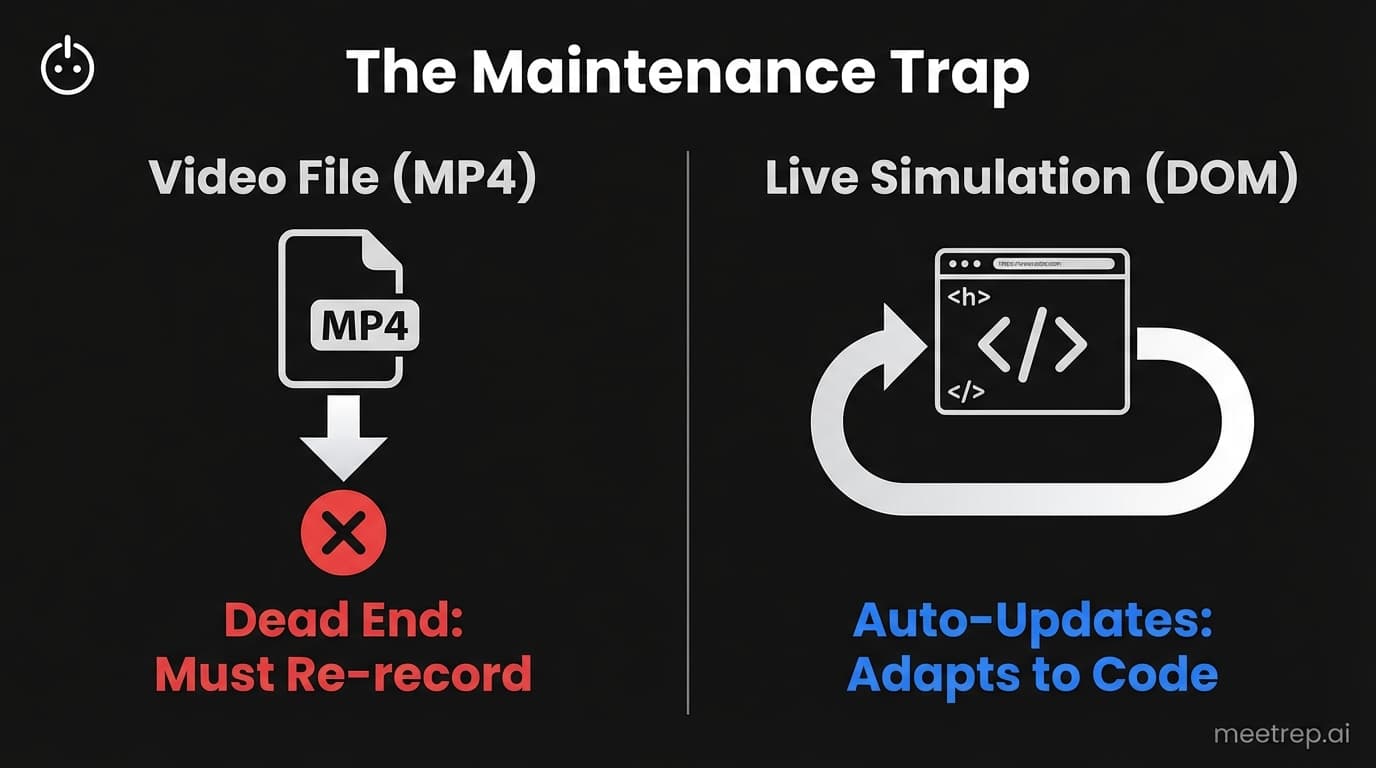
Video files are dead ends.
You spend $5,000 or 20 hours making a perfect MP4 product review. You put it on YouTube.
- Can the viewer click a button inside the video to try the feature? No.
- If they have a question, can the video answer it? No.
- When you update your UI next week, does the video update? No.
This is why we architected Rep as a live simulation engine, not a video renderer.
When a prospect clicks a "Watch Demo" link with Rep, they aren't downloading an MP4. They are entering a live room where an AI agent is actually driving a browser in the cloud.
If they ask, "Wait, show me that integration again," Rep stops, goes back, and shows it. If your engineering team pushes a UI update, Rep sees the new code and adapts automatically.
Static video is the past. Autonomous, interactive simulation is the future.
Authenticity is your only currency.
We built GoCustomer.ai. We're building Rep. We have seen the data. Buyers are smart. They can smell a fake video from a mile away.
If you use AI to help you communicate truth—by showing your product clearly, answering questions instantly, and being available 24/7—you win.
If you use AI to mask reality with a polished, fake avatar reading a script they don't understand, you lose.
Choose the tool that respects your customer's intelligence.
Ready to stop making static videos? See how an autonomous AI agent can give live, interactive product reviews 24/7. Meet Rep.

Nadeem Azam
Founder
Software engineer & architect with 10+ years experience. Previously founded GoCustomer.ai.
Nadeem Azam is the Founder of Rep (meetrep.ai), building AI agents that give live product demos 24/7 for B2B sales teams. He writes about AI, sales automation, and the future of product demos.
Frequently Asked Questions
Table of Contents
- What Is an AI Product Review Video Generator?
- The Three Architectures of AI Video
- Why "Perfect" Avatars Kill Trust
- Top AI Product Review Generators Compared
- How to Create an AI Product Review (The Right Way)
- The Hidden Cost of Video Files
Ready to automate your demos?
Join the Rep Council and be among the first to experience AI-powered demos.
Get Early AccessRelated Articles
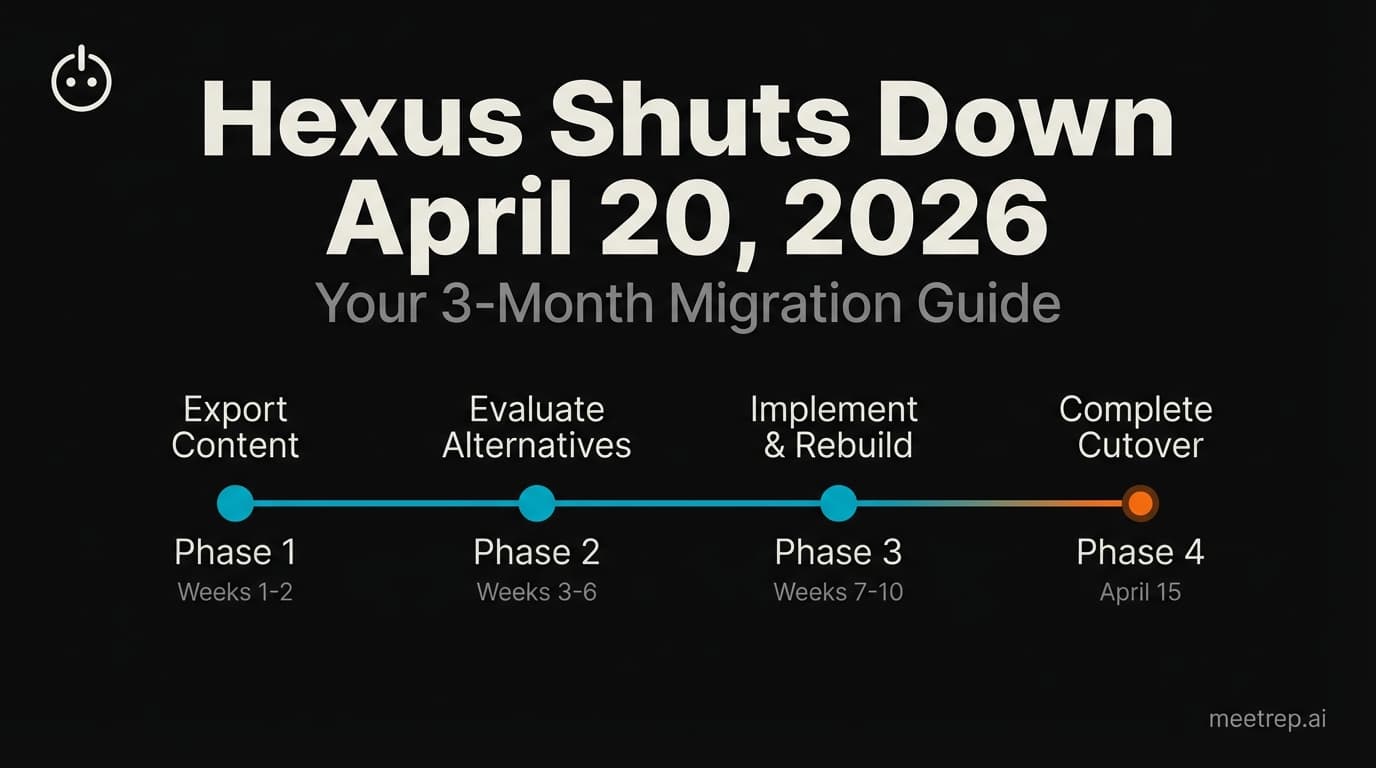
Hexus Acquired by Harvey AI: Congrats & What It Means for Demo Automation Teams
Hexus is shutting down following its acquisition by Harvey AI. Learn how to manage your migration and discover the best demo automation alternatives before April 2026.
Why the "Software Demo" is Broken—and Why AI Agents Are the Future
The traditional software demo is dead. Discover why 94% of B2B buyers rank vendors before calling sales and how AI agents are replacing manual demos to scale revenue.
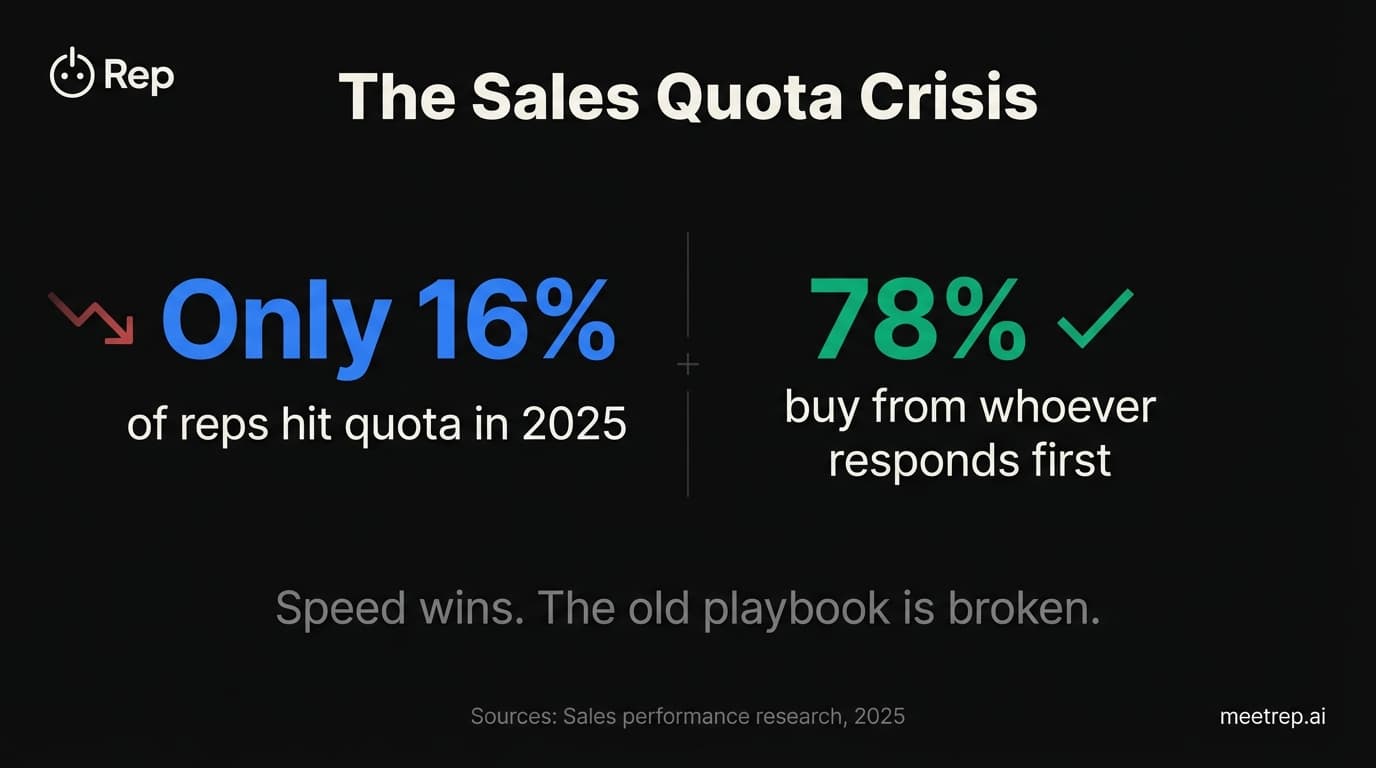
Why Autonomous Sales Software is the Future of B2B Sales (And Why the Old Playbook is Dead)
B2B sales is at a breaking point with quota attainment at 46%. Discover why autonomous 'Agentic AI' is the new standard for driving revenue and meeting the demand for rep-free buying.