AI Lead Generation: Why Agents Are Replacing Copilots in 2026

Executive Summary
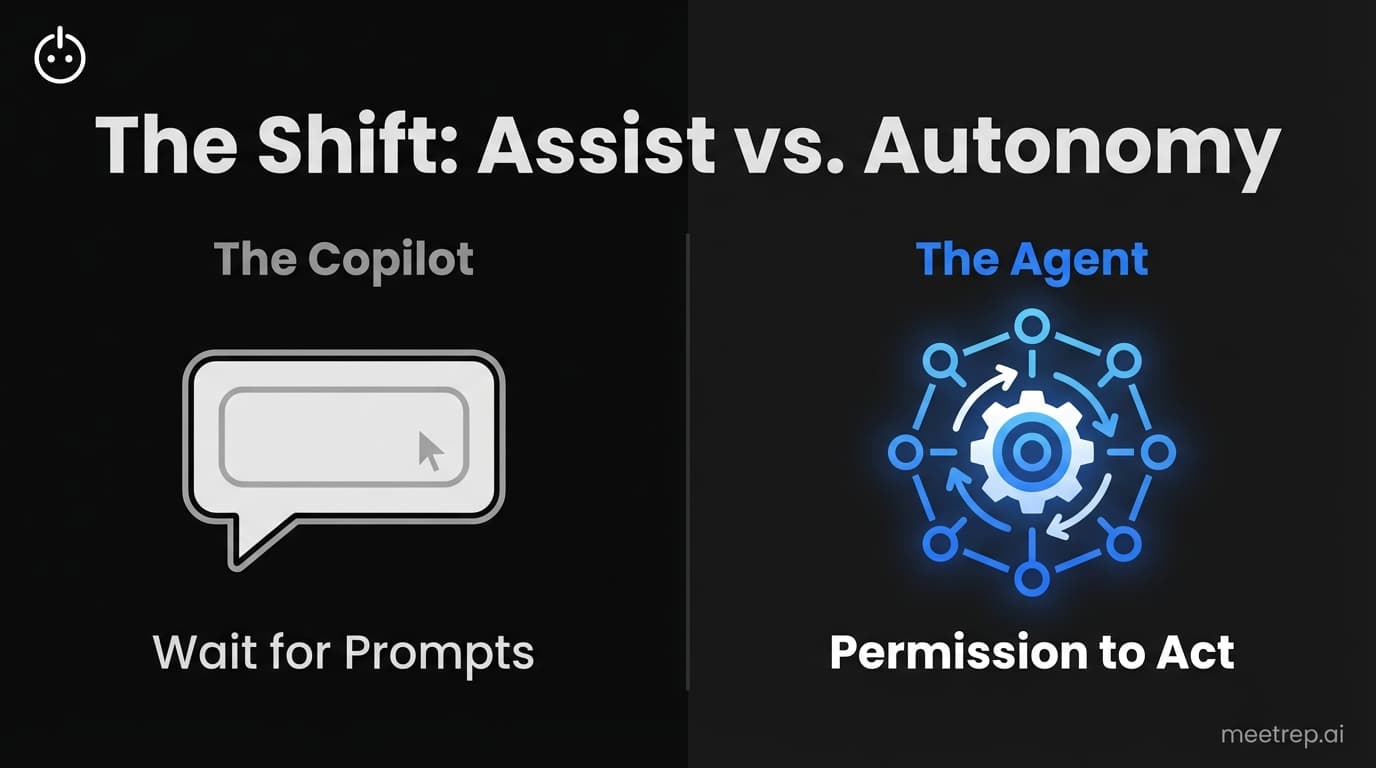
- The Shift: The market is moving from "Copilots" (human-assisted) to "Agents" (autonomous).
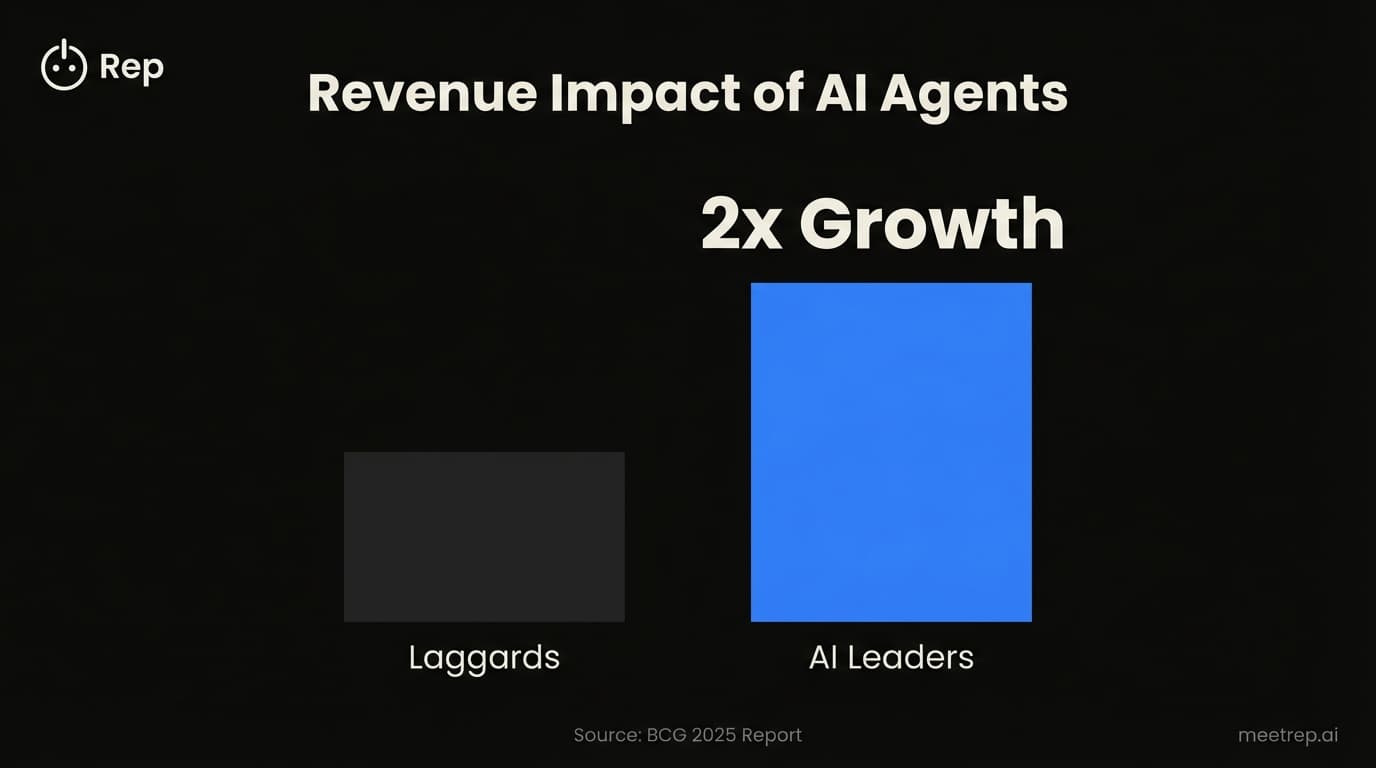
- The ROI: Teams using AI agents are seeing 2x revenue growth compared to laggards.
- The Stack: It’s no longer about one tool. It’s about a workflow: Data (Clay) → Outreach (11x) → Demo Engagement (Rep).
- The Risk: Inaction is expensive. 84% of companies report margin erosion due to unmanaged AI costs.
If you’re a sales leader in 2026, you’re probably tired of hearing about AI. I don't blame you. For the last two years, you've likely been pitched a hundred different "copilots" that promised to revolutionize your pipeline but really just helped your reps write slightly better emails, slightly faster.
But the era of the copilot is ending.
We are seeing a hard shift toward "Agentic AI"—systems that don't just help your reps work, but actually do the work. The data backs this up. According to Gartner, by 2027, 95% of seller research workflows will begin with AI (up from less than 20% in 2024).
Having built sales automation tools at GoCustomer.ai and now autonomous agents at Rep, I’ve seen this transition firsthand. The winners aren't using AI to spam more people. They're using it to build a digital workforce.
Here is what AI lead generation actually looks like in 2026, and why you can’t afford to ignore it.
What Is AI Lead Generation in 2026?
AI lead generation is the use of agentic artificial intelligence to autonomously identify, qualify, and engage potential customers. Unlike traditional methods that rely on manual research or simple list-buying, AI agents (often called "digital workers") analyze vast datasets to detect buying signals, execute personalized outreach at scale, and even conduct initial product demonstrations 24/7.
It’s important to distinguish this from what we saw in 2024. Back then, "AI lead gen" mostly meant using ChatGPT to write generic email templates that you then blasted out via a sequencer.
That doesn't work anymore.
Today, Agentic AI means the software has permission to act. It perceives a signal (e.g., a prospect hires a new VP of Engineering), decides on the right play, finds the contact info, enriches the data, writes the message, and handles the initial reply—all without human intervention.
Key Insight: Real AI lead generation is about Speed-to-Lead. A human BDR sleeps. An AI agent replies to an inbound lead in 8 seconds, qualifies them, and runs the demo right then and there.
The "Spam Cannon" Crisis (And How to Fix It)
We need to talk about the elephant in the room.
If you open your inbox right now, it’s probably a disaster zone. Dozens of irrelevant, poorly personalized emails from "AI tools."
This is the backlash.
At GoCustomer.ai, we learned this lesson the hard way. We saw that when you give teams unlimited automation power, their instinct is often to turn up the volume. "If 1,000 emails get me 5 meetings, 10,000 emails will get me 50."
Wrong.
The market has adjusted. Spam filters are aggressive. Buyers are annoyed. It's noisy. It's messy. And "spray and pray" tactics are burning your total addressable market (TAM).
The solution isn't less AI. It's Signal-Based Selling.
Top-performing teams are using AI to perform deep research that no human has time for. Instead of emailing everyone, they use tools to monitor:
- Technographic changes (e.g., "Company X just installed HubSpot")
- Hiring signals (e.g., "Company Y is hiring 5 SDRs")
- Funding news
LinkedIn data shows that while 56% of sales pros use AI daily, the most successful ones are using it for research, not just writing.
Copilots vs. Agents: The Critical Difference
This is where most sales leaders get stuck. They buy a tool thinking it will solve their pipeline problem, but it just adds another tab for their reps to manage.
You need to understand the difference between a Copilot (Gen 1) and an Agent (Gen 2).
| Feature | AI Copilot (2023-2024) | Agentic AI (2025-2026) |
|---|---|---|
| Role | Assistant to the human | Autonomous digital worker |
| Trigger | Human prompts the AI | AI triggers itself based on data |
| Action | Drafts emails/summaries | Executes workflows & demos |
| Oversight | 100% human review required | Human-on-the-loop (strategic) |
| Example | ChatGPT, Jasper, standard CRM AI | Rep, 11x, AutoGPT |
The results of making this switch are massive. Salesforce research found that 83% of sales teams with AI grew revenue in the past year, compared to only 66% of teams without it.
That gap is only widening.
The New Autonomous Tech Stack
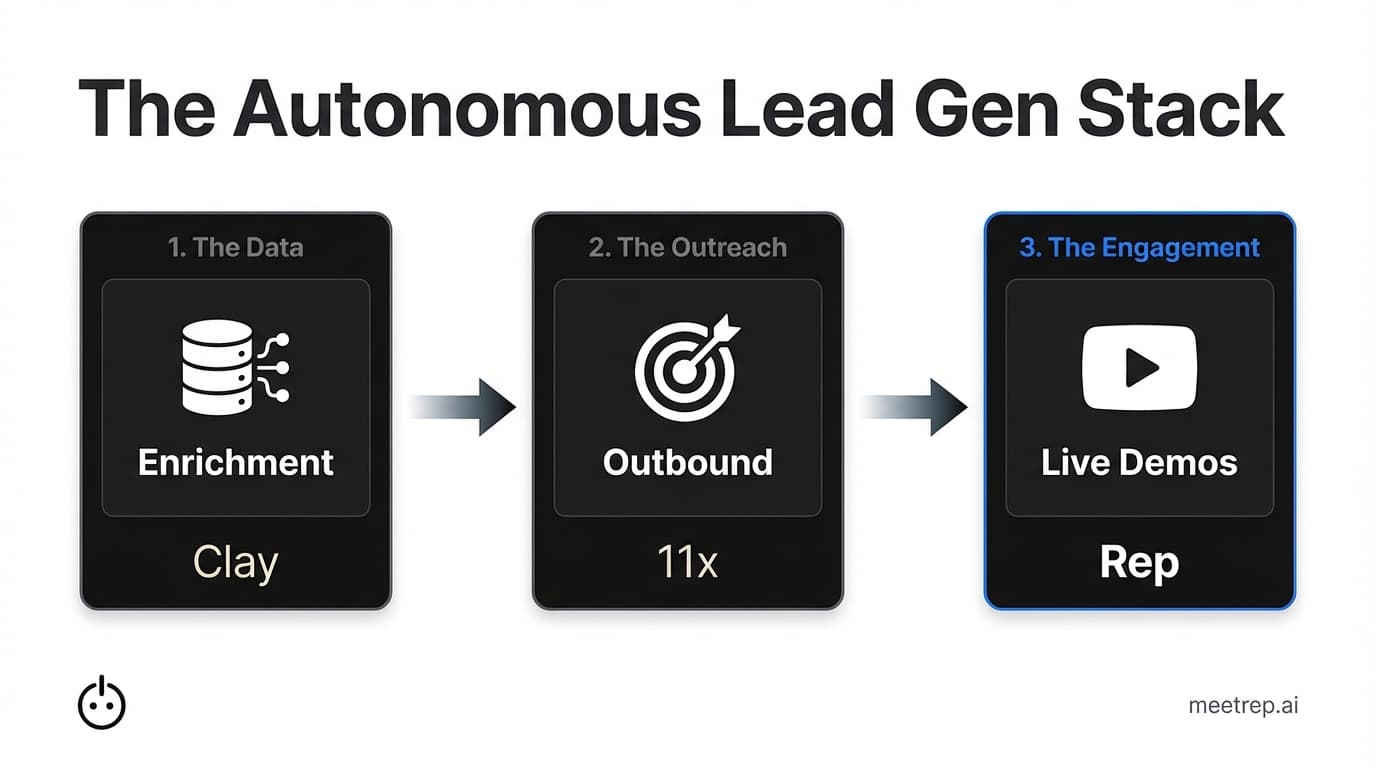
So, what does a modern AI lead generation stack look like?
It’s not one "all-in-one" platform. It’s a series of specialized agents passing data to each other. At Rep, we see the most sophisticated teams building a three-layer stack:
1. The Data Layer (The Fuel)
Example:Clay You can't automate outreach if you don't know who to talk to. Tools like Clay allow for "waterfall enrichment"—querying dozens of data providers sequentially to find the right email, phone number, and context. This is the foundation.
2. The Outreach Agent (The Hunter)
Example:11x.ai Once you have the data, you need a "Digital Worker" to do the outreach. Companies like 11x create agents (like "Alice" or "Julian") that handle outbound email and phone calls.
The Data: Connecteam used 11x's digital worker to handle 120,000 monthly calls. The result? They saved $450,000 annually in SDR salaries and reduced no-shows by 73%.
3. The Engagement Agent (The Closer)
Example:Rep This is where we fit in. Great, your Outreach Agent got a bite. A prospect is interested. Now what? Do they have to wait 3 days to book a demo on a human's calendar?
That’s where you lose them.
We built Rep to handle this specific moment. Rep is an autonomous demo agent that joins video calls, shares its screen, and navigates your product live. It answers questions, handles objections, and qualifies the lead 24/7.
Why we built Rep this way: We noticed a gap. Tools like Clay find the lead. Tools like 11x message the lead. But nobody was showing the product. We realized that if you automate the finding but not the showing, you just create a bottleneck at the bottom of the funnel.
The Hidden Cost of Inaction
I talk to sales leaders every week who say, "We're waiting to see how this shakes out."
My take? That's a dangerous strategy.
BCG's 2025 report shows that "AI Leaders" (the top 5% of adopters) are seeing 2x revenue increases compared to laggards. They are also reducing operational costs by 40%.
The scary part isn't just missing out on growth. It's the bleeding. Mavvrik reports that 84% of companies are seeing gross margin erosion because they haven't figured this out yet. They are paying human salaries for work that competitors are doing with software cents.
If your competitor's CAC (Customer Acquisition Cost) is half of yours because they use digital workers, you can't compete on price. You lose.
Common Mistake: Thinking you need to replace your whole team. You don't. Start by automating the low-value work (list building, initial qualification calls) so your humans can focus on closing deals.
The Future is Agentic
The transition from manual prospecting to agentic AI is messy. I see teams struggle with it every day. They get the data wrong, or they don't set guardrails, and they give up.
But the alternative—sticking with manual "spray and pray"—is a guaranteed path to irrelevance. The math just doesn't work anymore.
My advice? Don't try to automate everything tomorrow. Start with one digital worker. Maybe it's an agent that handles your inbound demo requests at 2 AM. Maybe it's an agent that enriches your CRM data. Just start.
The technology is ready. The question is, are you?
If you want to see how an autonomous agent handles a live prospect interaction, you can experience a Rep demo here.

Nadeem Azam
Founder
Software engineer & architect with 10+ years experience. Previously founded GoCustomer.ai.
Nadeem Azam is the Founder of Rep (meetrep.ai), building AI agents that give live product demos 24/7 for B2B sales teams. He writes about AI, sales automation, and the future of product demos.
Frequently Asked Questions
Table of Contents
- What Is AI Lead Generation in 2026?
- The "Spam Cannon" Crisis (And How to Fix It)
- Copilots vs. Agents: The Critical Difference
- The New Autonomous Tech Stack
- The Hidden Cost of Inaction
- The Future is Agentic
Ready to automate your demos?
Join the Rep Council and be among the first to experience AI-powered demos.
Get Early AccessRelated Articles
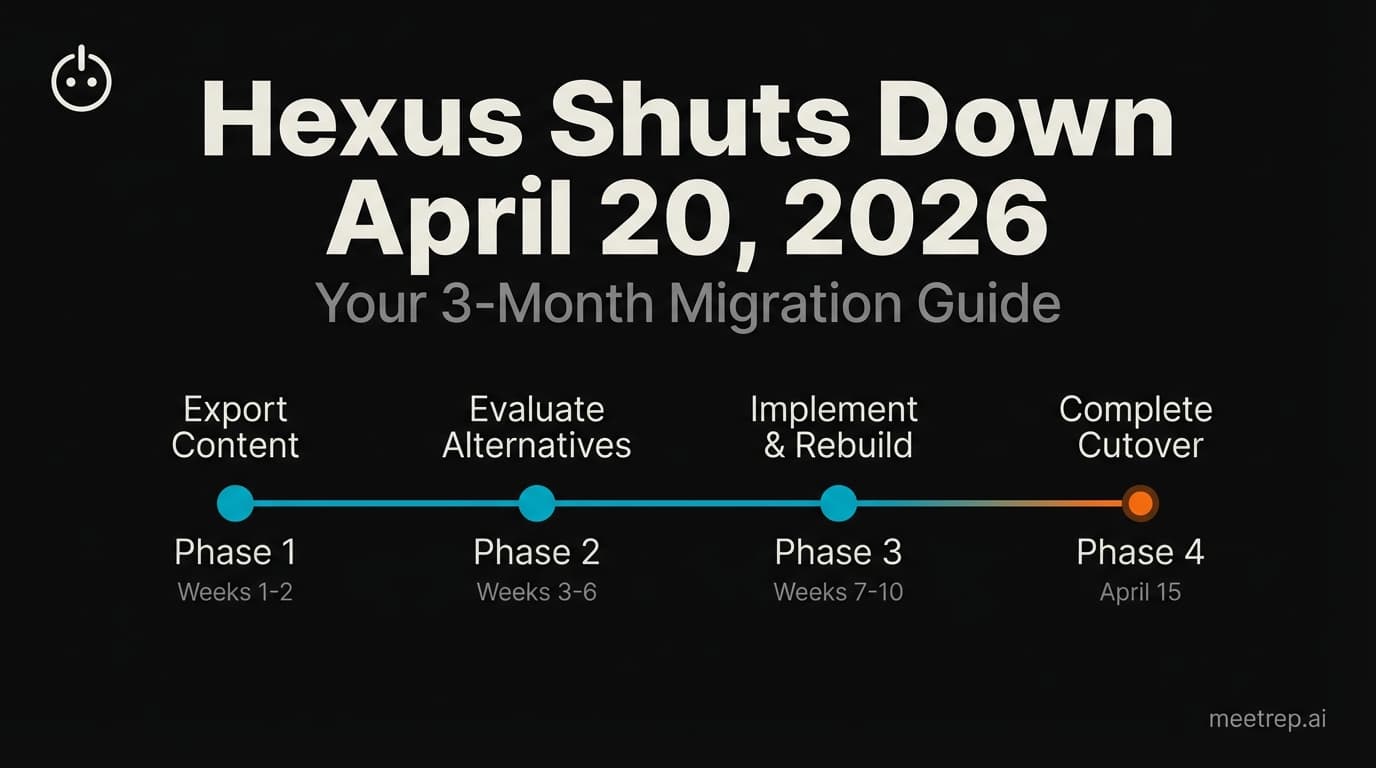
Hexus Acquired by Harvey AI: Congrats & What It Means for Demo Automation Teams
Hexus is shutting down following its acquisition by Harvey AI. Learn how to manage your migration and discover the best demo automation alternatives before April 2026.
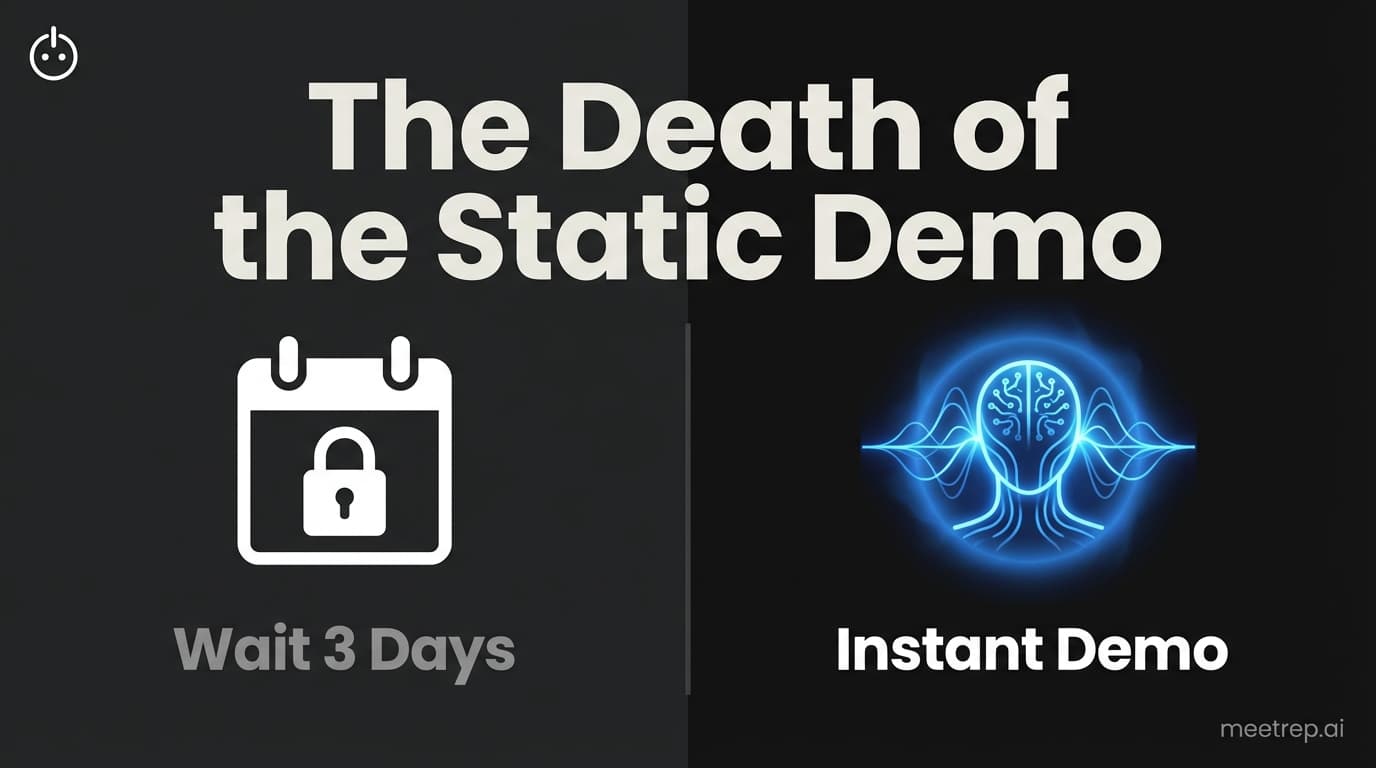
Why the "Software Demo" is Broken—and Why AI Agents Are the Future
The traditional software demo is dead. Discover why 94% of B2B buyers rank vendors before calling sales and how AI agents are replacing manual demos to scale revenue.
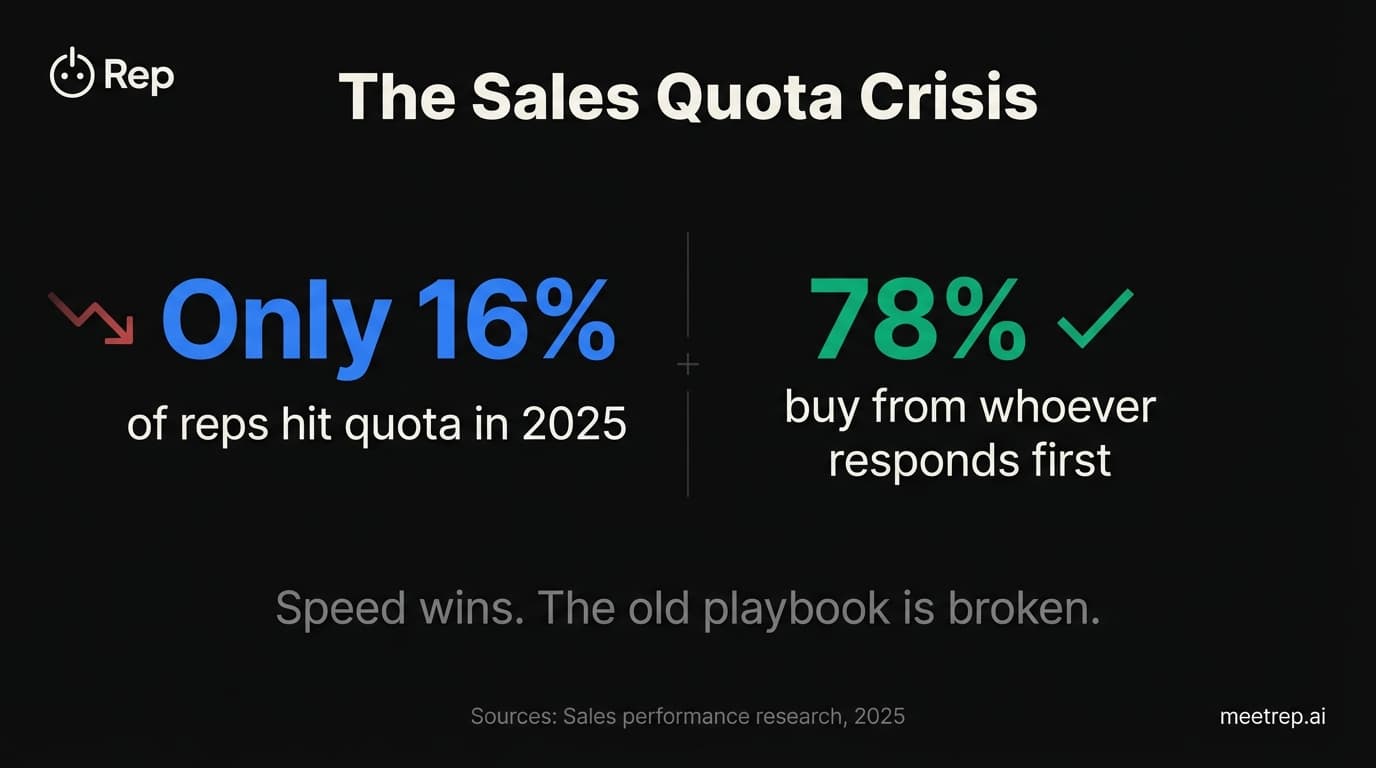
Why Autonomous Sales Software is the Future of B2B Sales (And Why the Old Playbook is Dead)
B2B sales is at a breaking point with quota attainment at 46%. Discover why autonomous 'Agentic AI' is the new standard for driving revenue and meeting the demand for rep-free buying.