AI in Sales Statistics: What 2026 Data Reveals About Adoption, ROI, and the Gap Nobody Talks About

Executive Summary
- 88% of organizations use AI, but only 5% have achieved integration at scale
- AI-using sales teams are 17 percentage points more likely to grow revenue (83% vs 66%)
- The productivity gains are real: 40-60 minutes saved daily per rep
- But here's the catch: 95% of AI pilots fail to achieve revenue acceleration
- The market is shifting from "copilots" to autonomous agents—by 2028, agents will outnumber sellers 10x
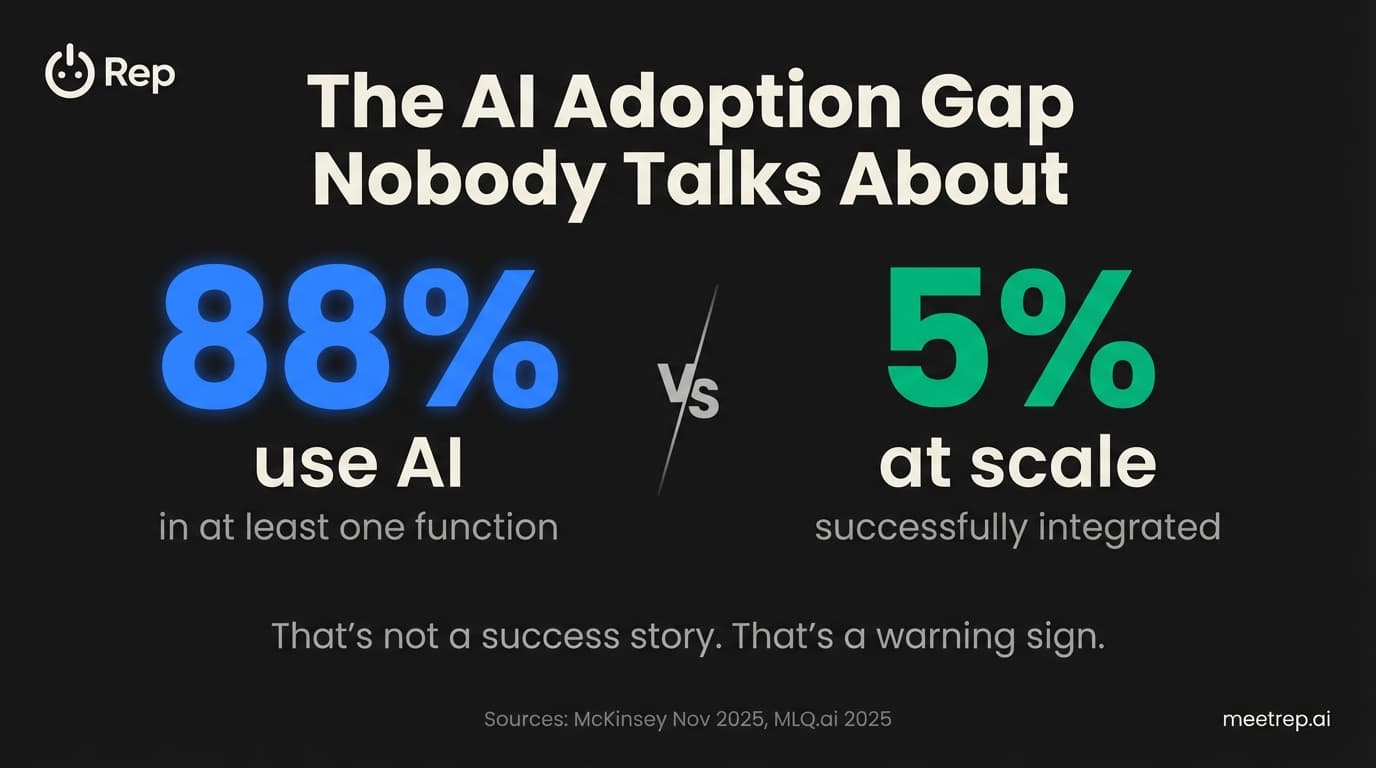
Here's the ai sales statistics that should make you uncomfortable: 88% of organizations now use AI in at least one business function. But only 5% have successfully integrated AI at scale.
That's the story most articles won't tell you. They'll show you the adoption numbers—which are genuinely impressive—without mentioning that the vast majority of implementations are stuck in what I'd call "pilot purgatory."
I've been building in the sales automation space since GoCustomer.ai, and now at Rep where we're building AI demo agents. What I've learned: the gap between "we use AI" and "AI is actually working for us" is enormous. And the data backs this up.
This piece gives you the real AI sales statistics for 2026—every number sourced, every claim verified. Use these in your board presentations, budget requests, or team planning. That's what they're for.
What Percentage of Companies Use AI in Sales?
AI in sales refers to using artificial intelligence—including machine learning, natural language processing, and generative AI—to automate and improve revenue-generating activities. These systems analyze customer data, behavioral signals, and historical performance to improve lead qualification, personalize buyer engagement, and optimize deal execution.
According to McKinsey's November 2025 State of AI survey, 88% of organizations now use AI in at least one business function—up from 78% in 2024. Sales and marketing consistently rank among the top functions.
The numbers get more specific when you look at sales teams directly. Salesforce's State of Sales report found that 81% of sales teams are either experimenting with or have fully implemented AI. And HubSpot's 2025 data shows 92% of sales reps now use AI in some form.
That's nearly universal adoption. At least on paper.
The Data: AI adoption rose from 24% in 2023 to 43% in 2024 to 92% in 2025 among sales reps (HubSpot). The trajectory isn't slowing.
But here's what bothers me about these numbers: adoption isn't the same as success.
McKinsey's same report found that only 6% of organizations qualify as "AI high performers." And broader research from MLQ.ai shows just 5% of enterprises have successfully integrated AI tools into workflows at scale.
So we have 88% adoption. And 5% actual scale. That's not a success story. That's a warning sign.
| Metric | Percentage | Source |
|---|---|---|
| Organizations using AI in any function | 88% | McKinsey Nov 2025 |
| Sales teams experimenting/deployed AI | 81% | Salesforce 2024 |
| Sales reps using AI in some form | 92% | HubSpot 2025 |
| Organizations achieving AI at scale | 5% | MLQ.ai 2025 |
| "AI high performers" | 6% | McKinsey Nov 2025 |
Does AI Actually Improve Sales Performance?
Yes—when implemented correctly. AI-using sales teams show measurably better results across revenue growth, deal velocity, and win rates. The evidence here is solid.
Salesforce's 2024 research found that 83% of sales teams with AI reported revenue growth, compared to just 66% of teams without AI. That's a 17-percentage-point gap. Not subtle.
Bain & Company's September 2025 analysis showed early AI adopters achieving greater than 30% improvement in win rates. And ZoomInfo's 2025 State of AI report found AI users reporting 81% shorter deal cycles and 73% increases in deal sizes.
These aren't marginal gains. They're potentially business-changing.
Key Insight: Companies NOT using AI are 17 percentage points less likely to see revenue growth. In a tight market, that gap compounds fast.
McKinsey's 2024 research puts numbers to the ROI: companies investing in AI see 3-15% revenue uplift and 10-20% sales ROI improvement.
But I need to give you the other side.
Gartner's November 2025 prediction landed hard in our space: by 2028, fewer than 40% of sellers will report that AI agents actually improved their productivity. Not 40% will see gains. Fewer than 40%.
And MIT's research via ShiftUpAI found that 95% of AI pilot programs fail to achieve rapid revenue acceleration.
So the potential is real. But so is the execution gap.
How Much Time Do Sales Reps Actually Save With AI?
Time savings represent AI's most immediately measurable benefit for sales teams. The data shows reps saving 40-60 minutes per day on average, primarily through automation of research, data entry, and content creation tasks.
OpenAI's December 2025 enterprise research found that average enterprise AI users save 40-60 minutes daily. ZoomInfo's 2025 study puts it at roughly 12 hours per week for GTM professionals.
Let me make that concrete. That's 1.5 working days per week. Per rep. Every week.
| Time Metric | Amount | Source |
|---|---|---|
| Daily time saved | 40-60 minutes | OpenAI Dec 2025 |
| Weekly time saved | 12 hours | ZoomInfo 2025 |
| Research & personalization time reduction | 90% | Outreach 2025 |
Outreach's Prospecting 2025 report showed that 100% of AI-powered SDR users reported time savings—with 40% saving 4-7 hours per week just in their SDR workflows. AI tools cut research and personalization time by 90%.
Here's a named example that stopped me when I read it: Lumen Technologies reduced their sales research time from 4 hours to 15 minutes per account using Microsoft Copilot. They're projecting $50 million in annual savings.
What we learned at GoCustomer: When we built GoCustomer.ai, the biggest wins came from eliminating the small repeated tasks—not from any single massive improvement. Death by a thousand cuts works in reverse too.
The productivity data also explains something counterintuitive. Bain's research found that sellers currently spend only about 25% of their time actually selling. The rest goes to admin work, research, data entry. AI could double that selling time.
And that's where ZoomInfo's 47% productivity boost figure comes from. It's not that reps are working 47% faster at selling. It's that they're spending dramatically more time on activities that actually generate revenue.
Will AI Replace Salespeople?
Honestly, this is the question I get most often. AI is transforming sales roles rather than eliminating them. The data points clearly toward augmentation—AI handling administrative work while humans focus on relationship building and complex deals.
By 2028, Gartner predicts that AI agents will outnumber human sellers by 10x. That sounds terrifying until you look at the employment data.
Salesforce's 2024 study found something unexpected: 68% of sales teams WITH AI added headcount, compared to just 47% of teams without AI.
Read that again. AI-using teams are MORE likely to hire, not less.
Hot take: The "AI will replace salespeople" narrative is lazy thinking. AI is replacing tasks, not jobs. The teams that figure this out are growing. The ones that don't are falling behind.
The explanation makes sense when you think about it. AI handles the repetitive, scalable stuff—initial outreach, scheduling, basic demos, data entry. This frees up human reps to handle what AI still can't do well: complex negotiations, relationship building, navigating multi-stakeholder deals.
Gartner also predicts that 75% of B2B buyers will prefer human interaction over AI by 2030. Buyers still want to talk to people for high-stakes decisions. They just don't want to wait three days for someone to walk them through basic product features.
This is exactly why we built Rep the way we did—AI that handles the repetitive demo work so human AEs can focus on the deals that actually need them.
The Autonomous Agent Shift: From Copilots to Digital Workers
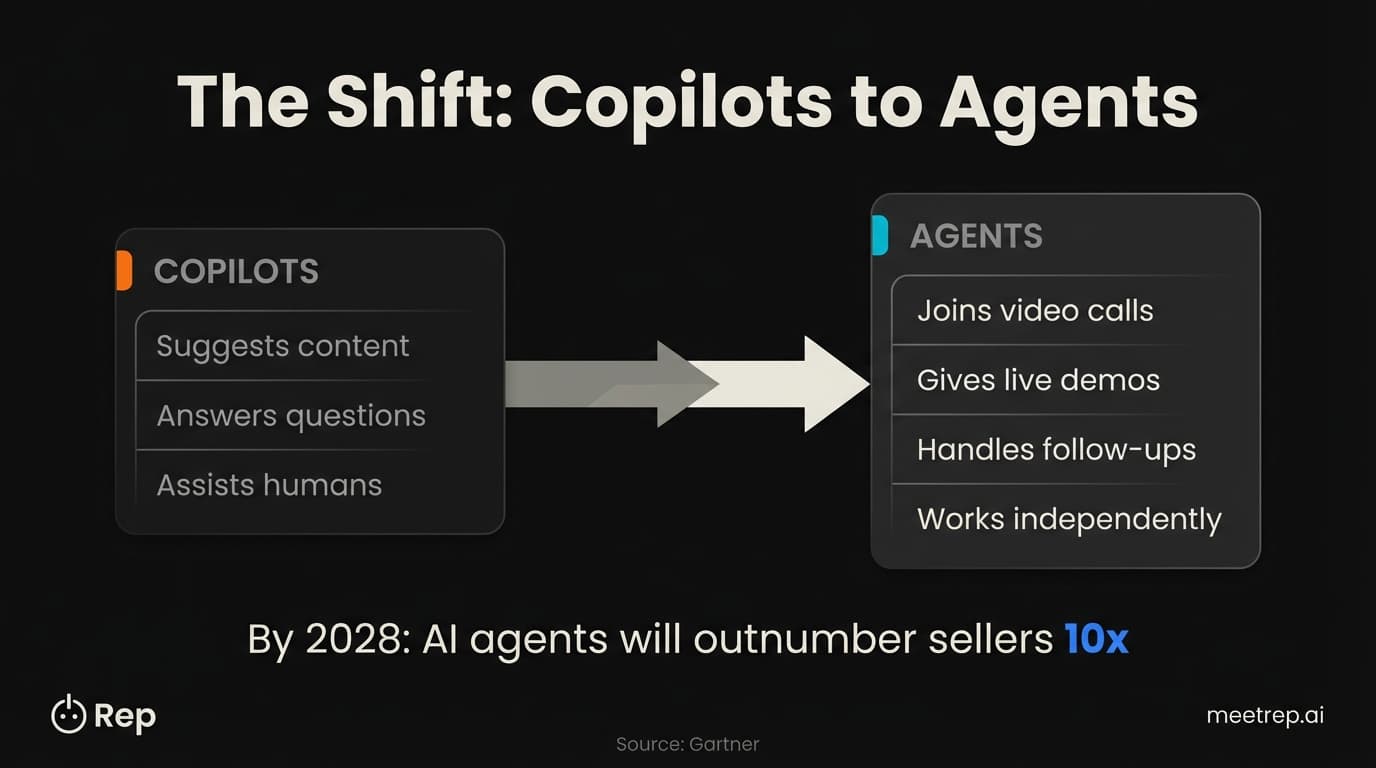
The AI sales market is pivoting from passive "copilots" that suggest content to autonomous "agents" that execute complete workflows. This shift defines sales technology trends for 2026 and beyond.
An autonomous sales agent is an AI-driven system that can execute complex sales workflows without human intervention. Unlike chatbots that simply answer FAQs, these agents can prospect leads, conduct live product demos, join video calls, and handle follow-ups independently.
McKinsey's November 2025 data shows 62% of organizations are at least experimenting with AI agents. Gartner predicts that by 2027, 95% of seller research workflows will begin with AI—up from less than 20% in 2024.
And here's the prediction that gets attention: by 2028, 90% of B2B buying will be intermediated by AI agents. Not influenced by AI. Intermediated.
What does this look like in practice? Unlike chatbots that wait for questions and respond with text, agents can:
- Conduct outbound prospecting independently
- Join video calls and present live demonstrations
- Navigate software and show features in real-time
- Follow up with next steps without human intervention
Why we built Rep this way: At Rep, we built an autonomous demo agent because we saw the gap between "chatbot that answers FAQ" and "AI that actually does the demo." The technology for true autonomous action—joining calls, sharing screens, navigating products live—is finally here.
Forrester's October 2025 predictions forecast that 20% of sellers will use agent-led negotiations by 2026. That's not a pilot. That's mainstream adoption of autonomous deal-handling.
The market size reflects this shift. According to Grand View Research, the global AI agents market sits at $7.6 billion in 2025 and will hit $47.1 billion by 2030—a 45.8% CAGR.
Why 95% of AI Implementations Fail
Before you invest another dollar in AI tools, understand why most implementations don't work. The failure rate is real, documented, and largely avoidable—if you know the patterns.
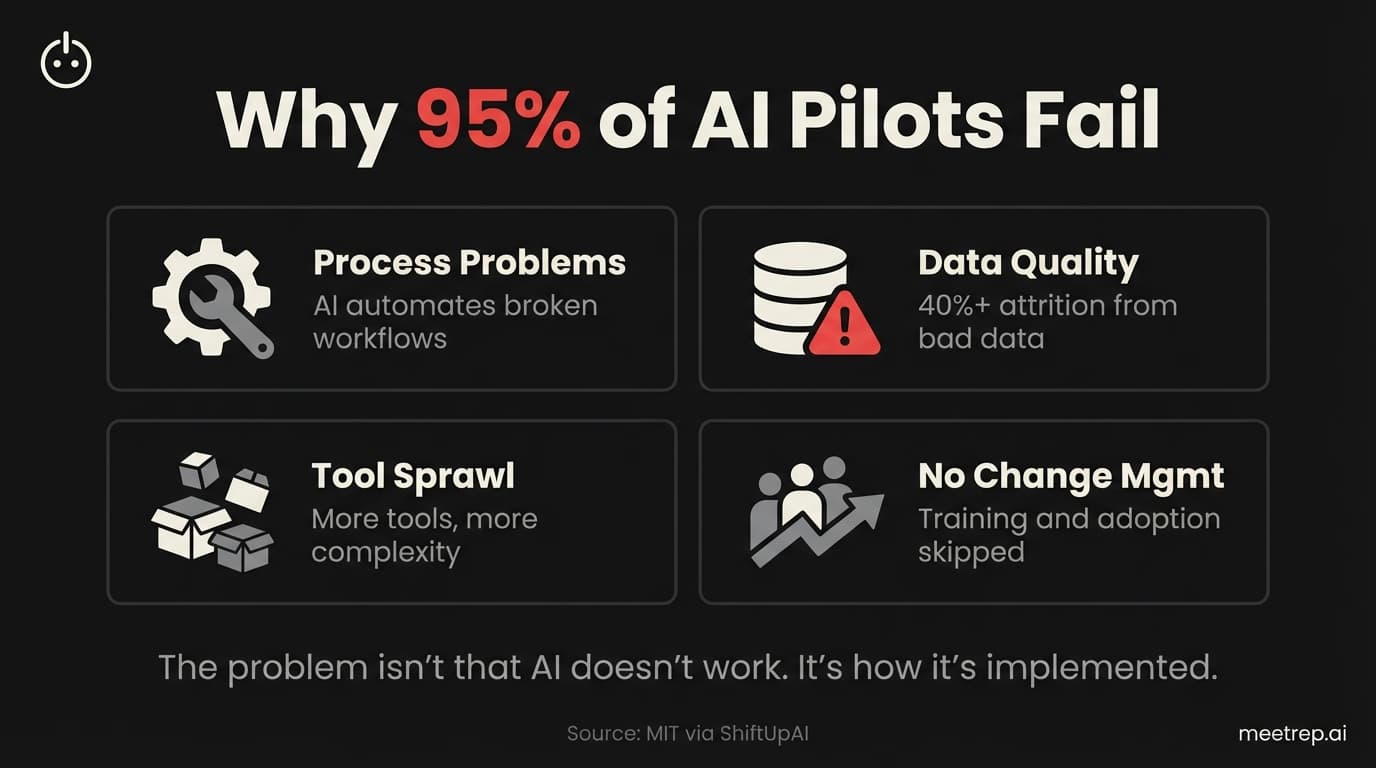
MIT research via ShiftUpAI found that 95% of AI pilot programs fail to achieve rapid revenue acceleration. Not 50%. Not 70%. Ninety-five percent.
Forrester predicts that ungoverned AI will cause $10 billion or more in losses. And Gartner's January 2026 analysis describes the current market as the "Trough of Disillusionment"—the phase where hype fades and organizations demand proven, measurable ROI.
Key Insight: The problem isn't that AI doesn't work. It's that most organizations don't implement it in ways that can work. They add tools to broken processes and wonder why nothing improves.
Common failure patterns I've seen (and made mistakes around at GoCustomer):
Process problems, not tool problems. AI automates what you tell it to automate. If your sales process is broken, AI will automate a broken process. Faster garbage is still garbage.
Data quality issues.Forbes research shows that poor data quality contributes to 40% or higher attrition in sales teams. AI is only as good as the data it uses.
Tool sprawl without integration. More tools rarely means better results. It usually means more complexity, more data silos, and more rep frustration.
No change management. You can't drop AI into a team and expect adoption. People need training, new workflows, and reasons to change behavior.
Melissa Hilbert, VP Analyst at Gartner's Sales Practice, put it directly: "Beyond a certain point, more AI does not mean more productivity. In fact, layering additional prompts and tools onto already complex workflows risks overwhelming sellers and accelerating burnout."
The Market Investment: $2.52 Trillion in 2026
The numbers here tell you where the industry is heading. Organizations are betting big—and my read is that this level of investment will separate the teams that figure out execution from those that keep experimenting.
Gartner's January 2026 forecast projects worldwide AI spending at $2.52 trillion—a 44% increase from 2025. Of that, $1.37 trillion goes to infrastructure alone (servers, data centers, compute).
| Investment Metric | Amount | Source |
|---|---|---|
| Total AI spending 2026 | $2.52 trillion | Gartner Jan 2026 |
| GenAI spending 2025 | $644 billion | Gartner Mar 2025 |
| AI in Sales market 2025 | $8.8 billion | P&S Intelligence |
| AI in Sales market 2032 (projected) | $63.5 billion | P&S Intelligence |
| Sales/marketing AI value potential | $0.8-1.2 trillion | McKinsey 2024 |
P&S Intelligence projects the AI in Sales market specifically will grow from $8.8 billion in 2025 to $63.5 billion by 2032—a 32.6% CAGR.
And McKinsey estimates that GenAI could add $0.8-1.2 trillion in productivity across sales and marketing functions alone.
The investment thesis is clear. Whether individual implementations succeed is a different question.
Companies Actually Seeing Results
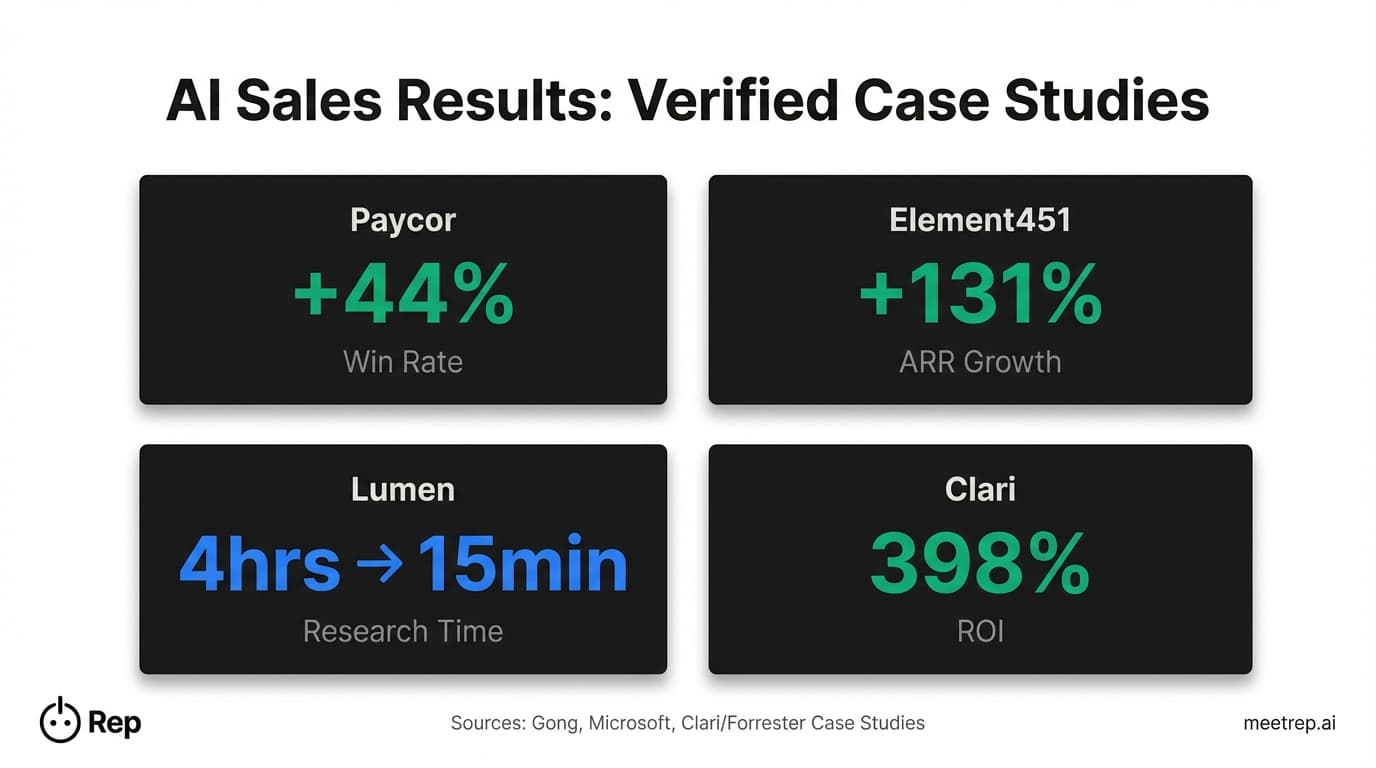
The statistics are more credible when attached to named companies with specific outcomes. Here are verified case studies from 2024-2026.
Paycor (HR/Payroll SaaS) implemented Gong's revenue intelligence platform and saw a 44% increase in win rate.
Element451 (Education Technology) used Gong AI and achieved 131% increase in ARR.
Lumen Technologies (Enterprise Telecom) deployed Microsoft Copilot and cut sales research time from 4 hours to 15 minutes per account. They project $50 million in annual savings.
Clari's composite enterprise study (Forrester TEI analysis) showed 398% ROI, $96.2 million in net value, and 96% forecast accuracy.
Airtel Business (Telecom) used BambooBox AI SDR and generated $2.25 million in pipeline with a 10.2% increase in SDR productivity.
The Data:ZoomInfo's platform data across 35,000+ customers shows average results of 32% more revenue and 46% pipeline growth.
The pattern across these case studies: specific, measurable outcomes with clear implementation scope. Not vague "AI improved things."
The AI sales statistics tell two stories. The adoption story is impressive—near-universal usage, massive investment, clear productivity gains for companies that get it right.
The execution story is harder. Most implementations fail. Most teams are stuck between "we bought the tools" and "the tools actually work." The 88% vs 5% gap isn't closing as fast as the investment numbers suggest.
My take: 2026 is the year companies stop treating AI as a science project and start demanding results. The ones who focus on execution quality—not tool quantity—will pull ahead. The ones who keep adding tools to broken processes will keep wondering why nothing improves.
If you're evaluating AI for your sales team, start with process, not tools. Figure out what's actually broken. Then find AI that fixes that specific problem.
At Rep, we built an autonomous demo agent because we saw a specific problem: qualified prospects waiting days for a demo that a human didn't need to give. That's one narrow problem. It's the one we know how to solve.
Whatever your problem is, make sure you actually understand it before you buy the tool.

Nadeem Azam
Founder
Software engineer & architect with 10+ years experience. Previously founded GoCustomer.ai.
Nadeem Azam is the Founder of Rep (meetrep.ai), building AI agents that give live product demos 24/7 for B2B sales teams. He writes about AI, sales automation, and the future of product demos.
Frequently Asked Questions
Table of Contents
- What Percentage of Companies Use AI in Sales?
- Does AI Actually Improve Sales Performance?
- How Much Time Do Sales Reps Actually Save With AI?
- Will AI Replace Salespeople?
- The Autonomous Agent Shift: From Copilots to Digital Workers
- Why 95% of AI Implementations Fail
- The Market Investment: $2.52 Trillion in 2026
- Companies Actually Seeing Results
Ready to automate your demos?
Join the Rep Council and be among the first to experience AI-powered demos.
Get Early AccessRelated Articles
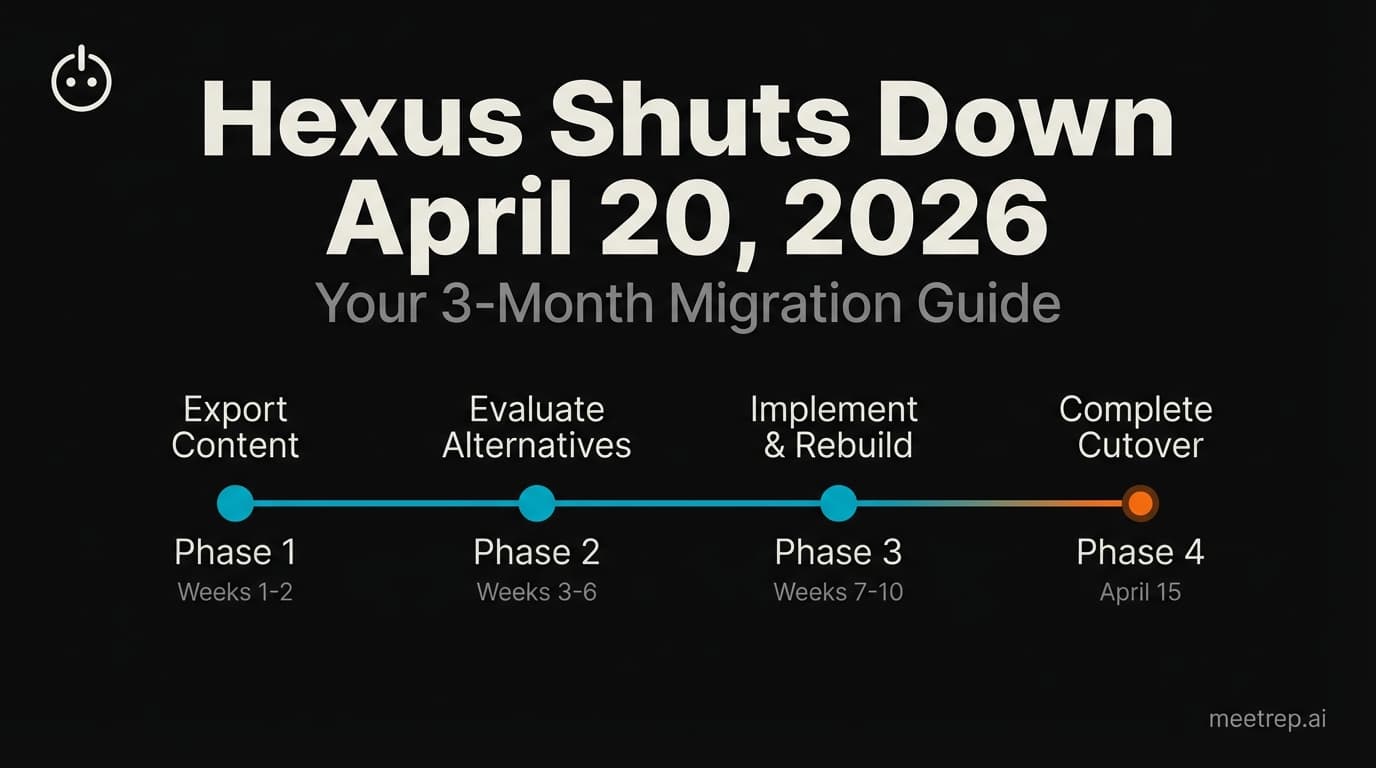
Hexus Acquired by Harvey AI: Congrats & What It Means for Demo Automation Teams
Hexus is shutting down following its acquisition by Harvey AI. Learn how to manage your migration and discover the best demo automation alternatives before April 2026.
Why the "Software Demo" is Broken—and Why AI Agents Are the Future
The traditional software demo is dead. Discover why 94% of B2B buyers rank vendors before calling sales and how AI agents are replacing manual demos to scale revenue.
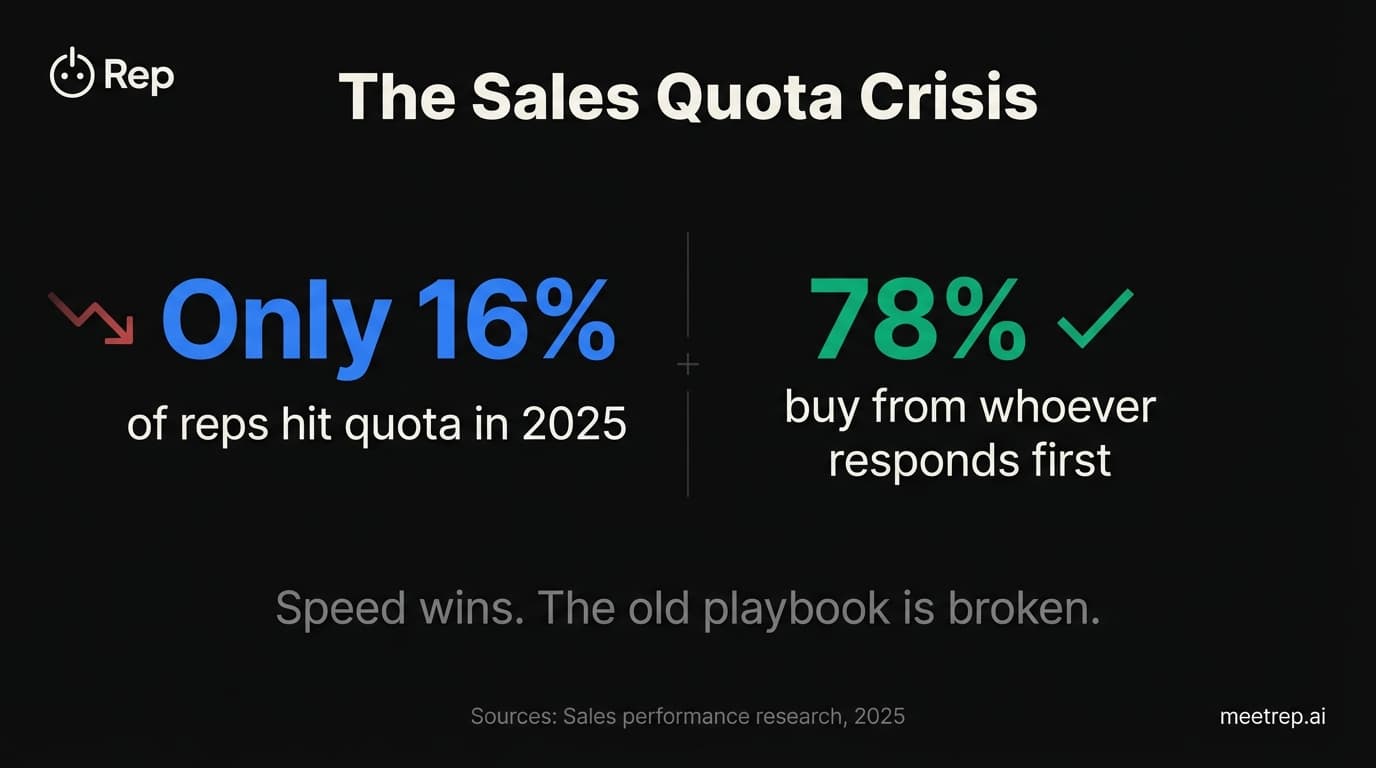
Why Autonomous Sales Software is the Future of B2B Sales (And Why the Old Playbook is Dead)
B2B sales is at a breaking point with quota attainment at 46%. Discover why autonomous 'Agentic AI' is the new standard for driving revenue and meeting the demand for rep-free buying.