After-Hours Leads: The Revenue You're Losing While You Sleep

Executive Summary
- 45% of leads respond after hours—and convert 36% better than daytime leads (Verse.ai 2024)
- 63.5% of B2B companies never respond to inbound leads at all (RevenueHero 2024)
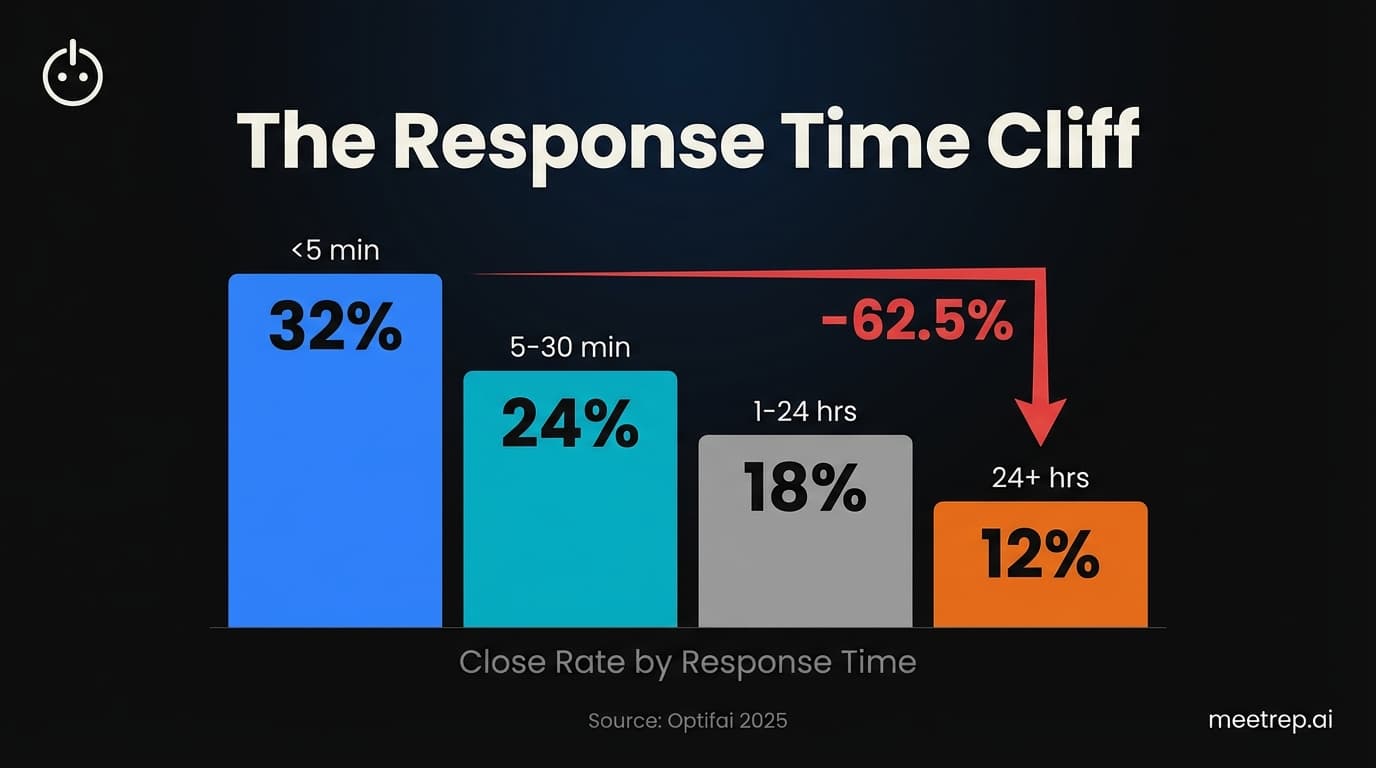
- Responding under 5 minutes yields 32% close rates vs. 12% for 24+ hour response (Optifai 2025)
- The solution isn't hiring night shifts—it's AI-powered demos that engage prospects the moment they raise their hand
That demo request that came in at 9:47 PM on Friday? By Monday morning, your prospect had already talked to three competitors.
I've watched this happen hundreds of times. At GoCustomer.ai, we'd see qualified after hours leads hit the system over the weekend, and by the time reps followed up Monday, the prospect had already made a shortlist. We weren't on it.
Here's what surprised me: this isn't an edge case. It's nearly half your total lead volume.
Verse.ai's December 2024 research found that 45% of B2B leads respond outside business hours. And those leads? They're 36% more likely to qualify than your Tuesday afternoon traffic.
You're not just missing leads. You're missing your best leads.
What makes after-hours leads so valuable?
After-hours leads convert better because they represent high-intent buyers doing serious research, not casual browsers killing time between meetings.
Think about when you research major purchases. It's rarely during the chaos of the workday. It's at night, once the Slack notifications stop. Or on weekends, when you can actually focus.
Your buyers behave the same way.
DesignRush's September 2024 study found a 23% increase in weekend traffic from B2B decision-makers. These aren't junior employees—they're the people with budget authority, doing homework before making a recommendation to their team.
The Data:Drift/Salesloft's analysis of 30M+ conversations found 41% of meetings are booked outside 9-5. That's 4 in 10 deals being won or lost while your team is offline.
And here's the uncomfortable math: if you're not covering after-hours, you're effectively ignoring nearly half your addressable market. Your competitors who are covering those hours get first-mover advantage on your best prospects.
Why most teams are hemorrhaging leads (and don't know it)
The data on B2B response times is brutal. I knew it was bad. I didn't know it was this bad.
RevenueHero's March 2024 study of 1,000 B2B SaaS teams found that 63.5% of companies never respond to inbound leads at all. Not slow response. No response.
The companies that do respond? Average response time is 47 hours according to Optifai's Q1-Q3 2025 benchmark. That's nearly two full business days.
Think about what happens in 47 hours. Your prospect has already:
- Searched for alternatives
- Requested demos from competitors
- Read G2 reviews comparing you to options you didn't know existed
- Potentially made a shortlist that doesn't include you
Only 17.2% of companies respond instantly (under 2 minutes), according to RevenueHero's research. That's your real competition for after hours leads—the small percentage of teams who have figured out instant engagement.
Common mistake: Assuming your team is "responsive" because they reply within a few hours. A few hours is an eternity in lead response. You're not competing against "slow" companies—you're competing against the 17% who reply in minutes.
The math that should scare your CFO
Speed to lead isn't a nice-to-have metric. It's the difference between a healthy pipeline and a leaky one.
Optifai's 2025 benchmark tracked close rates by response time:
| Response Time | Close Rate | Notes |
|---|---|---|
| Under 5 minutes | 32% | The benchmark to hit |
| 5-30 minutes | ~24% | Already losing ground |
| 1-24 hours | ~18% | Significant decay |
| 24+ hours | 12% | 62.5% lower than sub-5-minute |
The gap between 32% and 12% is massive. On 100 leads per month at a $50K average deal size, that's the difference between $1.6M and $600K in pipeline.
Let me put it another way: waiting 24 hours costs you 62.5% of potential conversions.
The Data: 77% of B2B companies fail to meet the 5-minute response benchmark (Optifai 2025). That means you can beat three-quarters of your competitors just by showing up fast.
Workato's August 2025 study found that companies with lead routing automation respond in 3 hours 32 minutes on average. Those without? 12 hours 59 minutes. Automation alone cuts response time by 73%.
But here's the thing: 3.5 hours still isn't fast enough. For after-hours leads, you need coverage when there are no humans available to route to. That's the gap automation alone can't solve.
What buyers actually want (the "rep-free" paradox)
Here's where it gets interesting. You might assume buyers want to talk to a human. They don't. At least not for initial discovery.
Gartner's June 2025 research found that 61% of B2B buyers prefer an overall rep-free buying experience. They want to research on their own terms, without scheduling calls, waiting for callbacks, or sitting through small talk.
But wait—doesn't that contradict the importance of fast response?
No. It clarifies it.
Buyers don't want no interaction. They want frictionless interaction. They want the answers a rep provides without the hassle of getting a rep on the phone. (The scheduling dance. The "let me loop in my manager." The time zone math for international leads.)
My take: Stop thinking about this as "automated vs. human." The winning model is hybrid: AI handles instant engagement and discovery; humans handle complex negotiations and relationship-building. This is why McKinsey found that hybrid sales approaches drive up to 50% more revenue.
The problem with traditional chatbots? They're too dumb to be useful. Scripted responses. Decision trees. "Let me transfer you to a human" after two questions.
What buyers actually want is product access. They want to see your product, explore features relevant to their use case, and get answers to real questions. Not FAQ links. Actual answers.
That's the gap that a new category—agentic AI—is designed to fill.
How leading companies capture round the clock sales
The companies winning at after-hours lead engagement aren't just fast. They're always-on.
TableRock Residential deployed EliseAI to handle after-hours inquiries in their real estate business. The result? They converted 57 after-hours leads to leases in Q4 2024 alone. One property's occupancy rose from 79% to 95%. (Worth noting: 39% of their total inquiry volume came outside business hours—right in line with the broader B2B stats.)
Keepme built an AI sales agent called "Antares" for their fitness industry clients. According to their August 2024 case study, 1 in 4 leads converted by the AI agent came in while the human sales team was asleep. They saw a 185% increase in lead-to-tour bookings.
Wrike implemented Drift's conversational AI and achieved a 496% pipeline increase with 15X ROI—driven largely by instant engagement.
Matterport used Qualified's platform to close deals 40% faster, with one SDR exceeding quota by 300%.
The pattern is clear: AI handles initial engagement (qualification, discovery, product exploration) while humans focus on complex closing.
What we learned at GoCustomer: We experimented with chatbots early on. They captured contact info but didn't actually help prospects. My biggest regret was waiting too long to move beyond scripted bots. The conversion from "chatbot conversation" to "qualified meeting" was abysmal. What worked was giving prospects something useful immediately—not making them wait.
For companies where the product demo is critical to the sale—which is most B2B software—this means AI that can actually demonstrate the product. Not just answer FAQs. Not just share links. Actually show the product in real-time.
That's why we built Rep to join live video calls, share its screen, and walk prospects through your product at 2 AM if that's when they want to see it. The prospect gets the demo experience they wanted; your team gets a qualified lead briefing in the morning.
Building your 24/7 lead engagement system
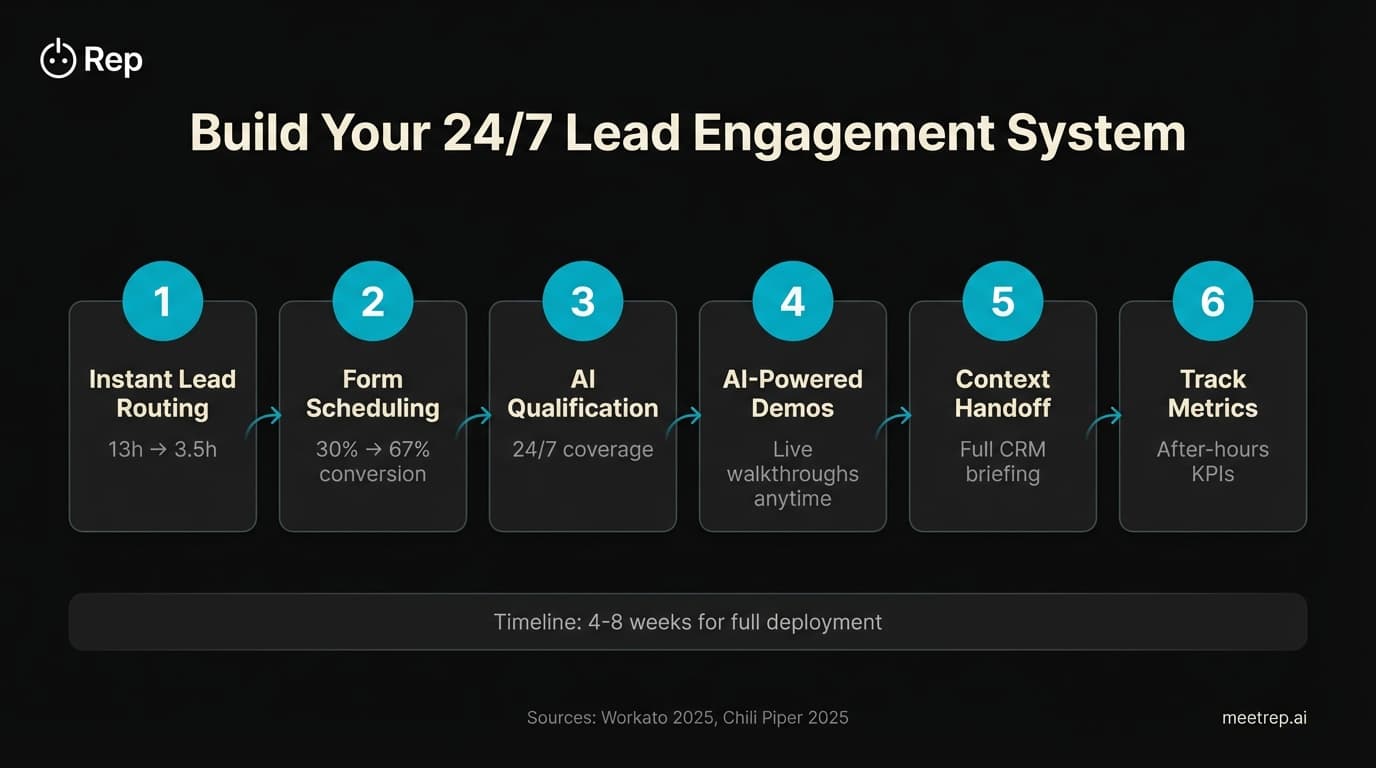
You don't need to hire a night shift. You need the right stack. Here's my framework:
1. Implement instant lead routing (cuts response from 13h to 3.5h) Deploy tools like Chili Piper, LeanData, or Calendly to route leads immediately based on territory, company size, or product interest. Chili Piper's 2025 data shows that form scheduling doubles conversion from 30% to 66.7%.
2. Enable instant scheduling on every form "Thanks, someone will reach out" is a conversion killer. Replace it with "Book your call now." Only 11.3% of B2B companies offer instant scheduling on forms (RevenueHero 2024). Easy win.
3. Deploy AI qualification for 24/7 coverage Tools like Qualified or Drift (now part of Salesloft) can assess fit and intent around the clock. The goal: route hot leads instantly and filter noise before human handoff.
4. Add AI-powered live demos for high-intent prospects This is where the category is evolving fast. Instead of just capturing info and promising a callback, AI demo platforms like Rep can give prospects an actual product walkthrough—voice conversation, screen sharing, real-time Q&A—any hour of the day.
5. Ensure context transfers to humans Whatever AI touches the lead first, make sure it logs everything to your CRM: transcript, pain points, questions asked, features explored. Your AE should wake up to a full briefing, not "Someone requested a demo."
Common mistake: Buying tools that don't integrate with your CRM. If the handoff is lossy—if context gets dropped—you've just created a worse experience than the old way.
6. Track after-hours metrics separately You can't improve what you don't measure. Create dashboards that show:
- After-hours lead volume (% of total)
- After-hours coverage rate (leads engaged within 5 min)
- After-hours conversion rate vs. business hours
- Pipeline attributed to after-hours engagement
Realistic timeline: Expect 4-8 weeks for full deployment. Routing and scheduling tools are faster (days). AI qualification takes tuning (weeks). AI demos require training on your product (varies by complexity).
The competitive window is closing
The AI agents market is projected to grow from $7.92 billion in 2025 to $236 billion by 2034, according to Precedence Research. That's not a typo. 30X growth over a decade.
SuperAGI's 2025 report estimates 85% of enterprises will adopt AI agents by the end of 2025. First movers are building competitive advantage right now.
I'll be direct: if your after hours leads are going to voicemail while competitors are serving instant demos, you're already behind.
Key Insight: The "5-minute rule" everyone cites is already outdated. In a world of AI-powered instant engagement, the new standard is immediate. Not 5 minutes. Zero minutes.
The good news? Most of your competitors haven't figured this out yet. 77% are still failing the 5-minute benchmark. You can leapfrog them.
The question isn't whether to invest in 24/7 lead engagement. The math is too clear for that. The question is whether you'll move now or wait until the gap widens.
Start by measuring your after-hours coverage rate. I'd bet it's lower than you think. Then look at the tools that can close that gap—routing automation, instant scheduling, AI qualification, and AI-powered demos.
At Rep, we built specifically for this problem: prospects clicking a link at 11 PM and getting a full, live product demo from an AI agent that knows your product inside and out. No scheduling. No waiting. No lost opportunity.
See how Rep handles after-hours demos →
Your competitors are sleeping on this. You don't have to.

Nadeem Azam
Founder
Software engineer & architect with 10+ years experience. Previously founded GoCustomer.ai.
Nadeem Azam is the Founder of Rep (meetrep.ai), building AI agents that give live product demos 24/7 for B2B sales teams. He writes about AI, sales automation, and the future of product demos.
Frequently Asked Questions
Table of Contents
- What makes after-hours leads so valuable?
- Why most teams are hemorrhaging leads (and don't know it)
- The math that should scare your CFO
- What buyers actually want (the "rep-free" paradox)
- How leading companies capture round the clock sales
- Building your 24/7 lead engagement system
- The competitive window is closing
Ready to automate your demos?
Join the Rep Council and be among the first to experience AI-powered demos.
Get Early AccessRelated Articles
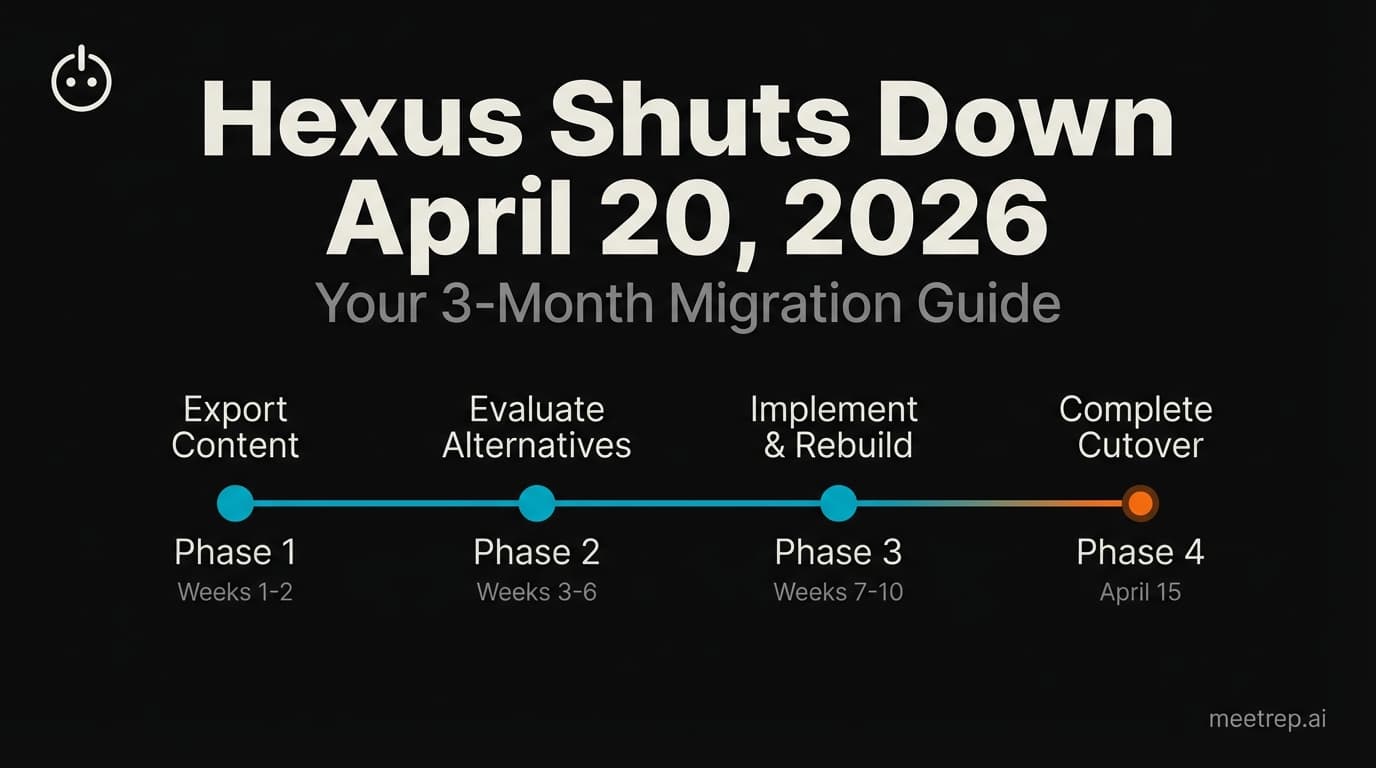
Hexus Acquired by Harvey AI: Congrats & What It Means for Demo Automation Teams
Hexus is shutting down following its acquisition by Harvey AI. Learn how to manage your migration and discover the best demo automation alternatives before April 2026.
Why the "Software Demo" is Broken—and Why AI Agents Are the Future
The traditional software demo is dead. Discover why 94% of B2B buyers rank vendors before calling sales and how AI agents are replacing manual demos to scale revenue.
Why Autonomous Sales Software is the Future of B2B Sales (And Why the Old Playbook is Dead)
B2B sales is at a breaking point with quota attainment at 46%. Discover why autonomous 'Agentic AI' is the new standard for driving revenue and meeting the demand for rep-free buying.