5 Ways to Reduce Lead Response Time Starting Today

Executive Summary
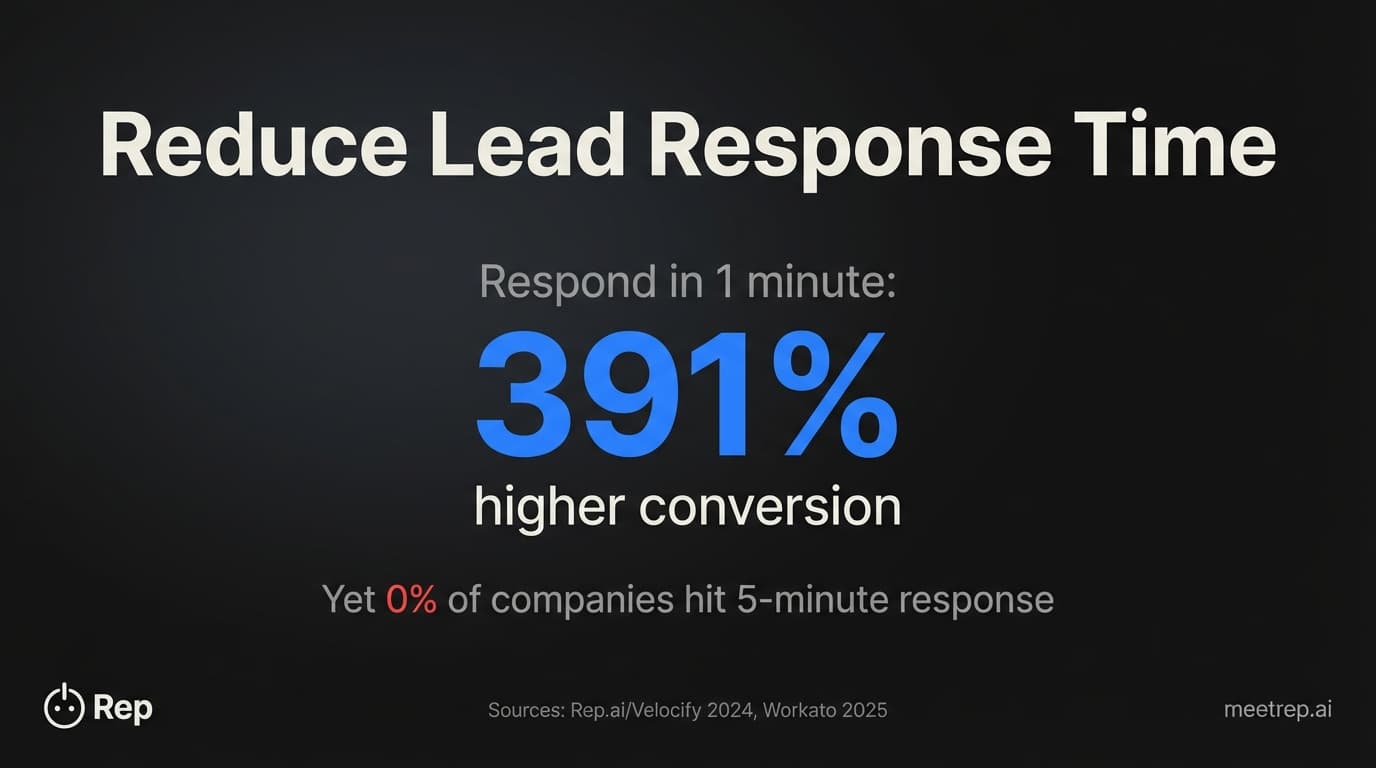
- Average lead response time is 29-42 hours, but responding in 1 minute lifts conversion by 391%
- 63.5% of companies never respond at all—that's free opportunity for everyone else
- Automated routing cuts response from 13 hours to 3.5 hours
- 44% of leads arrive after hours; AI coverage is the only scalable solution
- Top performers like Salesforce have cut response from 20 minutes to 20 seconds
Your leads are dying. Not slowly—fast.
The average B2B company takes 29 hours to respond to an inbound lead. That's not a typo. Twenty-nine hours. And here's what makes it worse: 63.5% never respond at all.
I've watched this problem up close. When we built GoCustomer.ai, we saw deals evaporate because leads sat untouched for a day. Sometimes two. The prospect had already signed with a competitor by the time our clients' reps called back. That pattern—repeated across hundreds of companies—is why we built Rep to handle lead response time differently.
This guide gives you five ways to fix it. Not next quarter. Today.
What Is Lead Response Time (And Why Most Teams Fail at It)?
Lead response time is the duration between when a prospect submits a form or requests a demo and when a sales rep actually reaches out. It's also called "speed to lead." Simple concept. Brutal execution for most teams.
The math tells the story. RevenueHero's 2024 study of 1,000 B2B SaaS companies found the average sits at 29 hours. Teamgate's 2025 analysis puts it at 42 hours. Either way, we're talking about more than a full business day before someone picks up the phone.
But the average isn't even the problem. The problem is the distribution.
The Data:Only 17.2% of B2B companies respond instantly—under 2 minutes. The other 82.8%? They're letting leads go cold. (Source: RevenueHero, March 2024)
So what happens in those 29 hours? Your prospect Googles three more vendors. Books a demo with your competitor. Gets distracted by actual work. Forgets they even filled out your form.
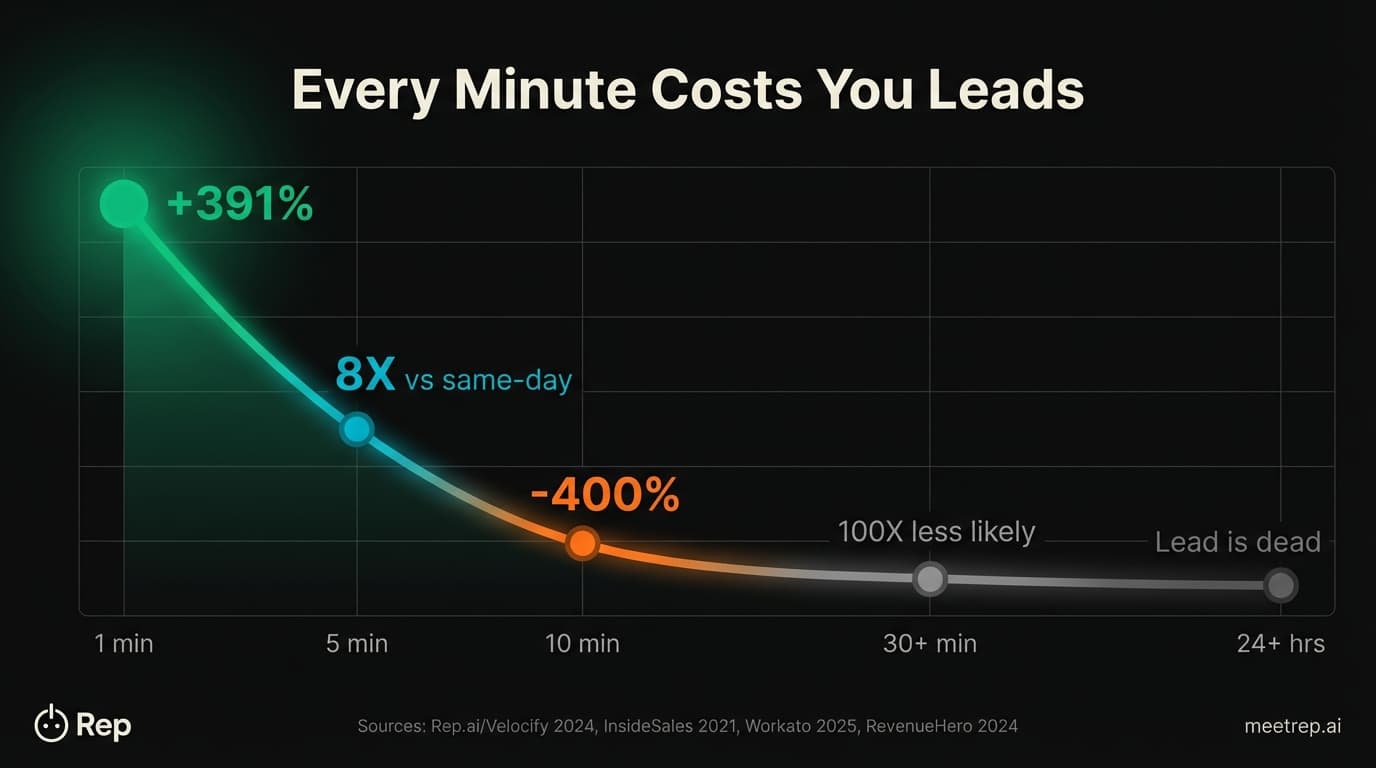
And the impact on conversion is exponential, not linear. Workato's 2025 research found that waiting just 10 minutes—not 10 hours, 10 minutes—decreases qualification odds by 400% compared to responding in 5 minutes.
| Response Time | What Happens to Conversion |
|---|---|
| Under 1 minute | 391% lift vs. baseline (Rep.ai/Velocify 2024) |
| Under 5 minutes | 8X higher conversion vs. same-day response (InsideSales 2021) |
| 10 minutes | 400% drop vs. 5-minute response |
| 30+ minutes | 100X less likely to qualify vs. 5 minutes |
| 24+ hours | Lead is essentially dead |
The teams winning this game aren't working harder. They're working faster. And usually, they've automated the slow parts entirely.
The Real Cost of Slow Response in 2026
Here's the context that makes this urgent: SDR teams are shrinking.
SaaStr and Emergence Capital's 2025 report found that 36% of B2B companies decreased their SDR headcount last year. Only 19% increased it. You're being asked to do more with less—and "respond faster" isn't getting easier when you have fewer people.
Meanwhile, buyer expectations have gone the other direction. 82% now expect a response within 10 minutes, according to LeadAngel's 2025 data. And 78% of customers buy from the company that responds first.
Read that again. First. Not best. Not cheapest. First.
Key Insight: The race isn't to have the best product or the slickest pitch. It's to show up before anyone else does. Speed is the new competitive moat—and my bet is it's only going to intensify.
When we were building GoCustomer, I thought great sequences and personalization would win deals. And they help. But the single biggest predictor of conversion we found? Who called first. Everything else was secondary.
The financial math is brutal too. If your average cost per lead is $84 (Flyweel, 2025)—and it's $110 on LinkedIn—then every lead that goes unanswered is cash in the trash. At a 63.5% non-response rate, a company generating 100 leads per month is wasting over $5,300 monthly on leads nobody even calls.
Way 1: Deploy AI Agents Instead of Auto-Responders
Old auto-responders are useless. A generic "Thanks for your interest, someone will be in touch" email? It goes straight to the trash folder. Email reply rates have dropped to 5.8% in 2025, down from 6.8% just two years ago.
The fix isn't a better auto-responder. It's replacing the responder with something that can actually engage.
AI agents—real ones that can qualify, answer questions, and book meetings—are the difference between "we'll get back to you" and actually getting back to them. Right now. At 2am. On a holiday.
This matters because 44% of leads arrive outside business hours, according to Podium's 2024 research. Almost half your inbound is showing up when your team is offline.
What we learned at GoCustomer: Our best-performing clients weren't the ones with the biggest SDR teams. They were the ones who had something answering the phone at midnight. Before AI agents existed, that meant global teams or expensive outsourcing. Now it means software. My advice? Start with your highest-intent leads and expand from there.
How to implement this week:
- Identify your highest-intent forms (demo requests, pricing pages)
- Connect an AI agent that can access your calendar and qualification criteria
- Set escalation rules for questions the AI can't handle
- Monitor conversation quality weekly and tune the responses
Tools in this space include Rep, Apten, and Drift. Rep takes a different approach—it joins video calls, shares its screen, and walks prospects through your actual product. But the core principle is the same: something smart answering when humans can't.
Way 2: Automate Lead Routing (Kill the Grey Zone)
Manual lead assignment is a silent killer. Every minute a lead sits in a queue waiting for someone to decide who owns it is a minute closer to death.
Look, I've talked to RevOps leaders who spend 10+ minutes per lead just figuring out territory assignments. That's insane. The prospect doesn't care about your territory map—they care about getting an answer.
The data backs this up. Workato's 2025 study found that companies using lead routing tools respond in 3 hours 32 minutes on average. Companies without them? 13 hours. That's a 73% improvement just from automating assignment.
| Routing Approach | Average Response Time | Why It Works |
|---|---|---|
| Manual assignment | 13 hours | Human decision-making adds hours |
| Automated routing | 3.5 hours | Instant assignment = instant notification |
| Automated + instant booking | Under 5 minutes | No scheduling back-and-forth |
SUSE is a good example. After implementing LeanData, they saw a 70% improvement in speed to lead and hit 100% SLA attainment. Hand-raisers—people actively requesting demos—got responses in 1.3 hours.
Key Insight: The best routing isn't just fast. It's invisible. The lead fills out a form, and the right rep gets pinged instantly—no human triage, no territory disputes, no grey zone where ownership is unclear.
How to implement this week:
- Map your current territory and product assignments in your CRM
- Build routing rules in tools like Chili Piper, LeanData, or Default (for Salesforce)
- Set fallback rules for edge cases (small accounts, unknown territories)
- Test with 10% of leads before rolling out fully
And here's a pro tip: add instant booking to your routing. Let the lead pick a time while they're still on your site. Chili Piper reports a 66.7% form-to-meeting conversion rate with their Form Concierge—versus a 30% industry average.
Way 3: Shift From the 5-Minute Rule to the 1-Minute Rule
The 5-minute rule for leads has been gospel for years. Respond within 5 minutes and you're golden. Right?
Not anymore.
The 5-minute rule came from Harvard Business Review research in 2011. That's 15 years ago. Buyer behavior has changed. Competition has intensified. The bar has moved.
Rep.ai's 2024 data shows that responding within 1 minute—not 5—increases conversion by 391%. That's the new benchmark. The platinum minute.
And almost nobody hits it. Workato's 2025 study tested 114 B2B companies. Zero called within 5 minutes. Only one sent a personalized email that fast. Zero.
So the opportunity is wide open. If you can hit 1 minute, you're in elite territory that basically no one occupies.
How to implement this week:
- Identify your "platinum leads"—demo requests, pricing inquiries, high-intent pages
- Set up instant SMS or chat triggers the moment those forms submit
- Give reps mobile CRM access so they can respond from anywhere
- Track your 1-minute SLA separately from your 5-minute SLA
- Use local presence dialing (shows a local number) to boost pickup rates
The mindset shift matters too. Stop thinking "we need to respond today." Start thinking "we need to respond now."
Way 4: Go Multi-Channel (Email Alone Won't Cut It)
Email is dying as a first-touch channel. Reply rates are down to 5.8%. If you're relying on email for lead response, you're missing 94% of prospects.
But here's what surprised me: phone isn't much better if it's your only channel. Workato found that only 31% of companies even attempt to call leads. And those that do? Average phone response time was 14 hours 29 minutes. Email was actually faster at 11 hours 54 minutes.
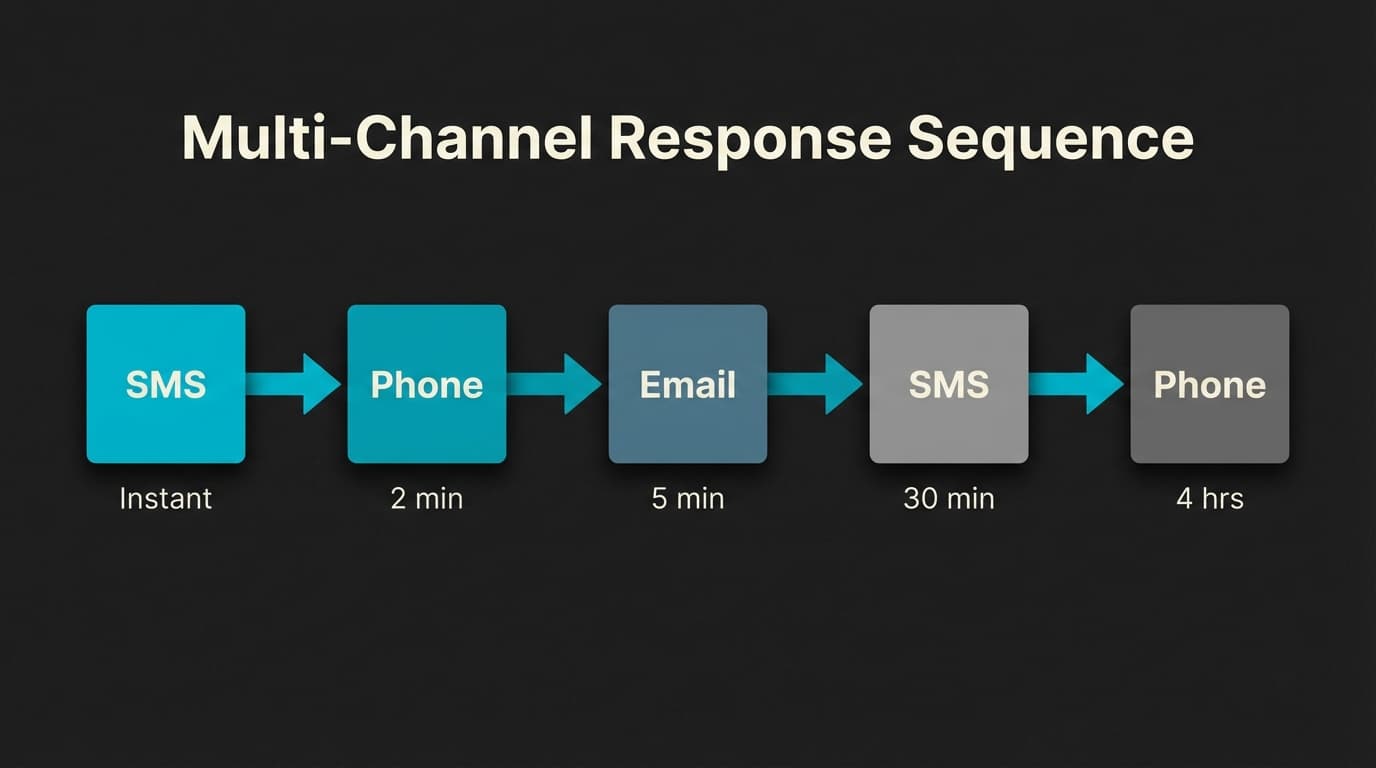
The winning play is layering channels. SMS gets read within 3 minutes. Phone creates urgency. Email provides documentation. Use all three.
The Data: Only 31% of companies call their leads at all. The rest rely entirely on email—which has a 5.8% reply rate. That's a lot of opportunity left on the table. (Source: Workato, August 2025)
A channel sequence that works:
- SMS (instant): "Hey [Name], got your demo request. Free in the next hour?"
- Phone (2 minutes): Quick call attempt with local presence dialing
- Email (5 minutes): Personalized follow-up with calendar link
- Second SMS (30 minutes): If no response, softer touch
- Second call (4 hours): Different time of day
Different personas need different channels too. Executives often prefer phone—it signals importance. Individual contributors tend toward email or chat. Test what works for your ICP and adjust.
How to implement this week:
- Add SMS to your stack (Kixie, Salesloft, and Outreach all support it)
- Build a multi-channel sequence in your CRM
- A/B test channel order for your specific audience
- Track response rates by channel monthly and optimize
Way 5: Enable Instant Data Enrichment (Stop the Research Delay)
Here's a hidden time sink: reps researching leads before calling.
I get it. You want context. You want to know if they're a good fit. You want to personalize the conversation. But that research time adds up. One G2 reviewer put it this way: "I used to spend over 10 minutes figuring out which AE should receive the demo."
Ten minutes of research. On every lead. That's death by a thousand cuts.
The fix is auto-enrichment. The moment a lead submits a form, tools like Clearbit, ZoomInfo, or Cognism can populate company info, tech stack, recent news, and more. Your rep gets context instantly. No manual LinkedIn stalking required.
Gong saw a 70% improvement in form conversion after combining Clearbit enrichment with instant routing. The rep knows who they're calling before they dial.
And Salesforce's own transformation is the extreme example. They consolidated 3 legacy systems into Data Cloud and cut response time from 20 minutes to 20 seconds—a 98% reduction. Most of that improvement came from eliminating manual data gathering.
How to implement this week:
- Integrate an enrichment tool with your form submissions
- Auto-populate CRM fields on lead creation
- Surface key data points in mobile CRM for on-the-go response
- Feed enriched data into your AI agent's knowledge base
The goal is zero research time for your first touch. Learn more as the conversation progresses, but don't let data gathering slow down that initial response.
How Top Companies Cut Response Time by 70%+
Theory is nice. Results are better. Here's what actual companies have done:
Salesforce was responding in 20 minutes with three disconnected legacy systems. After consolidating into Data Cloud, they hit 20-second response times. That's a 98% reduction. The lesson: system consolidation eliminates handoff delays.
SUSE had manual routing causing ownership confusion and missed SLAs. After implementing LeanData with priority-based SLAs, they saw 70% improvement and 100% SLA attainment. Hand-raisers got responses in 1.3 hours. The lesson: not all leads need the same speed—prioritize.
Cold Jet was at 3 hours for first touch. After implementing HubSpot Sales Hub, they got under 1 hour—a 66% reduction. The lesson: even mid-market companies see massive gains from consolidation.
| Company | Before | After | Improvement | Key Change |
|---|---|---|---|---|
| Salesforce | 20 min | 20 sec | 98% | System consolidation |
| SUSE | Hours (manual) | 1.3 hrs (hand-raisers) | 70% | Automated routing + SLAs |
| Cold Jet | 3 hours | Under 1 hour | 66% | CRM consolidation |
The common thread? Technology replaced manual processes. Every company that improved dramatically did it through automation, not headcount.
The teams winning right now aren't the ones with the most reps. They're the ones who respond first.
That's it. That's the whole game.
We built Rep because I watched too many deals die in CRM queues. An AI agent that can join calls, share its screen, and walk prospects through your product—at 2am on a Sunday if that's when they're ready—felt like the obvious solution. But whether you use Rep or something else, the principle is the same: automate the slow parts, show up before your competitors, and stop letting leads decay.
Pick one method from this guide. Implement it this week. Measure your response time before and after. I'd bet you'll see results within 30 days.
Your leads are waiting. Go get them.

Nadeem Azam
Founder
Software engineer & architect with 10+ years experience. Previously founded GoCustomer.ai.
Nadeem Azam is the Founder of Rep (meetrep.ai), building AI agents that give live product demos 24/7 for B2B sales teams. He writes about AI, sales automation, and the future of product demos.
Frequently Asked Questions
Table of Contents
- What Is Lead Response Time (And Why Most Teams Fail at It)?
- The Real Cost of Slow Response in 2026
- Way 1: Deploy AI Agents Instead of Auto-Responders
- Way 2: Automate Lead Routing (Kill the Grey Zone)
- Way 3: Shift From the 5-Minute Rule to the 1-Minute Rule
- Way 4: Go Multi-Channel (Email Alone Won't Cut It)
- Way 5: Enable Instant Data Enrichment (Stop the Research Delay)
- How Top Companies Cut Response Time by 70%+
Ready to automate your demos?
Join the Rep Council and be among the first to experience AI-powered demos.
Get Early AccessRelated Articles
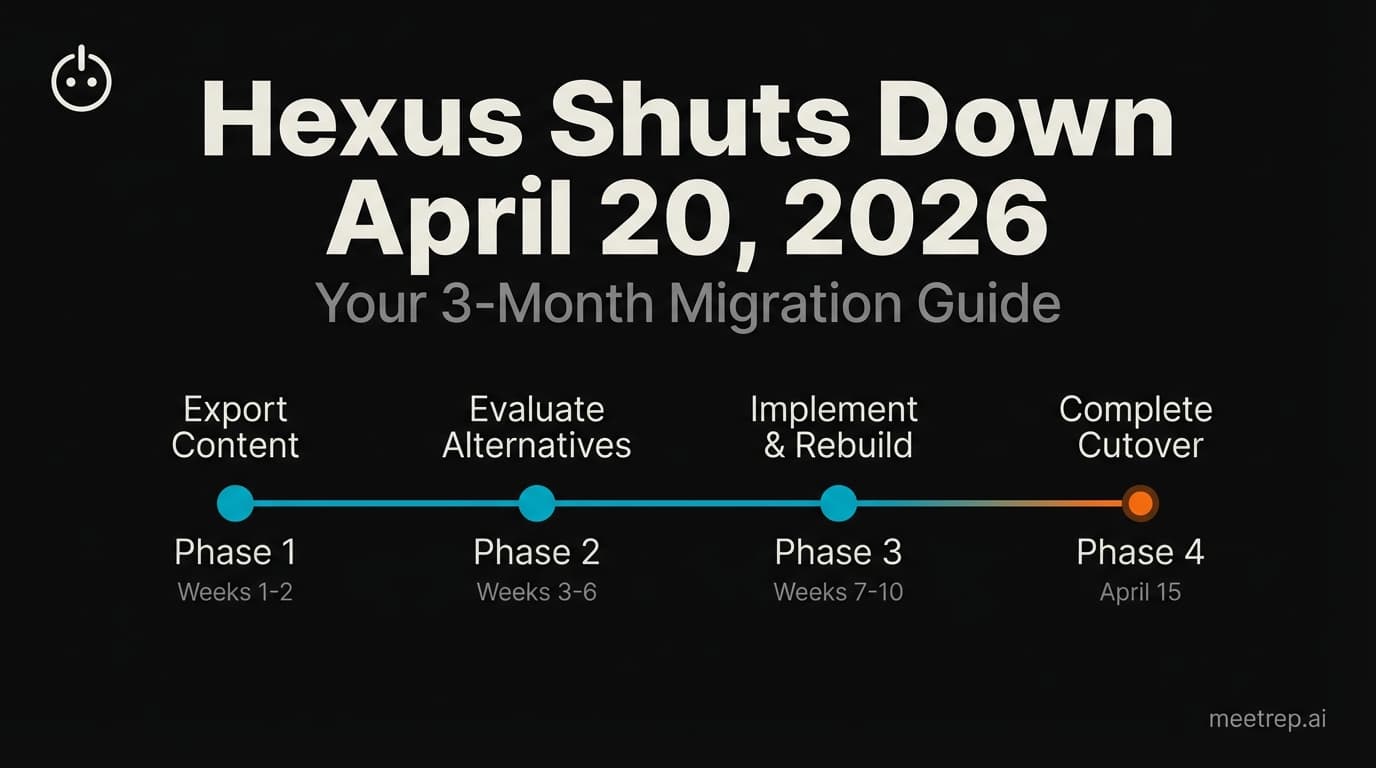
Hexus Acquired by Harvey AI: Congrats & What It Means for Demo Automation Teams
Hexus is shutting down following its acquisition by Harvey AI. Learn how to manage your migration and discover the best demo automation alternatives before April 2026.
Why the "Software Demo" is Broken—and Why AI Agents Are the Future
The traditional software demo is dead. Discover why 94% of B2B buyers rank vendors before calling sales and how AI agents are replacing manual demos to scale revenue.
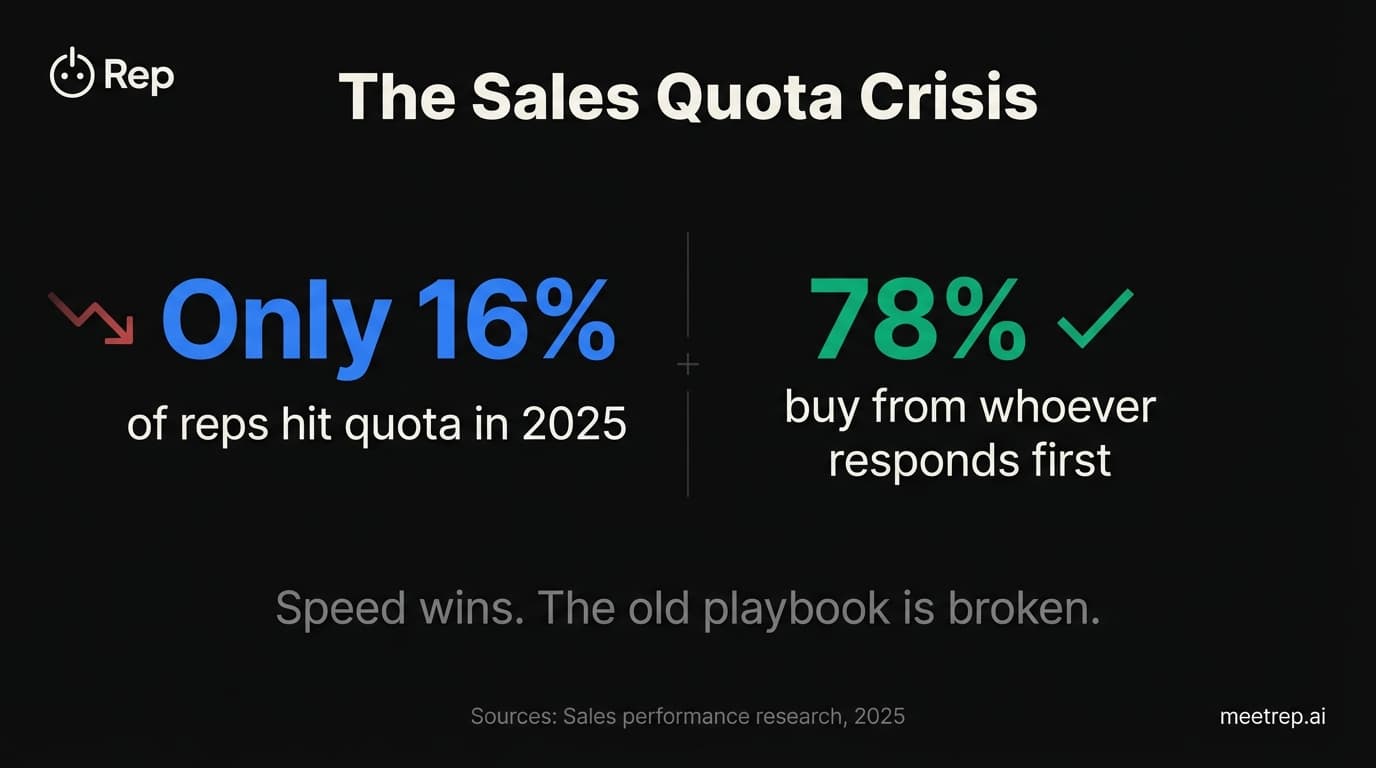
Why Autonomous Sales Software is the Future of B2B Sales (And Why the Old Playbook is Dead)
B2B sales is at a breaking point with quota attainment at 46%. Discover why autonomous 'Agentic AI' is the new standard for driving revenue and meeting the demand for rep-free buying.